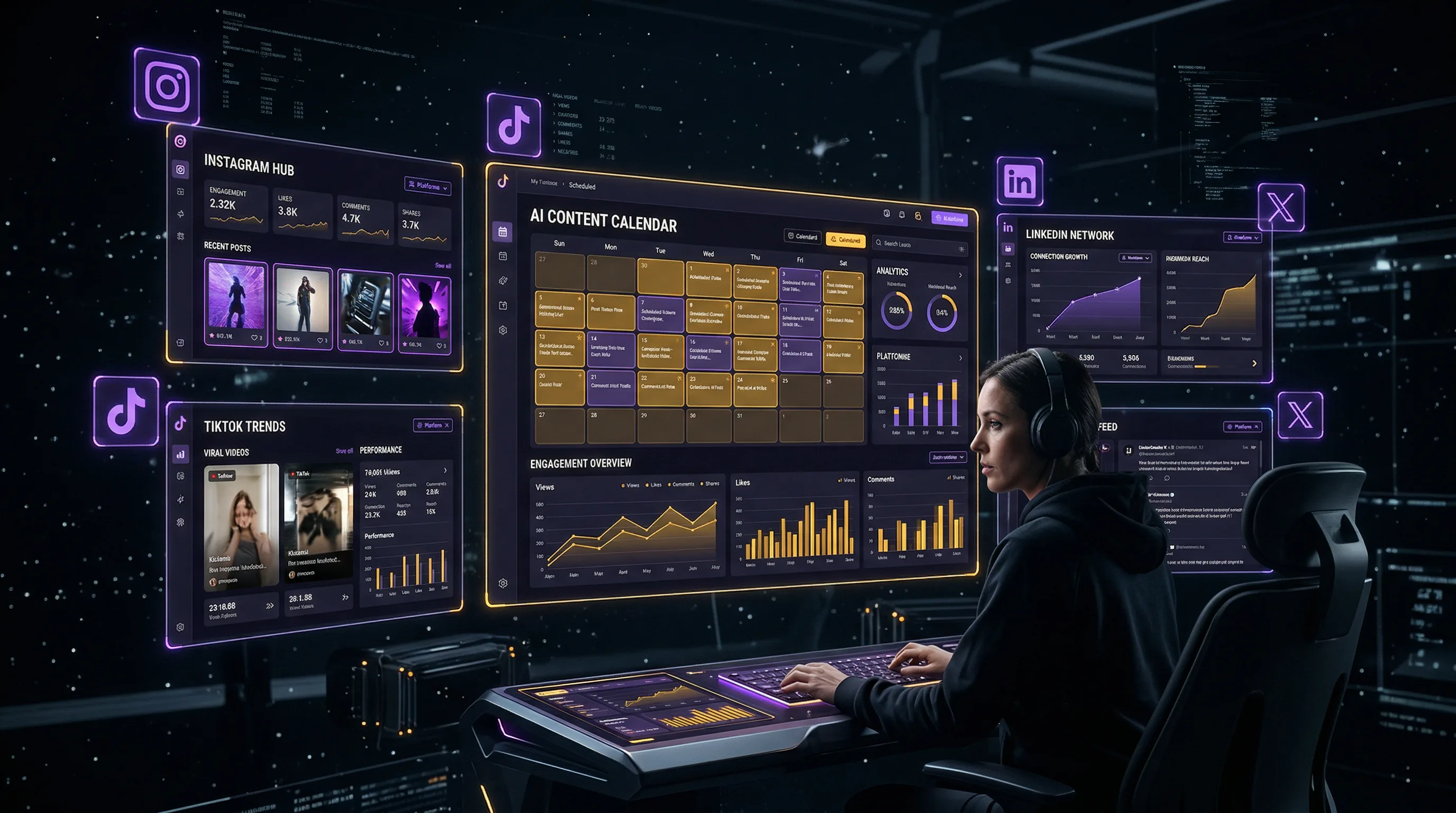
AI Social Media Content Strategy: Platform-by-Platform Playbook for 2026
An AI social media strategy that works on Instagram will fall flat on LinkedIn. What performs on TikTok will get ignored on Pinterest. Each social platform has its own culture, algorithm, content format preferences, and audience behavior.

The Artifio editorial team publishes research, tutorials, and release notes covering image, video, and audio generation models. All posts are reviewed by an editor before publishing.
An AI social media strategy that works on Instagram will fall flat on LinkedIn. What performs on TikTok will get ignored on Pinterest. Each social platform has its own culture, algorithm, content format preferences, and audience behavior. Generic AI-generated content posted everywhere performs poorly everywhere — and that's the biggest mistake brands and creators make with AI social media content.
This platform-by-platform playbook gives you specific AI content strategies for Instagram, LinkedIn, TikTok, X (formerly Twitter), and Pinterest. Each section covers what content works, how AI helps produce it, and the production workflow that keeps your publishing consistent.
Instagram AI Content Strategy
Reels, Stories, and Feed Posts
Instagram's algorithm in 2026 overwhelmingly favors Reels for discovery and new audience reach. Feed posts maintain existing audience engagement. Stories nurture your most engaged followers. Your AI content strategy needs to cover all three formats with different approaches.
For Reels, AI helps with concept generation, script writing, visual elements, and editing suggestions. The key is speed — trending audio and formats have a short window. AI lets you produce trend-responsive Reels in hours instead of days. Generate 10 Reel concepts per week, produce the 3-5 strongest, and let performance data guide future content.
For feed posts, AI generates carousel content (which consistently outperforms single-image posts for engagement), caption drafts optimized for your brand voice, and alternative text for accessibility. For Stories, AI produces quick poll questions, engagement prompts, and behind-the-scenes style narrative content.
Visual-First AI Content
Instagram is a visual platform first and a text platform second. AI image generation creates consistent visual branding across all your posts — maintaining color palettes, aesthetic styles, and brand recognition from post to post.
Develop a visual template system: three to five recurring visual formats that AI generates consistently. Examples include quote graphics with brand-consistent backgrounds, product-in-context lifestyle imagery, data visualization carousels, and before/after comparison graphics. Consistency trains the algorithm and your audience to recognize your content instantly. For detailed visual content tips, see our AI social media graphics guide.
Hashtag and Caption Optimization
AI generates caption drafts and hashtag sets optimized for reach and engagement. The caption formula that works on Instagram: hook line (stops the scroll), value delivery (the substance), engagement prompt (drives comments), and call to action. According to Sprout Social research, posts with specific engagement prompts ("Tag someone who needs this" or "Save this for later") consistently outperform posts without them.
For hashtags, use AI to generate niche-specific sets of 15-25 hashtags mixing high-volume discovery tags with lower-volume niche tags. Rotate hashtag sets across posts to avoid appearing spammy to the algorithm.
LinkedIn AI Content Strategy
Thought Leadership Posts
LinkedIn rewards expertise, opinions, and professional storytelling. AI drafts thought leadership posts, but the critical ingredient is your original insight. Here's the workflow: you provide the key insight or opinion, AI builds the post structure around it, and you edit to guarantee your authentic voice and perspective come through.
The LinkedIn post format that consistently performs: personal anecdote or observation (hook), insight or lesson derived from it (value), broader application for the reader (relevance), and invitation for discussion (engagement). AI structures this effectively; your experience provides the substance that makes it worth reading.
Carousel and Document Content
LinkedIn carousels (document posts) drive the highest engagement of any content format on the platform. AI generates carousel frameworks: multi-slide educational content, step-by-step guides, and framework explanations. Each slide should convey one key point with minimal text and maximum visual clarity.
For carousel creation, AI generates the content framework and slide-by-slide text. Pair this with AI-generated visuals or clean text layouts for a complete carousel that educates and engages. AI text and image models together can produce a polished 10-slide carousel in under 30 minutes.
Professional Storytelling
The formula for LinkedIn virality is surprisingly simple: personal story plus professional lesson equals engagement. AI helps you structure personal experiences into professional narratives, but the story itself must come from you. Authentic experiences, real failures, genuine lessons — these are what LinkedIn audiences connect with. AI is the formatting tool, not the storytelling tool.
TikTok AI Content Strategy
Short-Form Video with AI
TikTok demands volume, speed, and constant experimentation. The algorithm tests every video with a small audience, and only videos that earn strong engagement get pushed to larger audiences. This means you need to publish frequently and test different approaches — exactly what AI enables.
AI helps produce TikTok content at speed: script generation for talking-head or voiceover videos, AI-generated B-roll and visual elements, voiceover for faceless content, and caption optimization for search discovery (TikTok is increasingly a search engine for Gen Z).
Trend Surfing with AI Speed
TikTok trends emerge and fade within days. AI's speed advantage is critical here. When a trending sound, format, or topic emerges in your niche, AI lets you produce responsive content within hours — while the trend is still rising. Manual production often means your trend content publishes after the wave has passed.
Set up a trend monitoring system: check trending sounds and hashtags in your niche daily. When something fits your brand, immediately generate a script and visual concept with AI. Speed beats polish on TikTok every time.
Hook-First Content Structure
The first three seconds determine whether a viewer watches or swipes. AI generates hook variations — multiple opening lines for the same content — letting you test which hooks capture attention. Strong TikTok hooks include: surprising statistics, counterintuitive statements, questions that create curiosity, and "watch until the end" promises (used sparingly).
Generate five hook variations for every video. Use the strongest one and save the others for repurposing the same content with different openings. For more on AI-powered video content, see our faceless YouTube channel guide — many principles translate to short-form.
X (Twitter) AI Content Strategy
Thread Writing with AI
X threads turn longer content into a native format. AI generates thread frameworks from blog posts, reports, or topic outlines — breaking complex ideas into tweet-sized chunks that flow logically. The key to thread performance: a killer first tweet (the hook), consistent value in each subsequent tweet, and a clear call to action in the final tweet.
A good thread prompt: provide your topic or source material, specify the thread length (7-12 tweets is the Goldilocks zone), and instruct the AI to write each tweet as a standalone point that also flows into the next. Include a note to keep language punchy and direct — X penalizes verbose writing.
Engagement-Optimized Posts
Short, opinionated posts with strong stances drive the most engagement on X. AI drafts these, but you add the controversial or thought-provoking angle. The formula: state an opinion + explain why briefly + invite disagreement or agreement. Posts that take a clear position outperform neutral, informational posts by a significant margin on this platform.
Pinterest AI Content Strategy
Search-Optimized Pin Creation
Pinterest is fundamentally a search engine with a visual interface. Treat it accordingly. Every pin description should be written for discovery — include keywords that your target audience actually searches for. AI generates keyword-rich pin descriptions that read naturally while being optimized for Pinterest's search algorithm.
Unlike other platforms where content has a 24-48 hour lifespan, Pinterest content can drive traffic for months or years. This makes it one of the highest-ROI platforms for AI content investment — your effort compounds over time rather than evaporating.
AI Graphics for Pinterest
Pinterest favors tall, detailed, text-overlay graphics — a format AI image generation handles well. Create pin templates for your recurring content types: how-to graphics, checklist pins, infographic-style pins, and product showcase pins. AI generates variations within these templates to maintain visual consistency while keeping content fresh.
Artifio's multi-model platform covers every format social media demands — images, video, text, and audio for every platform from one dashboard. Whether you're creating Instagram Reels, LinkedIn carousels, TikTok scripts, or Pinterest graphics, you don't need separate tools for each. For more on creating UGC-style content for social, see our AI UGC content creation guide.
Building Your Cross-Platform AI Workflow
The most efficient approach isn't creating separate content for each platform from scratch. Start with a core content piece — a blog post, video, or in-depth idea — and use AI to adapt it for each platform's format and culture.
One core idea becomes: a LinkedIn thought leadership post, an Instagram carousel, a TikTok script, an X thread, and a set of Pinterest pins. AI handles the format adaptation; you see to it the core message stays consistent. This is content multiplication, not content repetition. For the complete content repurposing strategy, check out our AI content repurposing guide.
Frequently Asked Questions
What social media content can AI create?
Text posts, image graphics, video clips, captions, hashtag suggestions, content calendars, and engagement response templates. AI handles the production; you provide the strategy and personality.
Which social platform is easiest to produce AI content for?
LinkedIn and X (Twitter) are easiest — primarily text-based with optional visuals. Instagram and TikTok require more visual and video production. Pinterest requires image-focused content optimized for search.
Can AI manage my social media?
AI can produce content, suggest posting schedules, and draft responses. But genuine engagement — responding to comments, building community, making creative decisions — requires human judgment and presence.
How many social media posts should I create with AI per week?
Aim for 3-5 Instagram posts, 5-7 LinkedIn posts, 1-2 TikToks, 5-10 tweets, and 5-10 pins per week. These are starting points — track engagement and adjust frequency based on what your audience responds to.
Does AI social media content get less engagement?
Quality AI content performs comparably to human-written content. Generic, obviously-AI content underperforms. The difference is in the effort: AI with human refinement works; AI without editing doesn't.
Dominate Every Platform with AI
Dominate every social platform with Artifio. Text, images, video, and audio AI models for every platform in one subscription. Stop spreading yourself thin across five platforms — let AI handle the production while you focus on strategy and community.