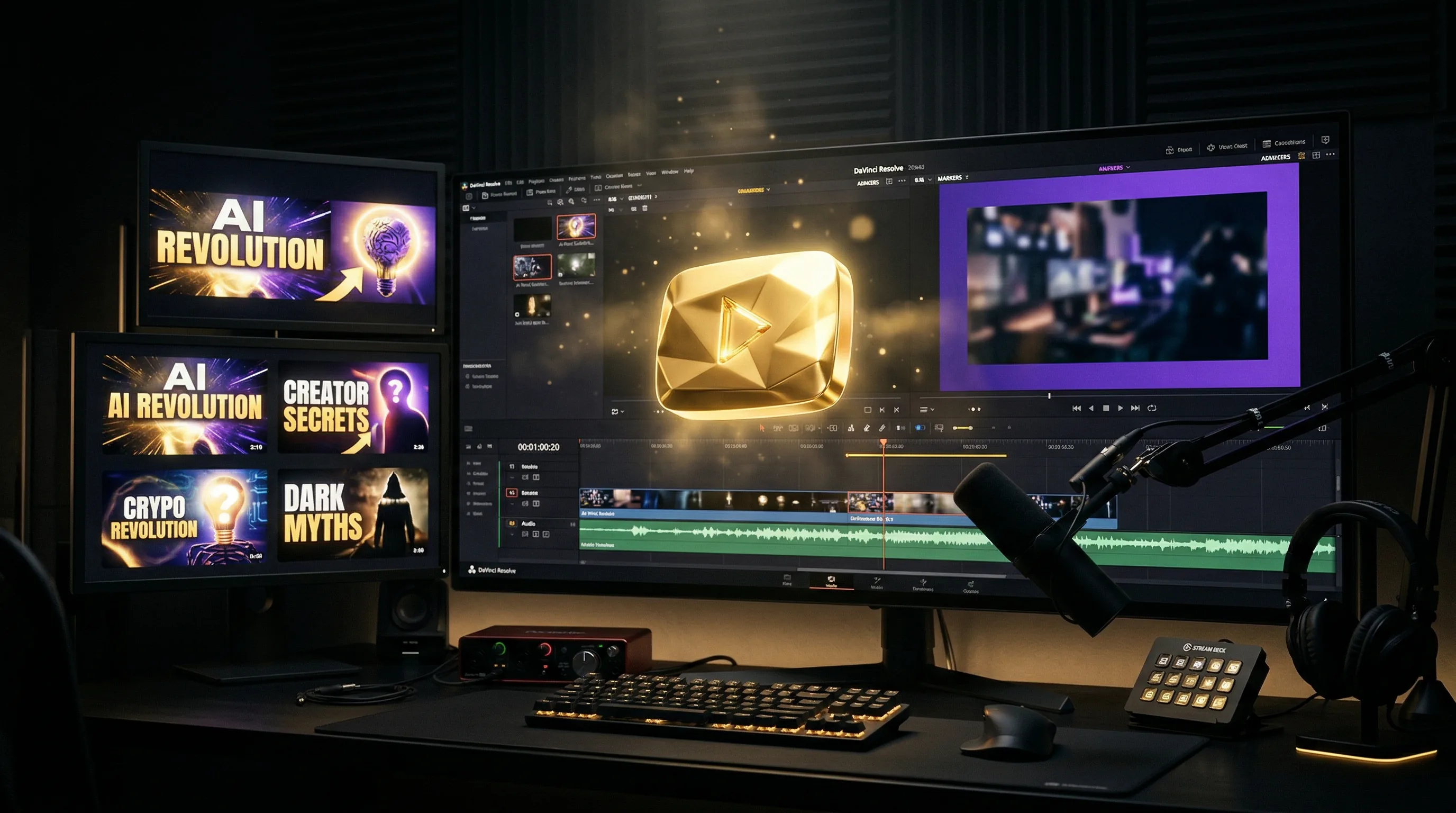
How to Build a Faceless YouTube Channel with AI: The Complete Step-by-Step Guide
A faceless YouTube channel uses AI-generated narration, visuals, and music to produce videos without ever showing a human face on camera.

The Artifio editorial team publishes research, tutorials, and release notes covering image, video, and audio generation models. All posts are reviewed by an editor before publishing.
A faceless YouTube channel uses AI-generated narration, visuals, and music to produce videos without ever showing a human face on camera. These channels earn real money — some pulling in six figures annually — by combining smart niche selection with AI-powered production workflows that let a single person publish at a pace that used to require an entire team.
This guide walks you through every step: choosing a profitable niche, building your AI production pipeline, optimizing for growth, and monetizing your channel. If you've been thinking about starting a YouTube channel but don't want to be on camera, this is your roadmap.
Choosing Your Faceless Channel Niche
Profitable Niches for Faceless AI Content
Your niche determines everything: audience size, ad rates, competition, and how well AI can serve the content format. The best niches for AI-powered faceless channels share three traits: high search demand, content that works without a face on screen, and topics where AI narration feels natural rather than forced.
Here are niches that consistently perform well:
- Personal finance and investing — High CPM (ad rates), evergreen content, and strong search demand. AI narration works perfectly for educational finance content.
- Technology explainers — "How does blockchain work?" or "What is quantum computing?" topics that viewers watch for information, not personality.
- History and science — Documentary-style content where authoritative narration over visuals is the expected format.
- Motivational and self-improvement — Scripted inspirational content with professional-sounding AI voiceover.
- Relaxation and ambient — Nature visuals with calming music. Minimal narration needed, and AI audio handles the music.
- True crime and mystery — Narrative storytelling over visual elements. A format perfectly suited to AI production.
Audience Research and Validation
Before committing to a niche, validate demand. Search YouTube for your topic keywords and look at view counts on recent videos. If similar channels are getting 50,000+ views per video, there's an audience. If the top videos have fewer than 5,000 views, the niche might be too small.
Also check for advertiser interest. Niches like finance, technology, and health attract high-paying advertisers, meaning higher CPMs (cost per thousand views). A finance channel earning a high CPM makes far more per view than an entertainment channel with a low CPM. The difference can be five to ten times the revenue per thousand views.
Competition Analysis
Look for niches with high demand but room for quality improvement. If existing channels have poor audio, basic visuals, or shallow content, that's your opportunity. AI lets you produce higher-quality content at a pace competitors can't match — especially if they're still doing everything manually.
The good middle ground: a niche with proven demand (existing channels have viewers) but where the quality bar can be raised. For broader context on how AI fits into different content strategies, see our complete guide to AI content use cases.
The AI Video Production Pipeline
Script Writing with AI
Your script is the foundation of every video. Start with a topic outline — the key points you want to cover and the structure you want to follow. Feed this outline into an AI text model with instructions for tone, reading level, and video length.
A solid script prompt includes: the topic, target video length (a 10-minute video needs roughly 1,500 words), the tone (educational, conversational, dramatic), and a note to write for spoken delivery rather than reading. Scripts written for reading sound awkward when narrated — always specify that the output should flow naturally when spoken aloud.
Write hooks that grab attention in the first five seconds. YouTube analytics consistently show that 20-30% of viewers leave within the first 30 seconds. Your opening line needs to create curiosity or promise value immediately.
AI Voiceover Generation
Voice selection makes or breaks a faceless channel. Choose a voice that matches your niche: authoritative and measured for educational content, warm and encouraging for motivational, calm and soothing for relaxation. Test three to five different AI voices with the same script before committing.
Once you find your voice, stick with it. Consistency builds familiarity. Viewers come to associate your channel with that voice, the same way they'd associate a traditional channel with the host's face. Switching voices between videos disrupts that connection.
For tips on getting the most out of AI audio, see our AI audio content creation guide.
Visual Asset Creation
Faceless videos need visual engagement to compensate for the lack of a talking head. AI image generation creates illustrations, diagrams, concept visualizations, and atmospheric backgrounds that keep viewers watching.
The visual strategy depends on your niche. Educational channels benefit from explanatory diagrams and visual metaphors. History channels need period-appropriate imagery. Motivational channels use striking, atmospheric visuals. Whatever your niche, plan visual variety — the same background image for 10 minutes will tank your retention. Check out our guide to fixing AI video glitches if you encounter quality issues during production.
Music and Sound Effects
Background music sets the emotional tone. AI audio models generate royalty-free music tailored to your content's mood — no licensing fees, no copyright strikes. Generate custom intro and outro music that becomes part of your channel's brand identity.
Keep background music subtle. It should enhance the narration, not compete with it. A common beginner mistake is using music that's too loud or too dynamic, distracting from the content itself.
Assembly and Editing
AI generates the components. Assembly still happens in editing software. Free options work fine for getting started — the tool matters less than the workflow. Lay down the voiceover track, sync visuals to match the narration, add background music, and include text overlays for key points.
Artifio is built for this workflow — text, voice, image, and video models in one platform. Build your entire production pipeline without juggling five different subscriptions.
Building Your Content Library and Brand Identity
Successful faceless YouTube channels develop a recognizable brand identity despite never showing a face. This identity comes from consistent visual styling, a distinctive AI voice, recurring content structures, and a reliable publishing schedule that viewers can count on.
Your visual style should be instantly recognizable. Develop a color palette, typography style, and visual treatment that appears consistently across all your videos and thumbnails. When viewers see your thumbnail in their feed, they should know it's your channel before reading the title.
Build a content library of reusable assets: intro and outro sequences, transition animations, background music beds, and commonly used visual elements. AI generates these once, and you reuse them across videos for efficiency and consistency. Over time, this library becomes a significant time-saver — new video production focuses on unique content while standard elements are already prepared.
Track your analytics obsessively, especially in the first three months. YouTube Studio provides data on click-through rate (how often people click your thumbnail), average view duration (how long they watch), and audience retention graphs (where people stop watching). These metrics tell you exactly what's working and what needs improvement. AI helps you iterate quickly on underperforming elements — rewrite scripts, regenerate thumbnails, or adjust your voiceover style based on what the data tells you.
Common Mistakes That Kill Faceless AI Channels
Knowing what to avoid is as valuable as knowing what to do. The most common mistakes that prevent faceless AI channels from gaining traction:
- Quantity over quality: Publishing ten low-effort videos per week looks like spam to the algorithm and viewers. Three high-quality videos outperform ten mediocre ones every time.
- Inconsistent voice: Switching AI voices between videos disrupts the viewer's connection. Pick one voice and stick with it.
- No content strategy: Random topics with no connecting theme make it impossible for the algorithm to understand your channel and recommend it to the right audience. Stay in your niche.
- Ignoring community: Even faceless channels need community engagement. Respond to comments, create community posts, and build relationships with viewers. The face is absent, but the personality shouldn't be.
- Giving up too early: Most channels see minimal growth in the first 50 videos. The algorithm needs data to understand your channel. Consistency through the early plateau is what separates successful channels from abandoned ones.
Thumbnail and Title Optimization
Your thumbnail and title are the most important elements for getting clicks. YouTube's own data shows that 90% of top-performing videos have custom thumbnails. For faceless channels, AI image generation creates thumbnail concepts and variations for testing.
Effective faceless channel thumbnails typically feature: bold, readable text (4-6 words maximum), a single striking visual element, high contrast colors, and a clear emotional hook. Generate five to ten variations for each video and use YouTube's built-in A/B testing to find winners.
Titles should promise specific value. "How the Stock Market Actually Works" outperforms "Stock Market Explained" because it implies insider knowledge the viewer doesn't have. Use AI to generate 20+ title variations, then pick the one with the strongest curiosity hook.
Growth and Monetization Strategy
Consistency and Publishing Schedule
According to YouTube Partner Program requirements, you need 1,000 subscribers and 4,000 watch hours for monetization. The fastest way to reach these thresholds is consistent publishing. Aim for three to five videos per week during your growth phase.
AI makes this pace sustainable. A traditional creator might spend 8-10 hours per video. With an optimized AI workflow, you can produce a quality faceless video in 2-3 hours. That's the difference between burnout and sustainable output.
SEO and Discovery Optimization
YouTube is the world's second-largest search engine. Improve every video for search: include your target keyword in the title, the first line of the description, and your tags. AI generates keyword-rich descriptions and tag lists from your video topic.
Also sharpen for suggested video placement. Longer watch time, higher click-through rates, and strong audience retention all improve your chances of appearing in the "suggested videos" sidebar — which drives more views than search for most channels.
Monetization Paths
AdSense is just the beginning. Diversify your revenue with:
- Affiliate marketing — Link to products and services mentioned in your videos. Finance, tech, and product review niches have particularly strong affiliate opportunities.
- Sponsorships — Once you reach 10,000+ subscribers, brands in your niche will pay for sponsored segments. AI even helps you write the sponsor reads.
- Digital products — Course, ebook, or template sales to your audience. Your channel is the marketing engine for products you create.
- Channel memberships — Offer premium content or early access to members for a monthly fee.
Frequently Asked Questions
Can you make a YouTube channel with AI?
Yes. AI can handle scripts, voiceover, visuals, music, and thumbnail concepts. You'll need editing software to assemble the final video and a content strategy for growth. Many profitable YouTube channels are built primarily with AI.
How much does it cost to start a faceless YouTube channel with AI?
An affordable AI platform subscription plus editing software (free or low-cost options exist). The main investment is time — consistent production and publishing is more important than production quality in the early stages.
How long until a faceless AI YouTube channel makes money?
YouTube monetization requires 1,000 subscribers and 4,000 watch hours. With consistent 3-5 videos per week publishing, most channels reach this in 3-6 months. Revenue growth accelerates significantly after year one.
What's the best niche for faceless YouTube?
Educational content (finance, science, history), tech explainers, motivational content, and relaxation or ambient channels perform well. Choose a niche you can consistently produce content for and that has demonstrated audience demand.
Do faceless AI YouTube channels get demonetized?
YouTube evaluates content quality, not production method. Channels that provide genuine value and follow community guidelines are fine. Low-effort, mass-produced content without value may face issues, just like any other low-quality content.
What AI voice should I use for YouTube?
Choose a voice that matches your niche: authoritative for educational, warm for motivational, calm for meditation. Test 3-5 AI voices and let audience feedback guide your choice. Consistency matters — stick with one voice.
Build Your Faceless YouTube Channel Today
Build your faceless YouTube empire with one platform. Artifio handles scripts, voice, images, and video — everything you need to produce and publish. Stop planning and start publishing. Your first video doesn't need to be perfect. It needs to exist.