AI Avatar Creation: How to Build Consistent Digital Characters for Your Content
AI avatar creation lets you build digital characters for videos, social media, presentations, and marketing content — without hiring actors, setting up studios, or managing talent schedules.

The Artifio editorial team publishes research, tutorials, and release notes covering image, video, and audio generation models. All posts are reviewed by an editor before publishing.
AI avatar creation lets you build digital characters for videos, social media, presentations, and marketing content — without hiring actors, setting up studios, or managing talent schedules. But creating an avatar that looks consistent across dozens of appearances, speaks with a natural voice, and maintains believable expressions is harder than most platforms make it seem. This guide covers the complete workflow from initial design to deployment across your content.
Whether you're building a faceless YouTube channel, creating a brand spokesperson, or producing educational videos, the principles of effective AI avatar creation are the same: detailed character design, rigorous consistency techniques, and the right combination of AI models for different production needs.
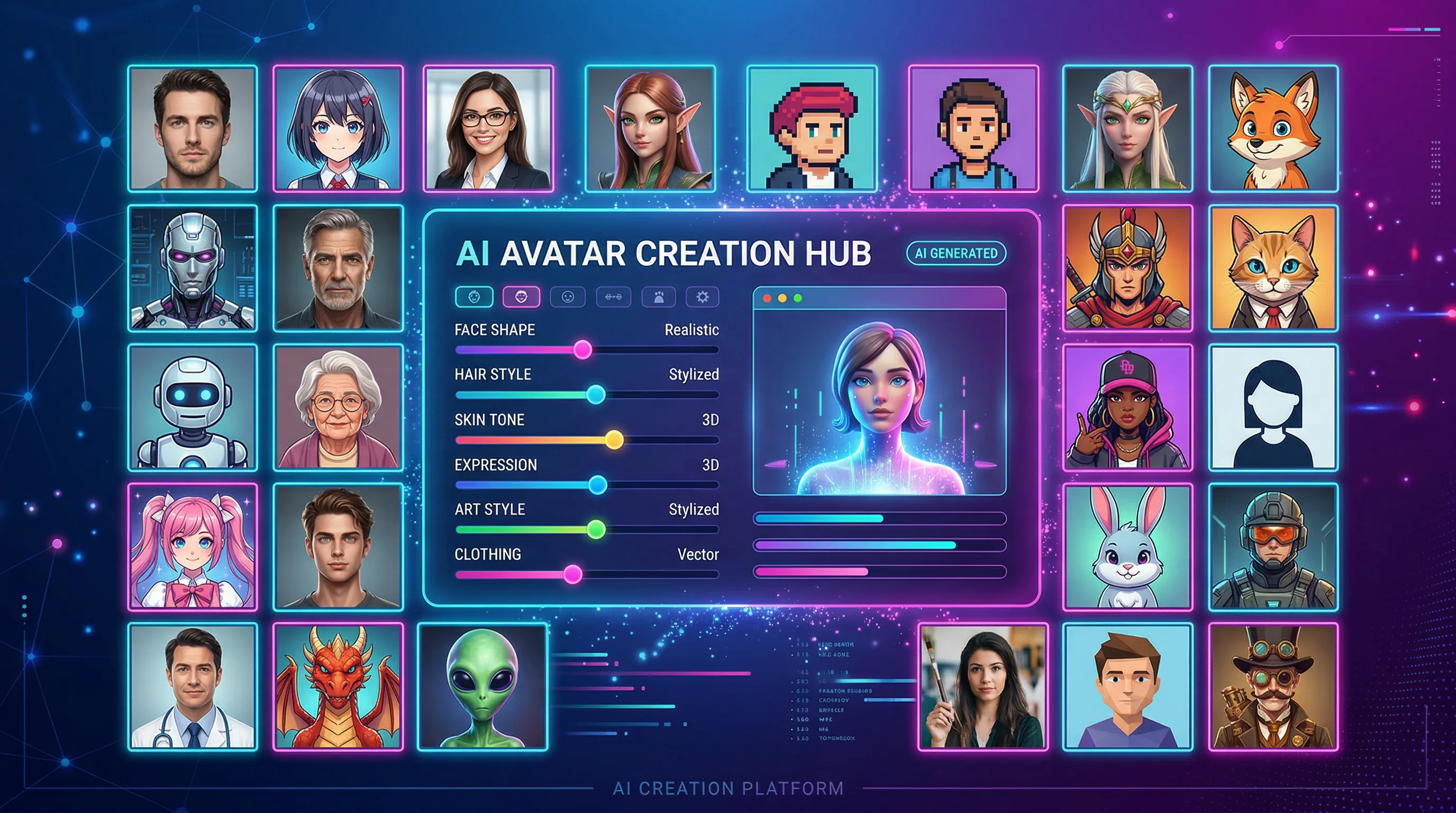
Types of AI Avatars and When to Use Each
Different content needs call for different avatar approaches. Choosing the right type upfront saves significant rework later.
Photorealistic Talking Head Avatars
These look like real people speaking to camera. They're ideal for educational content, news-style presentations, corporate training, and any context where a human-like presence builds trust and engagement.
Strengths: professional appearance, viewer familiarity with the format, strong for explaining concepts. Weaknesses: uncanny valley risk if quality isn't high, limited body language, and viewers may feel deceived if AI nature isn't disclosed. Research from institutions like the ACM digital library has explored how audiences perceive and respond to digital humans, finding that perceived authenticity significantly impacts engagement.
Stylized/Animated Avatars
Cartoon, illustrated, or stylized avatars sidestep the uncanny valley entirely. They're perfect for brand characters, social media personalities, gaming content, and any context where personality matters more than realism.
Strengths: distinctive brand identity, no uncanny valley issues, consistent across platforms, easier to maintain consistency. Weaknesses: less authoritative for corporate or educational contexts, requires stronger personality through voice and scripting.
Full-Body AI Characters
When you need a character that walks, gestures, interacts with objects, and exists in full scenes — not just a talking head. These are used for narrative content, product demonstrations, virtual events, and immersive presentations.
Strengths: most versatile for storytelling. Weaknesses: highest technical bar, most prone to inconsistency, requires the most post-production attention.
Designing Your AI Avatar for Consistency
Consistency starts with thorough character documentation before you generate a single image.
Creating a Detailed Character Sheet
Document every visual attribute of your avatar. Leave nothing to chance:
- Face: Shape (oval, square, round), skin tone (specific shade), age appearance, defining features
- Hair: Color (not "brown" but "warm chestnut brown"), style, length, texture
- Eyes: Color, shape, eyebrow thickness and arch
- Body: Build, height relative to frame, posture tendency
- Clothing: Default outfit with specific colors, style, and accessories
- Expression defaults: Resting expression, smile type, how emotion manifests
This character sheet becomes a prompt component that you include in every generation. Any detail you don't specify is a detail that will vary between generations.
Style and Aesthetic Decisions
Choose a visual style that you can reproduce consistently:
- Photorealistic: Highest viewer engagement but hardest to maintain consistency
- Soft illustration: Good balance of personality and reproducibility
- Flat/vector: Most consistent but least emotionally engaging
- 3D rendered: Professional appearance with good consistency if parameters are fixed
The style should match your content's purpose and your audience's expectations. A financial advice channel probably wants photorealistic. A kids' education channel works better with stylized animation.
Voice Pairing for Video Avatars
A great visual avatar paired with the wrong voice creates immediate dissonance. Match voice characteristics to avatar appearance:
- Age of voice should match apparent age of avatar
- Energy level should match the character's visual personality
- Accent and speech patterns should align with the target audience
- Pacing should match the avatar's lip-sync capabilities
Test multiple AI voice options with your avatar before committing. The right voice-avatar pairing feels natural; the wrong one feels uncanny.
Character Consistency Techniques
Consistency is the defining challenge of AI avatar creation. These techniques address it systematically.
Using Reference Images Across Sessions
Generate a "canonical" reference image of your avatar — the definitive version that represents how they should look. Include this image as a reference in every subsequent generation prompt.
Many models support image-to-image generation, where you provide a reference image alongside your text prompt. This anchors the generation to your established character design and significantly reduces variation.
Seed Values and Fixed Parameters
If your AI tool exposes seed values and generation parameters, document and reuse them. Same seed + same prompt + same parameters = more consistent output. This doesn't guarantee identical results, but it narrows the variation range.
Create a "character generation template" that includes your character sheet, standard seed values, and fixed parameters. Store it in a shared location so anyone on your team can generate consistent avatar content.
Multi-Model Approaches for Different Scenes
You may need different AI models for different avatar functions. One model might excel at generating still portrait images. Another might produce better video animations. A third might handle voice synthesis.
Artifio's platform includes avatar, image, and video models from 20+ providers — build your character with one model and animate with another, all in one dashboard. This multi-model approach lets you use the best tool for each part of the production pipeline.
Common Avatar Problems and Solutions
These problems affect nearly every AI avatar project. Here's how to handle them.
Lip Sync Issues
Lip sync quality varies dramatically between avatar models. Poor lip sync is the fastest way to make an AI avatar look fake. Test your model's lip sync with varied speech: fast passages, pauses, emphatic words, and whispered sections.
If your model's lip sync isn't convincing, consider alternatives: slightly offset audio timing, strategic camera angles that don't focus on the mouth, or B-roll cuts during challenging passages.
Expression and Emotion Control
Getting avatars to express specific emotions convincingly is difficult. "Happy" might produce an uncanny over-smile. "Concerned" might look angry instead.
Solution: be extremely specific. Instead of "happy expression," try "slight warm smile, relaxed eyebrows, eyes slightly crinkled at corners." Instead of "sad," try "neutral mouth, slightly lowered gaze, relaxed facial muscles." Specificity reduces the model's interpretation range.
Wardrobe and Setting Consistency
If your avatar appears in a series of videos, viewers notice when clothing changes unexpectedly or settings don't match. Document and reuse exact wardrobe descriptions and setting prompts. Create a "production bible" that locks down these details.
For broader guidance on visual consistency, see our complete AI image generation guide. For video-specific techniques, our AI video glitch guide covers the motion-related challenges. And for audio, our AI audio content guide covers voice synthesis and sound design.
Monetizing AI Avatars: Revenue Models
AI avatars aren't just a production tool — they're a business asset. Several proven revenue models exist for avatar-based content.
Faceless Content Channels
YouTube channels and social media accounts that use AI avatars as their on-screen presence are generating significant revenue. The avatar becomes the "host" of the channel, delivering content created from scripts and voice synthesis. Popular niches include educational content, news commentary, product reviews, and finance explainers.
The advantage: no personal camera anxiety, no scheduling around a real person's availability, and the ability to produce content around the clock. The challenge: building audience connection with a digital character requires strong scripting and personality development.
Brand Spokesperson Avatars
Companies are creating digital brand ambassadors — AI avatars that represent the brand across marketing materials, social media, and customer communications. These avatars never age, never have scheduling conflicts, and can be deployed across unlimited content simultaneously.
The key to success: the avatar needs genuine character development. A name, a personality, consistent reactions, and a recognizable visual identity. Treat the avatar like a character in a long-running series, not just a visual element.
Educational and Training Content
AI avatars are particularly well-suited for educational content: course presentations, training modules, onboarding videos, and tutorial series. The avatar provides a human-like presence that improves engagement compared to slides alone, at a fraction of the cost of filming an instructor for every lesson.
For educational use, photorealistic avatars tend to perform better than stylized ones — students respond better to a "teacher" who looks like a real person. Invest extra effort in lip sync quality and natural expression for educational applications, as viewers are watching more attentively than casual social media scrollers.
Frequently Asked Questions
How do I create a consistent AI avatar?
Create a detailed character sheet documenting every visual attribute. Use reference images in every generation session. Fix seed values and key parameters. Test across multiple models to find which maintains the best consistency for your character design.
What's the best AI tool for avatar creation?
Different tools excel at different avatar types. Talking head generators, image models, and video models each have strengths. The best approach often uses multiple models: one for the base character, another for animation or video.
Can I use AI avatars for commercial content?
Yes, most AI platforms allow commercial use of generated avatars. Check the specific terms of service for your model. Original character designs you create are generally yours to use commercially.
How do I add voice to my AI avatar?
Use an AI text-to-speech model to generate voice audio, then sync it with your avatar video. Some avatar platforms include built-in voice synthesis. Match voice characteristics (age, gender, accent, pace) to your character's appearance.
Are AI avatars good enough for professional videos?
For many use cases — educational content, social media, marketing — AI avatars are production-ready. For applications requiring complex emotions, nuanced body language, or close-up interaction, some post-production work may be needed.
Build your perfect AI avatar with models for images, video, and voice — all in one platform. Start creating on Artifio today.