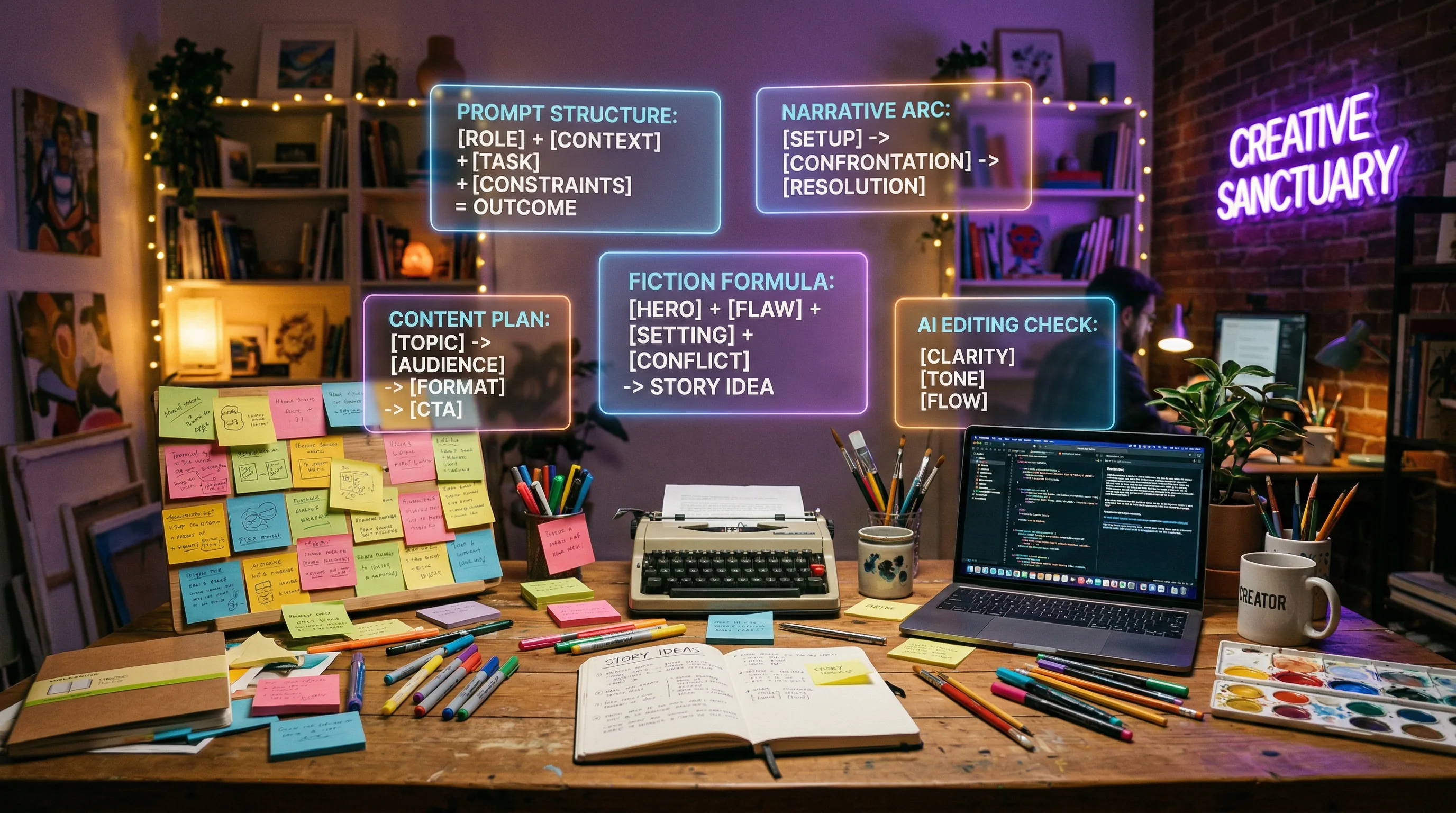
50 AI Writing Prompts That Produce Content Worth Publishing
These 50 AI writing prompts are engineered to produce content that sounds natural, adds genuine depth, and engages readers — the opposite of the generic output most people get from vague prompts.

The Artifio editorial team publishes research, tutorials, and release notes covering image, video, and audio generation models. All posts are reviewed by an editor before publishing.
These 50 AI writing prompts are engineered to produce content that sounds natural, adds genuine depth, and engages readers — the opposite of the generic output most people get from vague prompts. Each prompt is organized by content type and includes the specific elements that separate publish-worthy output from forgettable filler: audience targeting, tone direction, structural requirements, and anti-pattern safeguards.
The difference between mediocre AI content and something worth publishing almost always comes down to the prompt. A great prompt is an investment that pays dividends across every piece of content it helps create.
Why Your AI Prompts Are Producing Bad Content
Before the prompts, a quick diagnosis of why most prompts fail.
The Vague Prompt Problem
"Write a blog post about marketing." That prompt produces exactly what you'd expect: a generic 800-word overview that says nothing new, targets no specific audience, and reads like it was written by a committee of chatbots. Vague input produces vague output — every single time.
The prompt is the most important variable in AI content quality. It's more important than the model you use, the temperature setting, or any post-generation trick. A great prompt with an average model outperforms a terrible prompt with the best model on the market.
What Makes a Great AI Writing Prompt
Every effective prompt includes five elements:
- Audience: Who is reading this? (e.g., "B2B SaaS marketing managers with 3-5 years of experience")
- Angle: What specific perspective or thesis? (e.g., "Why most email A/B tests are statistically meaningless")
- Tone: How should it sound? (e.g., "Confident and direct, like a senior colleague explaining over coffee")
- Structure: What format? (e.g., "Problem-solution format with numbered steps and one real-world example per step")
- Anti-patterns: What to avoid? (e.g., "Never use 'it's important to note,' 'in today's landscape,' or generic business jargon")
As outlined in the Anthropic prompt engineering guide, specificity and clarity are the most important factors in prompt effectiveness. Let's put this into practice.
10 Prompts for Blog Posts and Articles
- The Contrarian How-To: "Write a 1,500-word guide for [audience] on [topic]. Challenge the most common advice by presenting what actually works based on real-world data. Use a conversational, confident tone. Include at least one specific case study. Never start a section with a definition."
- The Problem Diagnosis: "Write about why [common problem] keeps happening despite [common solution]. Target [audience] who have already tried the standard advice. Tone: empathetic but direct. Structure: diagnose the real problem first, then provide the counterintuitive fix."
- The Expert Roundup Replacement: "Instead of listing generic tips from unnamed experts, write a deep-dive on [topic] that provides one complete, actionable framework with specific steps, metrics, and timelines. Audience: [role] at [company type]."
- The 'What Nobody Tells You' Post: "Write about the hidden challenges of [topic] that popular guides omit. Focus on the 20% of issues that cause 80% of the problems. Be specific — include exact numbers, timeframes, and real scenarios."
- The Data-Driven Analysis: "Write a data-driven analysis of [topic] for [audience]. Include placeholder spots marked [INSERT DATA] where I'll add my proprietary data. Structure around 3-5 key findings, each with implications and recommended actions."
- The Beginner's Honest Guide: "Write for complete beginners to [topic] without being condescending. Acknowledge that most beginner guides are unhelpfully vague. Provide the specific first three steps someone should take this week, with expected outcomes."
- The Comparison Framework: "Create a decision framework for choosing between [Option A approach] and [Option B approach] for [goal]. Don't hedge — give a clear recommendation for each common scenario. Include a summary decision table."
- The 'After the Basics' Post: "Write for [audience] who already know the fundamentals of [topic]. Skip 101-level advice entirely. Focus on intermediate-to-advanced techniques that require existing knowledge to understand and put in place."
- The Process Walkthrough: "Walk through [process] step by step as if you're screen-sharing with a colleague. Include what to click, what to type, common mistakes at each step, and how long each step takes. Make it so specific that someone could follow it blindfolded."
- The Myth-Busting Post: "Identify and debunk 5-7 common myths about [topic]. For each myth, explain why it persists, what the truth actually is (with evidence), and what the reader should do instead. Be direct — don't hedge with 'well, it depends.'"
10 Prompts for Marketing Copy
- Email Subject Lines (AIDA): "Generate 20 email subject lines for [product/service] targeting [audience]. Use the AIDA framework. Keep under 50 characters. Mix urgency, curiosity, and direct benefit approaches. No clickbait or ALL CAPS."
- Landing Page Hero: "Write hero section copy for a landing page selling [product]. Lead with the biggest headache your customer faces, then position the product as the solution. Include headline (under 10 words), subhead (under 25 words), and 3 bullet points."
- PAS Ad Copy: "Write 5 ad copy variations using Problem-Agitate-Solve for [product/audience]. Each version under 150 words. Make the agitation specific — describe the frustration in visceral detail. The solution should feel like relief."
- Product Description (Benefits-First): "Write a product description for [product] that leads with benefits, not features. For each feature, translate it into what the customer gains. Tone: enthusiastic but not hyperbolic. Include sensory language."
- Case Study Narrative: "Write a customer success story following this arc: situation before (with specific pain metrics), decision to try [solution], rollout experience, and results after (with specific improvement metrics). Make it read like a story, not a press release."
- BAB Email Sequence: "Write a 3-email Before-After-Bridge sequence for [product]. Email 1: paint the 'before' picture vividly. Email 2: show the 'after' transformation. Email 3: bridge from their current state to the after state using [product]. Each under 200 words."
- Social Proof Copy: "Write 5 ways to present this customer testimonial in marketing copy without just quoting it verbatim: [paste testimonial]. Include headline versions, narrative versions, and stat-based versions."
- Feature Announcement: "Write a feature announcement for [new feature] that focuses on what users can now DO rather than what the feature IS. Lead with the use case, not the specifications. Include 3 specific scenarios showing the feature in action."
- Comparison Page: "Write comparison page copy for [our product] vs the general category. Don't name competitors. Focus on the category-level frustrations our audience faces and how our approach solves them differently. Honest tone — acknowledge tradeoffs."
- Re-engagement Email: "Write a re-engagement email for users who haven't logged in for 30 days. Don't guilt-trip. Instead, highlight what they're missing: new features, content they'd find valuable, or results other users are getting. Include a single, clear CTA."
10 Prompts for Social Media Content
- LinkedIn Thought Leadership: "Write a LinkedIn post (under 1,300 characters before 'see more') sharing a counterintuitive lesson about [topic]. Start with a hook that challenges conventional wisdom. End with a question that invites comments. No hashtags in the main text."
- Twitter/X Thread: "Write a 7-tweet thread about [topic]. Tweet 1 must hook with a surprising fact or bold claim. Each subsequent tweet adds one new idea. Final tweet includes a CTA. Each tweet under 280 characters. Use line breaks for readability."
- Instagram Carousel Script: "Write text for a 10-slide Instagram carousel about [topic]. Slide 1: bold statement that stops scrolling. Slides 2-9: one hands-on tip per slide (under 30 words each). Slide 10: CTA and account tag. Make each slide standalone."
- LinkedIn Story Post: "Write a personal story post for LinkedIn about a professional failure or unexpected lesson related to [topic]. Start in the middle of the action. Keep it under 1,500 characters. End with the takeaway and a question."
- Twitter/X Hot Take: "Write 5 hot takes about [industry topic] that are genuinely contrarian but defensible. Each under 200 characters. They should make people stop scrolling to disagree or agree — not just nod along."
- Instagram Caption (Product): "Write an Instagram caption for [product photo]. Start with a benefit-driven hook. Include a mini-story or use case. Add a CTA. Keep under 150 words. Put hashtags in a comment, not the caption."
- Facebook Group Post: "Write a discussion-starter post for a [niche] Facebook group about [topic]. Ask a specific question that invites sharing personal experiences. Don't lecture — be curious. Under 100 words."
- Pinterest Pin Description: "Write a Pinterest description for a [content type] about [topic]. Include relevant keywords naturally. Focus on what the viewer will learn or gain. Include a soft CTA. Under 200 characters."
- Social Media Poll: "Create 5 poll questions about [topic] for [platform]. Each question should reveal an interesting split in audience opinion. Include 2-4 answer options per question. Make them genuinely debatable."
- Content Repurposing: "Take this blog post excerpt: [paste excerpt]. Rewrite it as: (a) a LinkedIn post, (b) a tweet thread of 5 tweets, and (c) an Instagram caption. Each should feel native to the platform, not like a copy-paste."
10 Prompts for Email Newsletters
- Welcome Email: "Write a welcome email for new subscribers to [newsletter/product]. Set expectations: what they'll receive, how often, and why it's worth reading. Include one immediate value item they can use today. Warm, not corporate."
- Weekly Roundup: "Write a newsletter intro for this week's content roundup. Theme: [topic]. Make the intro engaging enough to read on its own — not just 'here's what we published.' Include one personal observation or industry trend."
- Educational Series Email: "Write email 3 of a 5-part series on [topic]. Assume the reader has read emails 1-2 covering [previous topics]. This email covers [specific subtopic]. Include one exercise or action item. Preview email 4's topic."
- Promotional Email (Soft Sell): "Write a promotional email for [product/offer] that leads with value, not pitch. First 80% of the email should teach something useful about [topic]. Last 20% naturally connects that lesson to [product]. Never say 'limited time.'"
- Reader Success Story: "Write a newsletter featuring a reader success story. Structure: their challenge, what they tried, what worked (connecting to advice from our newsletter), and their results. Make it feel authentic, not like a case study."
- Curated Links Email: "Write commentary for 5 curated links about [topic]. For each link: one sentence summarizing the article, one sentence with my take on it. Make each commentary add perspective the original article doesn't provide."
- Q&A Newsletter: "Write a newsletter answering the 3 most common questions about [topic]. Each answer should be 100-150 words. Be direct — give the actual answer in the first sentence, then explain the nuance."
- Year-in-Review Email: "Write an annual review email for [newsletter/brand]. Include: top content from the year, key stats, biggest lessons learned, and what's coming next year. Tone: grateful and forward-looking."
- Re-engagement Sequence: "Write a 3-email re-engagement sequence for inactive subscribers. Email 1: 'We miss you' with a valuable resource. Email 2: 'Has this changed?' asking if their interests have shifted. Email 3: 'Last chance' with clear unsubscribe option."
- Product Update Newsletter: "Write a product update email that doesn't bore people. Lead with the user benefit, not the feature name. Include a before/after comparison showing the improvement. End with how to try it today."
10 Prompts for Creative and Niche Content
- Video Script (Educational): "Write a 5-minute YouTube script about [topic]. Open with a hook question in the first 10 seconds. Use the 'curiosity loop' structure: open a question, explain partially, open another question. Include [VISUAL] markers where B-roll should appear."
- Podcast Show Notes: "Write show notes for a podcast episode about [topic] with [guest]. Include: episode summary (3 sentences), key takeaways (5 bullet points), timestamps for major topics, notable quotes from the guest, and resources mentioned."
- Whitepaper Executive Summary: "Write an executive summary for a whitepaper on [topic]. Target: C-suite readers with 2 minutes. Include: the problem, key findings (3 bullet points with data), recommended actions, and expected ROI. No jargon."
- Case Study Long-Form: "Write a 1,500-word case study for [client/scenario]. Structure: Challenge (with metrics), Process (with timeline and decision rationale), Solution (with execution details), Results (with before/after metrics), Lessons Learned."
- Product Documentation: "Write user documentation for [feature]. Include: what it does (one paragraph), step-by-step usage guide, common use cases (3 scenarios), troubleshooting FAQ (5 questions), and tips for power users. Write for someone mildly frustrated."
- Webinar Invitation: "Write webinar invite copy for [topic] presented by [speaker]. Focus on what attendees will learn, not the speaker's credentials. Include: catchy title, 3 bullet takeaways, time/date, and urgency element. Under 200 words."
- Sales One-Pager: "Write a one-page sales document for [product] targeting [buyer persona]. Structure: headline (their problem), 3 key benefits with evidence, one customer quote, pricing summary, and clear next step. Every sentence must earn its space."
- Internal Memo: "Write an internal memo about [initiative] for a team of [size/type]. Be transparent about the why, specific about the what, and clear about what changes for each person. Include timeline and who to ask for questions."
- Grant Proposal Summary: "Write a grant proposal summary for [project] requesting [amount] from [funder type]. Include: problem statement with evidence, proposed solution, team qualifications (brief), expected outcomes with metrics, and budget overview."
- Press Release: "Write a press release for [announcement]. Follow inverted pyramid: most important information first. Include one quote from [spokesperson]. No superlatives or promotional language — let the facts carry the story. Include boilerplate company description."
These prompts work across different AI models — try them on Artifio's 100+ options to see which model produces the best results for each content type. You may find that certain models excel at specific formats while struggling with others.
How to Customize These Prompts for Your Brand
These are starting templates, not final products. Customize each prompt by adding your brand voice document, swapping in your specific audience and industry details, and adjusting the anti-pattern rules based on your editing experience.
Test each customized prompt across 2-3 models before committing to a template. The best model for your blog post prompt might not be the best for your email newsletter prompt. For techniques on fixing common output issues, see our guides on fixing robotic AI tone and breaking repetitive AI patterns.
Frequently Asked Questions
What makes a good AI writing prompt?
A good prompt includes five elements: target audience, specific angle or thesis, desired tone, output format/structure, and what to avoid. The more specific your prompt, the less editing the output needs.
How long should an AI writing prompt be?
200-500 words for complex content, 50-100 words for short-form. Longer prompts with more context produce better output. Include examples, voice guidelines, and structural requirements for best results.
Can I reuse AI prompts across different topics?
Yes — create prompt templates with placeholders for topic, audience, and angle. The structural and voice instructions stay the same while the subject changes. This is the foundation of scalable AI content.
Why does the same prompt give different results?
AI models are probabilistic and generate slightly different output each time. Temperature settings control this variation. If you need consistent results, lower the temperature and provide more specific constraints.
Should I use different prompts for different AI models?
Ideally, yes. Models respond differently to the same instructions. A prompt optimized for one model may underperform on another. Test your prompts across models and adjust wording for each.
How do I write prompts for AI image generation?
Image prompts need different strategies: describe composition, lighting, style, and mood rather than narrative. Include technical terms like "rule of thirds," "soft lighting," or "minimalist." Negative prompts (what to exclude) are equally important.
Put these prompts to work across 100+ AI models. Sign up for Artifio and discover which model turns your prompts into publish-ready content.