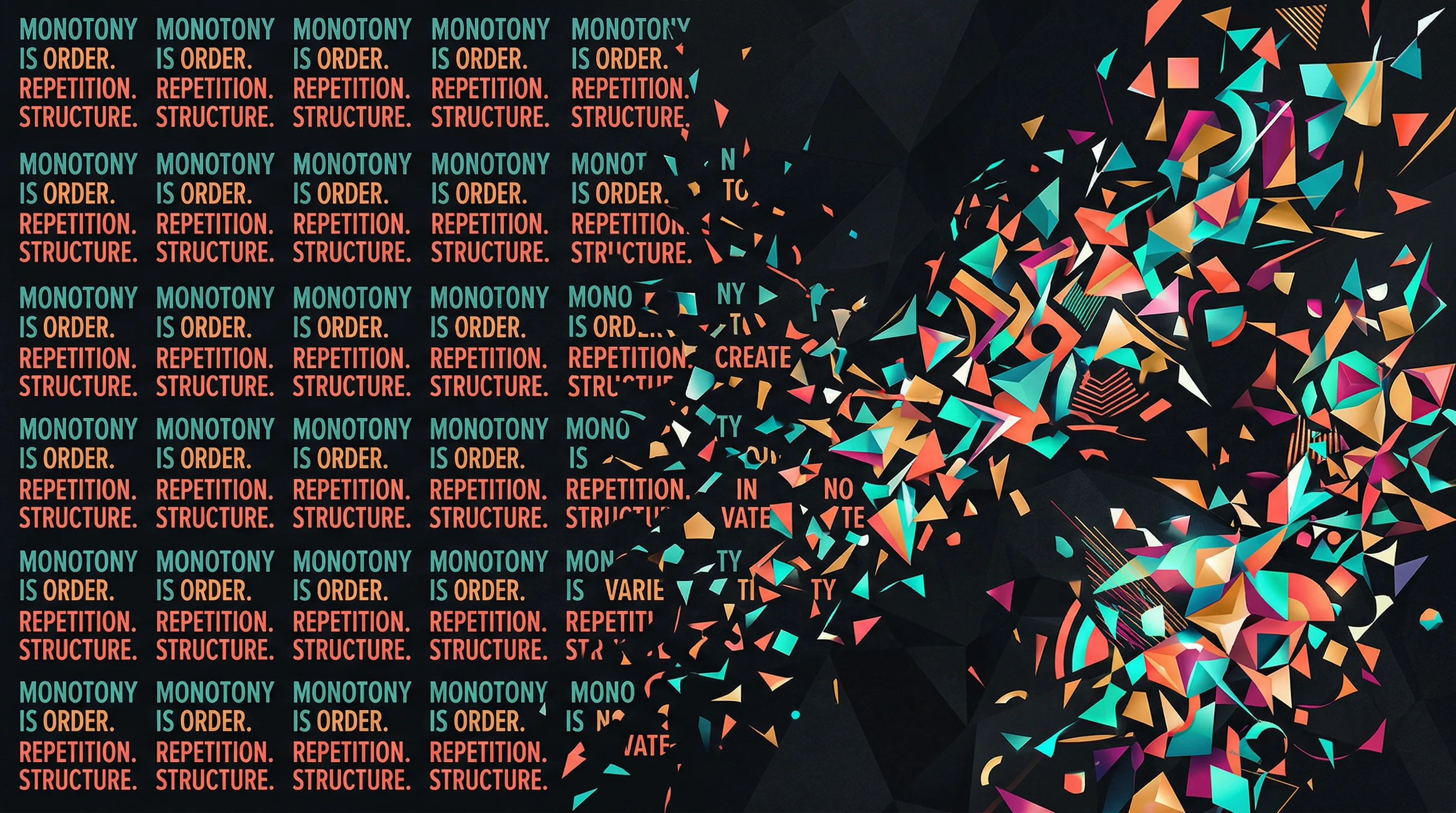
Why AI Writing Falls Into Repetitive Patterns and How to Break the Cycle
AI writing repetitive patterns happen because language models generate text based on statistical probability — and the most probable phrasing is, by definition, the most common phrasing.

The Artifio editorial team publishes research, tutorials, and release notes covering image, video, and audio generation models. All posts are reviewed by an editor before publishing.
AI writing repetitive patterns happen because language models generate text based on statistical probability — and the most probable phrasing is, by definition, the most common phrasing. If your AI output uses "Also" three times per article, follows the exact same paragraph structure everywhere, and recycles the same transition phrases, you're seeing a predictable behavior that's entirely fixable.
This guide explains why repetition happens at a technical level and gives you seven specific techniques to produce varied, engaging output.
The Most Common AI Writing Repetition Patterns
Let's name the patterns so you can spot them instantly. Once you recognize them, they become impossible to unsee.
Identical Transition Phrases
"What's more." "Beyond that." "On top of that." "In addition to this." These four transitions appear in virtually every AI-generated article. They're the linguistic equivalent of elevator music — technically functional and completely forgettable.
Real writers transition with variety: a question, a contrast, a callback to a previous point, or sometimes no explicit transition at all. The reader's brain fills in the connection naturally when the ideas flow logically.
Formulaic Paragraph Structure
AI follows a rigid pattern: topic sentence → explanation → example → transition. Every paragraph. Every time. Human writing doesn't work this way. Some paragraphs are one sentence. Some start with an example. Some start with a question. Some bury the main point at the end for dramatic effect.
The uniformity is what makes AI writing feel mechanical. Readers don't consciously analyze paragraph structure, but they feel the monotony.
Overused Filler Words and Hedges
"..." "It's important to understand that..." "When it comes to..." "When you zoom out, ..." These phrases add no information. They exist because AI models assign high probability to them — they appear frequently in training data and serve as easy transitions.
A good editing rule: if you can delete a phrase and the sentence still works, delete it. For more on cleaning up AI output, see our guide to fixing robotic AI tone.
Why AI Gets Stuck in Repetition Loops
The technical explanation helps you choose the right fix.
Temperature and Sampling Settings
AI models use a "temperature" parameter that controls randomness. Low temperature (0.1-0.3) produces predictable, safe, repetitive output. High temperature (0.8-1.0) produces creative, varied, but sometimes incoherent output.
Most AI interfaces default to moderate temperature settings that lean toward safety. According to documentation on temperature and sampling, this parameter directly controls the diversity of generated text. If you haven't adjusted it, you're getting the default — which prioritizes consistency over creativity.
Training Data Frequency Bias
Phrases that appear millions of times in training data get high probability scores. "In the current market, " exists in so many published articles that AI considers it a reliable, safe phrase to use. It doesn't evaluate whether the phrase adds value — only that it's statistically likely to fit.
Longer outputs amplify this effect. In a 300-word paragraph, the model has enough room to stay creative. By word 2,000, it's recycled its best phrasing and starts looping through the same constructions.
7 Techniques to Get Varied AI Output
These techniques range from simple settings changes to workflow adjustments. Use them in combination for the best results.
Adjust Temperature and Top-P Settings
If your AI tool lets you adjust temperature, try bumping it to 0.7-0.8 for creative content. For factual content, stay at 0.4-0.6 but compensate with other techniques from this list. Top-P (nucleus sampling) controls diversity differently — set it to 0.9 for balanced variety.
The key is experimentation. Generate the same content at three different temperature settings and compare the results. You'll quickly find the ideal balance for your content type.
Use Explicit Anti-Repetition Instructions
Add instructions directly in your prompt: "Never start two paragraphs the same way. Vary sentence length between 5 and 25 words. Do not use the words furthermore, moreover, or additionally. Use no more than one transition phrase per 300 words."
AI follows explicit prohibitions more reliably than vague instructions to "be varied." Name the specific patterns you want to avoid.
Generate in Shorter Segments
Instead of generating a full 2,000-word article in one prompt, generate section by section. Each new prompt resets the model's tendency to loop, producing fresher language in each section.
A 2,000-word article generated as four 500-word sections typically shows more variety than the same article generated in a single prompt. Our AI long-form content guide covers this technique in detail.
Switch Models Mid-Project
Different models have different repetition patterns. What sounds formulaic in Model A might sound fresh in Model B, and vice versa. Using two or three models across a single project introduces natural variety because each model draws from different probability distributions.
Artifio's multi-model access makes it easy to switch between models mid-project. Generate your intro with one model, your body with another — each brings different phrasing patterns to the table.
Provide Varied Example Text
If you provide monotonous example text, you'll get monotonous output. Feed AI diverse writing samples: a short punchy paragraph, a longer analytical section, a question-and-answer format, a narrative story. The more variety in your input, the more variety in your output.
Use Negative Prompting
Create a "banned phrases" list and include it in every prompt. Our running list includes:
- "In today's [anything]"
- "It's important to note"
- "Bottom line — "
- "When it comes to"
- "In the world of"
- "Navigate the landscape of"
- "It's worth mentioning"
- "Let's break this down." / "Let's explore"
Adding this list eliminates the worst offenders and forces the model to find alternative phrasing.
Post-Generation Diversity Editing
After generating, do a "repetition audit." Search for repeated phrases, scan paragraph openings for patterns, and check that sentence lengths vary. Fix any patterns that survived your prompting safeguards.
This takes 5-10 minutes and catches what prompting misses. Over time, you'll notice which patterns your preferred model defaults to and can add them to your negative prompt list.
For more context on AI content quality, see our complete AI content quality guide. And for overall editing strategy, check out our AI content editing workflow.
The Repetition-Diversity Spectrum
Think of AI output on a spectrum. On one end: completely repetitive, formulaic content that reads like it was generated by a machine running on autopilot. On the other end: chaotic, incoherent text that varies so wildly it lacks any structure or focus.
Your goal is the middle — what professional writers achieve naturally. Enough structure for clarity. Enough variation for engagement. Enough predictability that readers can follow the argument. Enough surprise that they stay interested.
The seven techniques in this guide move you from the repetitive end toward that productive middle ground without tipping into chaos. Use them in combination, calibrate based on results, and remember that perfect variety is the enemy of good variety. Your content doesn't need to read like literary fiction — it just needs to not read like a template.
Creating Your Own Anti-Repetition Prompt Library
Over time, you'll develop a personal library of anti-repetition instructions that work for your content style and preferred models. Build it systematically.
Week 1-2: Identify Your Model's Patterns
Generate 10 pieces of content with your standard prompts and highlight every instance of repetitive phrasing, identical transitions, and formulaic structure. You'll quickly see patterns: maybe your model always starts the second paragraph with "Also," or consistently uses a three-part list in every section.
Week 3-4: Build Counter-Instructions
For each identified pattern, write a specific prohibition. "Never use the word 'additionally'" is more effective than "vary your transitions." "Start at least one paragraph with a one-word sentence" is more effective than "vary paragraph structure."
These instructions compound. After a month of systematic pattern identification and counter-instruction development, your prompts will produce noticeably more varied, natural-sounding content. The repetition patterns that once plagued every output will largely disappear — replaced by writing that feels genuinely unpredictable and human.
The investment is modest: 30 minutes per week reviewing output and refining instructions. The return is enormous: AI content that passes the "does this sound like a machine?" test consistently.
Frequently Asked Questions
Why does AI keep using the same phrases?
AI models generate text based on statistical probability. High-frequency phrases from training data (like "It's important to note") have high probability scores and appear repeatedly. Adjusting temperature settings and using anti-repetition instructions helps.
How do I stop AI from writing formulaic content?
Use explicit instructions: "Vary paragraph lengths between 1-5 sentences. Never use the words furthermore, moreover, or additionally. Start some paragraphs with questions or single-word sentences." Specificity in your prompt creates variety in output.
What temperature setting should I use for AI writing?
For creative content, use 0.7-0.9. For factual content, use 0.3-0.5. Higher temperature increases variety but reduces predictability. Start at 0.7 and adjust based on the balance of creativity and accuracy you need.
Can switching AI models reduce repetition?
Yes. Different models have different phrasing tendencies. Using multiple models across a project introduces natural variety. Aggregator platforms let you switch models easily without managing separate accounts.
What AI writing phrases should I always remove?
"Today, " "It's important to note," "Alright, let's do this.," "When it comes to," "Realistically, " "In this article we will explore." These are the most common AI writing tells.
Break free from repetitive AI output. With Artifio's 100+ models, you can mix and match AI engines to create content that sounds fresh every time.