AI Detection False Positives: Why Your Human Writing Gets Flagged and What to Do About It
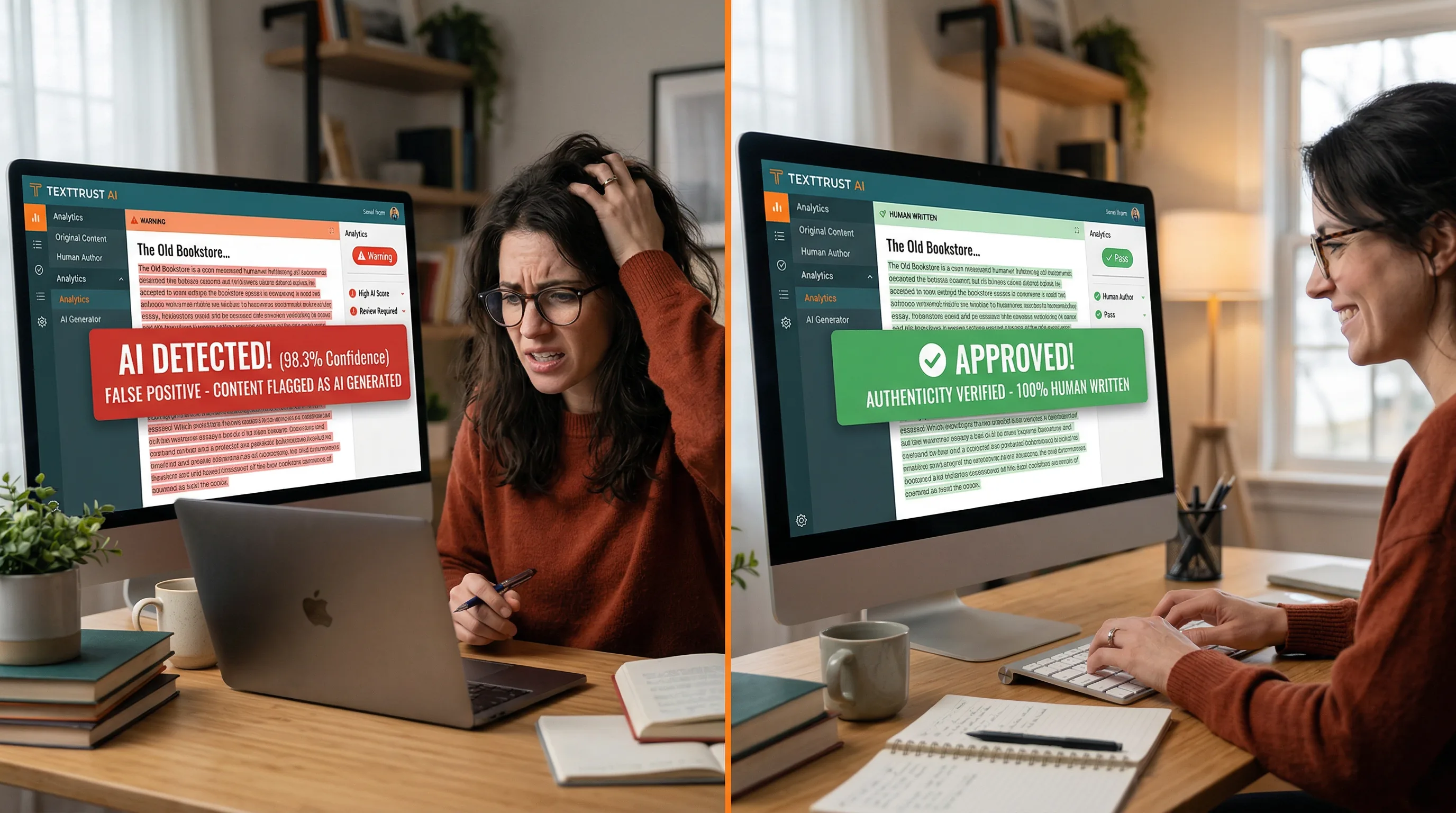
AI detection false positives happen when a detection tool incorrectly flags human-written content as AI-generated.

The Artifio editorial team publishes research, tutorials, and release notes covering image, video, and audio generation models. All posts are reviewed by an editor before publishing.
AI detection false positives happen when a detection tool incorrectly flags human-written content as AI-generated. If you've written every word yourself only to have a detector declare your work "95% AI," this is more common than you think — and the consequences range from annoying to career-threatening. Here's why it happens, who's most affected, and what you can do about it.
Why AI Detectors Get It Wrong
AI detectors don't actually know whether a human or machine wrote something. They make a statistical guess based on patterns, and that guess is frequently wrong.
The Statistical Approach and Its Limits
Detection tools measure two primary properties of text: perplexity (how predictable the word choices are) and burstiness (how varied the sentence structure is). AI text tends to be consistently predictable with uniform sentence lengths. Human text is typically more varied and unpredictable.
The problem is that these categories overlap significantly. Plenty of human writing — especially polished, well-edited writing — exhibits the exact patterns detectors associate with AI. When you carefully revise your work to be clear and concise, you may actually push your writing's statistical signature closer to AI patterns.
According to research published by GPTZero accuracy research, even the best detection tools struggle to distinguish between polished human writing and AI-generated text that has been lightly edited. The tools measure patterns, not authorship.
Who Gets Flagged Most Often
Some groups experience false positives at dramatically higher rates:
- Non-native English speakers: ESL writers use simpler vocabulary and more consistent grammar patterns, triggering detectors at 2–3x the rate of native speakers
- Technical writers: Precise, jargon-heavy writing with consistent structure resembles AI output
- Academic writers: Formal, structured writing with predictable organization flags frequently
- Writers who edit heavily: Ironic but true — thorough editing produces smoother, more uniform text that looks "AI-like"
- Younger writers: Students who grew up reading internet content may naturally adopt patterns similar to AI training data
This bias creates serious equity concerns, particularly in educational and employment contexts where detection results carry real weight.
Documented False Positive Rates
This isn't a minor edge case. Research repeatedly demonstrates significant false positive rates across all major detection tools.
Research on Detector Accuracy
Independent studies consistently report false positive rates between 5% and 20%. That means for every 100 pieces of purely human-written content run through a detector, between 5 and 20 will be incorrectly flagged as AI-generated.
For non-native English speakers, the rates are worse. Multiple studies have found false positive rates of 20% or higher for ESL writing. In one frequently cited study, over 50% of TOEFL essays written by real test-takers were classified as AI-generated by popular detection tools.
These accuracy numbers assume the content is purely human-written. For content that uses any AI assistance — even a grammar checker or a rephrasing tool — the picture gets murkier. Visit our full guide to AI content detection for the full breakdown of how these tools work.
Real-World Impact Stories
The consequences of false positives are tangible. Students have been accused of academic dishonesty, facing failing grades or disciplinary action for work they wrote entirely themselves. Freelance writers have lost clients after detection scans flagged their original work. Job applicants have had writing samples questioned during hiring processes.
One widely reported case involved a professor who ran all student essays through a detector and accused over a dozen students of using AI — several of whom were later cleared when they provided their handwritten notes and revision history. The damage to trust and student wellbeing, however, was already done.
How to Protect Your Content
While you shouldn't have to prove you wrote your own work, the reality of imperfect detection tools means preparation matters.
Maintaining Writing Process Evidence
The strongest defense against a false positive is a documented writing process. Keep your:
- Drafts and revisions: Use version control or save incremental drafts showing your writing's evolution
- Research notes: Screenshots of sources you consulted, bookmarks, annotations
- Outlines: Your planning documents show the thinking process behind the piece
- Communication records: Emails or messages discussing the work in progress
- Writing environment metadata: Google Docs revision history, Word track changes, or similar tools that show editing patterns over time
These artifacts demonstrate a human writing process that no AI tool would generate. They're far more convincing than trying to argue about a detector's methodology.
Responding to False Positives
If your content is flagged, stay calm and professional. Don't argue about whether AI detectors are reliable (even though they aren't). Instead, provide evidence of your writing process. Show your revision history. Offer to discuss the topic in depth to demonstrate your expertise.
Frame your response around evidence, not defensiveness: "I understand the detection result. Here are my notes, drafts, and revision history that demonstrate my writing process." This approach is more effective than challenging the tool's validity.
When to Challenge AI Detection Results
You should push back when detection results are used as the sole basis for serious consequences — academic penalties, contract termination, or public accusations. No major AI detection company claims their tool is definitive. Most include disclaimers that results are probabilistic and shouldn't be used as sole evidence.
Quote the tool's own documentation. Point to their published accuracy data. Reference the well-documented false positive rates. And always provide your process evidence alongside the challenge.
The Bigger Question: Does AI Detection Even Matter?
As AI becomes an increasingly normal part of content workflows, the focus on detection may be misplaced entirely.
Quality should be the metric, not authorship method. A well-researched, accurate, insightful article serves readers equally well whether it was written by a human, assisted by AI, or some combination. Conversely, a shallow, inaccurate article is problematic regardless of who or what created it.
The industry is moving toward disclosure over detection. Rather than playing cat-and-mouse with detection tools, the more productive approach is transparent AI disclosure — being honest about your tools and focusing on the quality of the output. Artifio supports transparent AI content creation — you know exactly which models you used, making disclosure straightforward when needed.
As we discuss in our guide to building audience trust with AI content, audiences care about quality and honesty, not about whether you used a tool during your creative process.
The Industry Response to Detection Limitations
As awareness of detection limitations grows, the industry is shifting its approach. Major detection tool providers have updated their documentation to include stronger caveats about accuracy. Some have added probability ranges rather than binary classifications. Others have introduced "inconclusive" categories for borderline results.
This evolution is positive but incomplete. Many users of these tools — teachers, editors, clients — still treat results as definitive despite the caveats. The gap between how detection tools present their limitations and how users interpret results remains significant.
For the broader content industry, the shift toward disclosure-based systems rather than detection-based policing represents the most promising path forward. Platforms that require AI labeling at the point of creation (rather than trying to detect AI after publication) address the transparency problem more effectively than any detection tool can.
The practical takeaway for creators: document your writing process, maintain transparency about your tools, and focus on producing content that stands on its quality rather than its authorship method. Detection tools may continue to improve, but they'll always have limitations. Building your reputation on quality and transparency is a more durable strategy than trying to game detection algorithms.
Professional writing communities are increasingly advocating for evaluation standards that focus on content quality, accuracy, and originality rather than attempting to determine the degree of AI involvement. This represents a maturation of the conversation around AI content — moving from fear and policing toward practical quality standards that serve readers regardless of how content was produced.
Frequently Asked Questions
Why does the AI detector say my writing is AI?
AI detectors analyze statistical patterns, not actual authorship. Formal writing, consistent structure, and technical vocabulary create patterns similar to AI output. Non-native English speakers and technical writers are disproportionately affected.
How reliable are AI content detectors?
Current detectors are 70–90% accurate at best, with false positive rates of 5–20%. They should be treated as one data point, not proof. No major detection tool claims to be definitive.
What do I do if my work is falsely flagged as AI?
Provide evidence of your writing process: drafts, outlines, revision history, research notes. Offer to discuss the content's subject matter to demonstrate expertise. Remain professional — false positives are a known limitation.
Can I make my writing less detectable by AI tools?
Yes, but you shouldn't have to. Varying sentence length, using personal anecdotes, and including informal elements reduce detection scores. But the real solution is advocating for better evaluation standards beyond simplistic AI detection.
Do AI detectors work on edited AI content?
Detection accuracy drops significantly on heavily edited AI content. If a human has substantially revised, restructured, and added expertise to AI-generated text, detectors often classify it as human-written — which makes sense, as the human contribution is dominant.
Create AI-Assisted Content with Confidence
Artifio's transparent platform makes it easy to track your AI usage and disclose when appropriate. With 100+ models and clear records, you always know what went into your content.