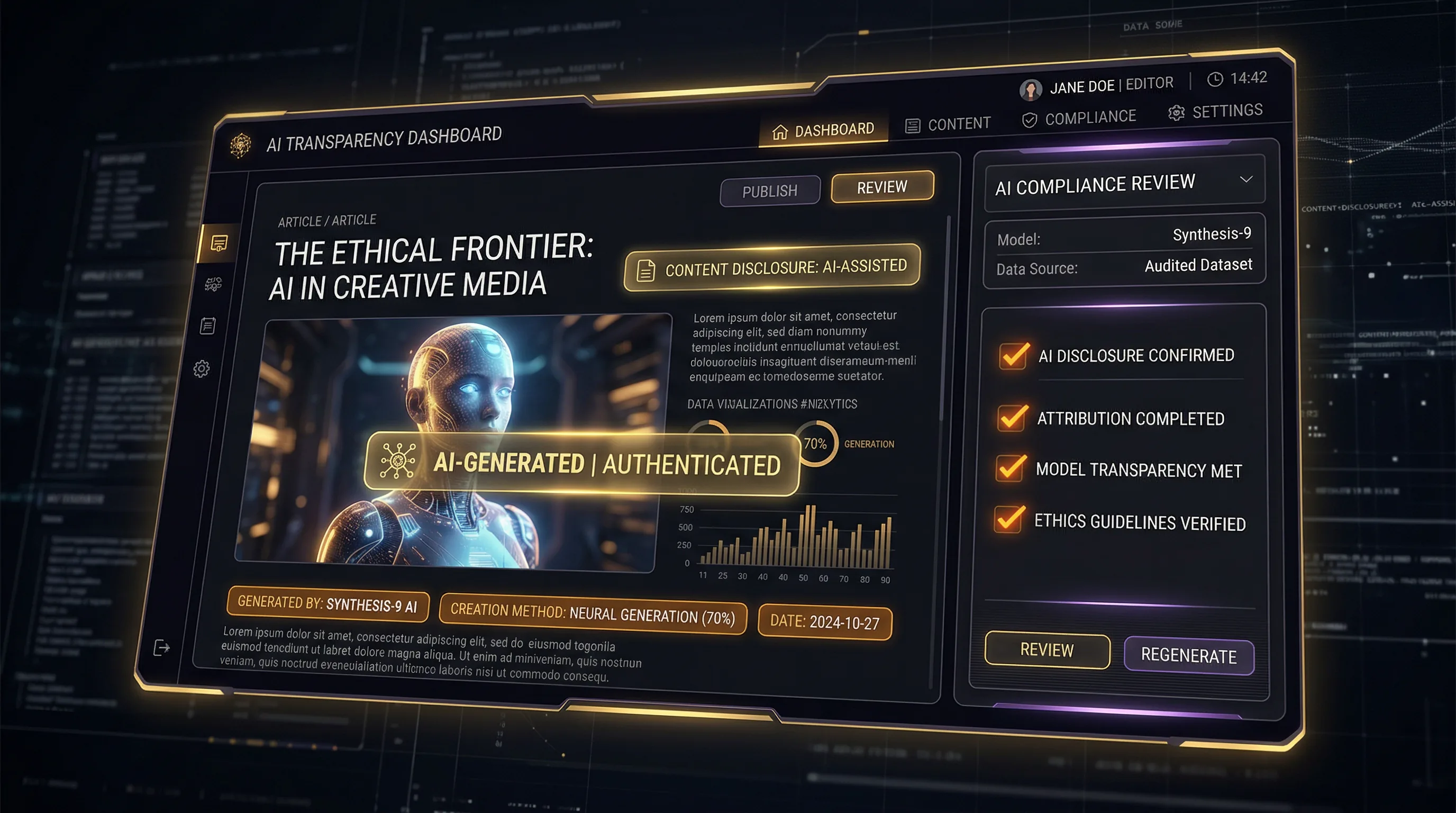
AI Content Disclosure: When, How, and Why to Tell Your Audience You Used AI
AI content disclosure means informing your audience that artificial intelligence was involved in creating your content. Whether you should disclose — and increasingly, whether you're legally required to — depends on where you publish, what kind of content you create, and which platforms you use.

The Artifio editorial team publishes research, tutorials, and release notes covering image, video, and audio generation models. All posts are reviewed by an editor before publishing.
AI content disclosure means informing your audience that artificial intelligence was involved in creating your content. Whether you should disclose — and increasingly, whether you're legally required to — depends on where you publish, what kind of content you create, and which platforms you use. This guide breaks down the current requirements, strategic benefits, and practical methods for AI disclosure in 2026.
Current AI Disclosure Requirements
The disclosure landscape is shifting rapidly. What was optional last year may be mandatory now, and today's best practices are becoming tomorrow's legal requirements.
EU AI Act Provisions
The EU AI Act is the most complete AI regulation in the world, and its disclosure requirements affect anyone creating content for European audiences. Key provisions require clear labeling of AI-generated content, particularly for deepfakes, synthetic media, and content that could be mistaken for depicting real events or people.
The Act applies to AI system providers and deployers operating within the EU, which means many global content creators and businesses fall under its scope. The requirements are risk-based: higher-risk content (like political content or synthetic media of real people) faces stricter disclosure obligations.
Platform-Specific Policies
Major platforms have implemented their own AI disclosure requirements, often ahead of regulation:
- Meta (Facebook, Instagram): Requires labeling of AI-generated or AI-altered content, particularly images and video
- Google/YouTube: Requires disclosure when realistic AI content could be mistaken for depicting real events or people
- TikTok: Mandates labeling AI-generated content and provides built-in disclosure tools
- LinkedIn: Encourages transparency about AI use in professional content
Violating platform disclosure policies can result in content removal, reduced distribution, or account penalties. These policies are updated frequently, so check each platform's current guidelines regularly.
Industry Standards Emerging
Beyond regulations and platform policies, industry groups are developing voluntary standards. Journalism organizations, advertising associations, and content marketing bodies are publishing AI disclosure guidelines. While voluntary today, these standards often become the basis for future regulation and platform policies.
Strategic Disclosure: Building Trust Through Transparency
Beyond compliance, disclosure can be a genuine strategic advantage.
Why Proactive Disclosure Builds Authority
Counter-intuitively, telling your audience you used AI tools can increase trust rather than decrease it. Disclosure signals confidence: "My content is good enough that knowing AI assisted in its creation doesn't diminish it." It also signals honesty — a trait that audiences increasingly value as they encounter more undisclosed AI content.
Studies on transparency in content creation consistently show that audiences penalize discovered deception far more than they penalize disclosed AI use. Being caught using AI without disclosure is significantly more damaging than proactively disclosing. The Edelman Trust Barometer data supports this broader trend toward transparency building trust. Our guide on building audience trust with AI content dives deeper into this dynamic.
How to Frame AI Disclosure Positively
The framing matters enormously. Compare these two disclosures:
Weak: "This article was generated by AI."
Strong: "This article was researched and drafted with AI assistance, then reviewed and edited by [Author Name], who has 12 years of experience in this field."
The strong version positions AI as a tool that supports human expertise. It emphasizes the human contribution and the expertise behind the content. This framing aligns with how most creators actually use AI — as a starting point that they enhance with their knowledge.
Practical Disclosure Methods
Different content types and platforms call for different disclosure approaches.
Blog and Article Disclosure
For written content, the most common approaches include:
- Editor's note at the top: Brief note before the article begins. Best for content where disclosure is legally required or where AI played a significant role.
- Footer disclosure: A note at the end of the article. Suitable for content where AI assisted but human expertise is dominant.
- Author bio inclusion: Mentioning AI tools in your author bio or "about our process" page. Works for publications with consistent AI use across all content.
Artifio provides clear records of which models and tools you used for each piece of content, making accurate disclosure straightforward. Knowing exactly which AI models contributed to a piece means your disclosure can be specific and credible.
Social Media Disclosure
Social platforms are building disclosure directly into their tools. Use platform-native labels when available — they're the most visible and carry the most credibility. When native labels aren't available, include disclosure in your caption or description. Hashtags like #AIGenerated or #AIAssisted are recognized conventions but shouldn't replace proper disclosure text.
Visual Content Disclosure
AI-generated images and videos require special attention. Include disclosure in the post description or caption. For images published on your own site, add alt text that mentions AI generation. For video, include disclosure in the description and consider a brief note within the video itself. Our pillar guide on AI content detection and authenticity covers how visual content detection works alongside disclosure best practices.
When Disclosure Is Not Required (But May Be Smart)
Not every use of AI requires disclosure. Understanding the thresholds helps you disclose appropriately without over-disclosing.
Generally doesn't require disclosure: Using AI for grammar checking, spell-checking, or basic proofreading. Using AI to brainstorm ideas or create outlines. Internal content like notes, summaries, or planning documents. Research assistance where you verify all findings independently.
Disclosure recommended: AI-generated first drafts that are substantially edited. AI-generated images or video. Content where AI wrote significant portions. Any content in regulated industries.
Disclosure required: Synthetic media of real people. Content covered by EU AI Act provisions. Content published on platforms with AI labeling requirements. Content in industries with specific AI disclosure regulations.
When in doubt, disclose. The risk of over-disclosing (minor unnecessary transparency) is vastly smaller than the risk of under-disclosing (potential legal liability, platform penalties, or trust damage).
Disclosure Best Practices Across Industries
Different industries have different disclosure norms and requirements. Understanding your industry's expectations helps you calibrate your disclosure approach.
Journalism and publishing: The highest disclosure expectations. Media organizations increasingly require explicit AI disclosure in editorial content. Many publications have formal AI use policies that specify what AI assistance is acceptable and how it must be disclosed. If you write for publications, check their AI policy before submitting.
Marketing and advertising: Disclosure requirements focus on preventing consumer deception. If AI-generated imagery or video could be mistaken for real photography or footage of real events, disclosure is typically required. The FTC's truth-in-advertising principles apply to AI-generated marketing claims.
Education: Academic AI policies vary enormously — from total prohibition to full integration. Always check your institution's specific policy. When in doubt, disclose and ask. The trend is toward integration with transparency rather than prohibition.
Corporate communications: Annual reports, investor communications, and regulatory filings are increasingly scrutinized for AI involvement. Many companies are developing internal AI disclosure standards for corporate content. Err on the side of over-disclosing in formal corporate contexts.
Creative industries: Art, music, and entertainment face intense debate about AI disclosure. Community norms are in flux rapidly. Many creative platforms and communities have implemented or are developing AI disclosure requirements. Understanding your specific creative community's standards is essential for maintaining reputation and trust.
Creating a Disclosure Template for Your Organization
Having pre-written disclosure templates saves time and ensures consistency across your content.
For blog content: "This article was researched and drafted with AI assistance using [tool/platform]. All content has been reviewed, fact-checked, and edited by [Author Name], who has [X years] of experience in [field]. Questions about our AI content policy? Contact us at [email]."
For social media: "AI-assisted content | Created with AI tools, reviewed by our [team/expert]"
For visual content: "Image generated with AI assistance | Edited and approved by [team]"
Customize these templates for your brand voice and specific requirements. Having them ready means disclosure becomes a quick, consistent step rather than an ad-hoc decision each time you publish.
Frequently Asked Questions
Do I have to disclose AI-generated content?
It depends on your jurisdiction, platform, and content type. The EU AI Act requires disclosure in many contexts. Major social platforms require AI labeling. Even without legal requirements, voluntary disclosure builds trust.
How do I disclose AI use in blog posts?
Add a simple note at the end: "This article was researched and drafted with AI assistance, then reviewed and edited by [author name]." Keep it factual and brief. Don't over-explain or apologize.
Will disclosing AI use hurt my content's performance?
Research suggests the opposite — transparent disclosure builds trust. Audiences are more forgiving of disclosed AI use than discovered undisclosed AI use. Quality matters more than authorship method.
What platforms require AI content disclosure?
Meta, Google/YouTube, and TikTok all have AI content labeling policies as of 2026. Requirements vary by content type and degree of AI involvement. Check each platform's current policies regularly.
Is using AI for content creation considered cheating?
No. AI is a tool, like spell-check or a calculator. The ethical line is about transparency and quality — not about whether you used a tool. Disclosing AI use and ensuring content quality is the professional standard.
Create Transparently, Create Confidently
Artifio tracks your AI model usage so disclosure is always accurate and effortless. With 100+ models across every content type, you know exactly what went into every piece you create.