AI Content Detection in 2026: What Every Creator Needs to Know About Authenticity
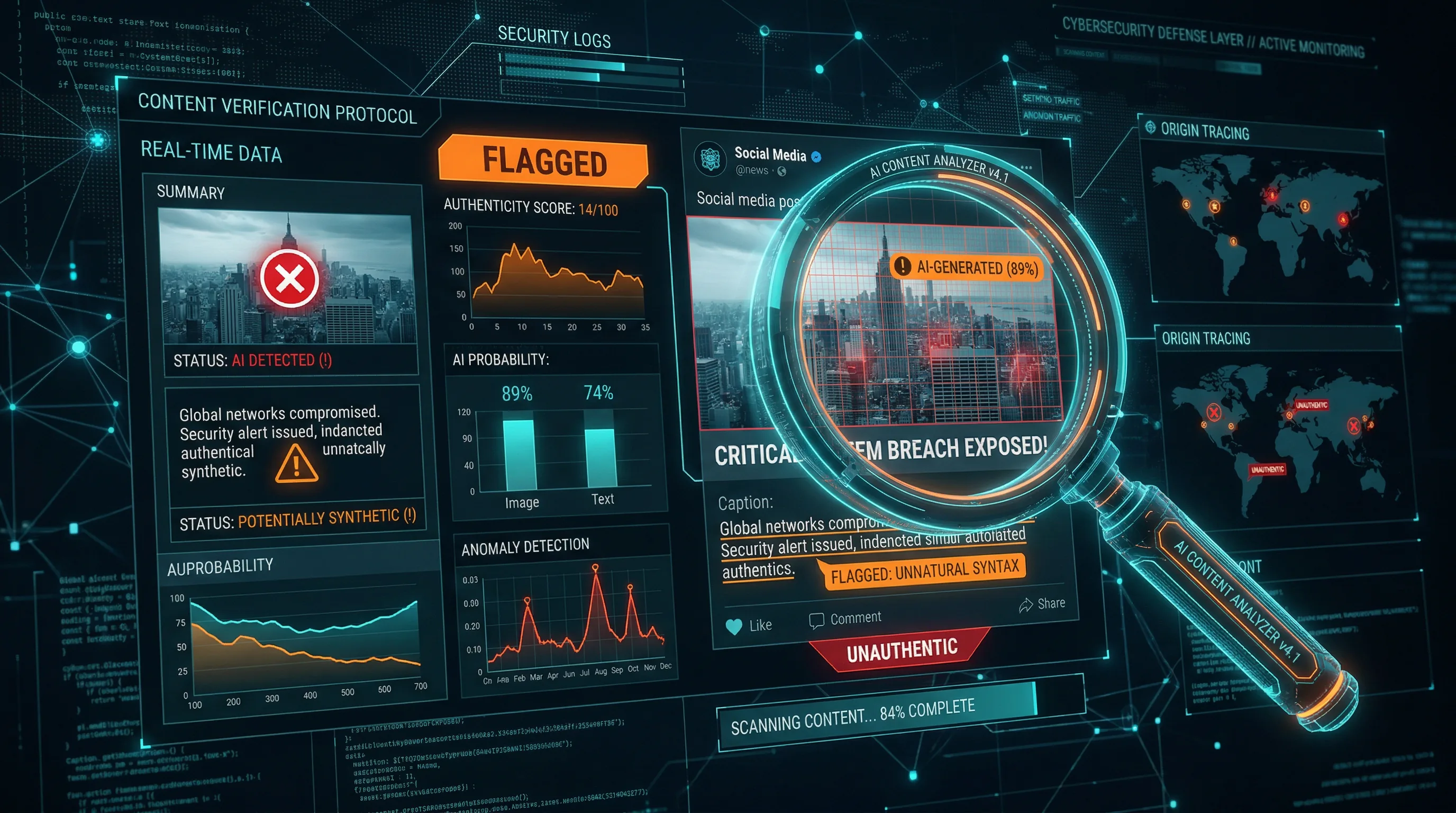
AI content detection is the process of determining whether text, images, or video were created by artificial intelligence — and in 2026, the tools used to do it are everywhere. Schools use them to check student essays. Employers run freelancer submissions through detectors.

The Artifio editorial team publishes research, tutorials, and release notes covering image, video, and audio generation models. All posts are reviewed by an editor before publishing.
AI content detection is the process of determining whether text, images, or video were created by artificial intelligence — and in 2026, the tools used to do it are everywhere. Schools use them to check student essays. Employers run freelancer submissions through detectors. Publishers scan articles before accepting them. But here's the uncomfortable truth: these tools are wrong far more often than most people realize, and the entire concept of "detecting AI" is more nuanced than a simple yes-or-no answer.
This guide covers everything creators need to know about AI detection, content authenticity, and building real trust with audiences — whether you use AI tools or not.
How AI Detection Tools Actually Work
Understanding how these tools function helps explain both their capabilities and their significant limitations. AI detectors don't "read" text the way a human does. Instead, they analyze mathematical patterns in word selection and sentence structure.
Perplexity and Burstiness Scoring
Every detection tool relies on two core metrics. Perplexity measures how predictable text is — AI-generated text tends to have consistently low perplexity because models choose statistically likely word combinations. Burstiness measures variation in sentence complexity — human writers naturally mix short punchy sentences with longer complex ones, while AI output tends to be more uniform.
The problem? Plenty of human writers produce low-perplexity, low-burstiness text. Academic writing, technical documentation, and ESL writers often exhibit patterns that look "AI-like" to these tools. According to Stanford HAI research on AI detection, the overlap between human and AI writing patterns is substantial enough to make definitive classification impossible.
Statistical Pattern Analysis
Beyond perplexity and burstiness, detectors look for broader statistical signatures. These include vocabulary distribution (AI tends to favor certain words), sentence length consistency, paragraph structure patterns, and transition phrase frequency. Each model has subtle "fingerprints" — word choices and patterns that appear more frequently in AI output than in human writing.
Modern detection tools combine multiple statistical signals to produce a probability score. But probability is not certainty. A score of "85% likely AI" still means there's a meaningful chance the content is human-written.
Watermarking and Metadata Detection
Some AI providers now embed invisible watermarks in their output — statistical signatures hidden in word choices or pixel data that are undetectable to humans but readable by specialized tools. This is a fundamentally different approach from pattern analysis: rather than guessing whether content is AI-generated, watermark detection checks for a specific embedded signal.
However, watermarking is far from universal. Not all AI providers roll out it, watermarks can degrade through editing, and the absence of a watermark doesn't prove content is human-written. It's a useful tool in the detection toolkit, but not a complete solution.
The False Positive Problem
If AI detection tools were highly accurate, the conversation would be simpler. They're not. The false positive problem — human content incorrectly flagged as AI-generated — is one of the most significant issues in the detection space.
Why Human Writing Gets Flagged as AI
Several categories of human writing routinely trigger false positives. Non-native English speakers write with simpler vocabulary and more consistent sentence structures, patterns that closely resemble AI output. Technical and scientific writers use precise, predictable language. Writers who naturally favor clear, well-organized prose — ironically, the best communicators — often score higher on AI detection tools.
One widely cited study found that AI detectors misclassified non-native English writing as AI-generated at rates two to three times higher than native English writing. This creates a serious equity issue, particularly in educational contexts.
Impact on Students, Writers, and Businesses
False positives aren't just inconvenient — they carry real consequences. Students have faced academic misconduct charges based solely on AI detector results. Freelance writers have lost clients when their original work was flagged. Employees have been questioned about using AI when they hadn't. The false positive problem in AI detection affects millions of people who never used AI to create their content.
Documented Accuracy Rates of Detection Tools
Independent research consistently shows that AI detection tools achieve 70–90% accuracy under ideal conditions — meaning purely AI-generated, unedited text. When text is edited, mixed with human writing, or paraphrased, accuracy drops significantly. False positive rates typically range from 5% to 20%, depending on the tool and the type of text being analyzed.
These numbers matter. A 10% false positive rate means roughly one in ten pieces of human-written content will be incorrectly flagged as AI-generated. At scale, that's millions of false accusations.
AI Content Oversaturation: The 'AI Slop' Problem
While detection tools struggle with accuracy, a separate but related challenge is reshaping how content works today: the sheer volume of low-quality AI content flooding the internet.
What Content Oversaturation Looks Like
Estimates suggest that AI assists in the creation of 30–50% of online content published in 2026. That's not inherently a problem — AI as a writing tool is like any other technology that increases productivity. The problem is that the vast majority of AI-assisted content is unedited, generic, and adds nothing new to the conversation.
Search results fill with nearly identical AI-generated articles covering the same topics with the same surface-level insights. Social media feeds overflow with AI-generated images. Review sites host fake AI reviews. The AI content oversaturation problem is real, and it's eroding trust in online content broadly.
How It Affects Your Content's Credibility
Even if your AI-assisted content is excellent, you're competing in an environment where audiences are increasingly skeptical. Readers who encounter low-quality AI content develop a reflexive distrust of anything that "sounds AI." This skepticism doesn't distinguish between lazy AI output and carefully crafted AI-assisted work.
Standing Out in an AI-Saturated Market
Paradoxically, the flood of low-quality AI content creates a massive opportunity. When 90% of AI content is generic, the bar for standing out is lower than ever. Content that includes original research, personal experience, genuine expertise, and a distinctive voice immediately separates itself from the noise. As outlined by Google's helpful content guidelines, content quality — not authorship method — determines what gets rewarded.
Building Audience Trust with AI-Assisted Content
Trust isn't about hiding AI use. It's about demonstrating that your content, regardless of how it was created, genuinely serves your audience. The creators who build lasting trust in 2026 are those who lean into transparency rather than running from it.
Transparency: When and How to Disclose
Disclosure requirements are changing rapidly. The EU AI Act mandates disclosure in certain contexts. Major platforms like Meta, YouTube, and TikTok require AI labeling. But beyond legal requirements, proactive disclosure is a trust-building strategy. When you tell your audience "I used AI to help research and draft this article, then reviewed and edited it with my 15 years of industry experience," you're demonstrating confidence in your process. Learn more about navigating AI content disclosure requirements effectively.
Quality Signals That Build Trust
Several quality signals tell audiences your content is worth their time, regardless of AI involvement. Real author bylines with verifiable credentials. Original data or research they can't find elsewhere. Specific examples from firsthand experience. Links to authoritative sources that support your claims. Depth that goes beyond what a quick AI prompt would produce.
These signals work because they demonstrate genuine expertise — something AI can assist with but cannot replace.
The Human-AI Collaboration Model
The most effective approach treats AI as a collaborative tool. Use AI for research synthesis, initial drafting, and formatting. Add your expertise, experience, and editorial judgment. The result is content that's more efficient to produce but still carries the depth and authenticity of human expertise. Artifio empowers this collaboration model — access 100+ models to find the right AI partner for your specific expertise, and produce content that genuinely earns trust.
Explore strategies for building audience trust with AI-assisted content that apply across every content format.
Practical Strategies for Authentic AI Content
Theory is helpful, but you need ready-to-use tactics. Here's how to create AI-assisted content that audiences trust and search engines reward.
Adding Human Elements AI Can't Replicate
The strongest authenticity signal is content that AI simply couldn't produce on its own. This includes:
- Personal experience: "When I implemented this strategy for a client last quarter, here's what happened..."
- Original data: Surveys you conducted, experiments you ran, metrics from your own work
- Expert interviews: Quotes and insights from real conversations with industry practitioners
- Genuine opinions: Positions that go beyond safe, balanced AI-style hedging
- Specific examples: Real-world cases with enough detail that they're clearly not fabricated
These elements make your content uniquely valuable. No amount of AI prompting can replicate your lived experience.
Quality Over Volume
One of the biggest mistakes creators make is using AI to dramatically increase publishing volume. The math is tempting: if AI cuts production time by 70%, you could publish five times more content. But the oversaturation problem shows what happens when everyone does this — a sea of mediocre content that nobody trusts.
Instead, use AI-enabled time savings to invest in quality. Spend the time you save on deeper research, better editing, and adding those human elements that make content irreplaceable. One exceptional piece outperforms ten generic ones every time.
Building a Content Authenticity Strategy
Document your content standards and apply them consistently. Define what "quality" means for your brand. Specify the role AI plays in your workflow. Create editing checklists that confirm every piece meets your authenticity standards before publishing. Consistency builds trust over time — audiences learn to expect quality from your content.
Look ahead at how the future of AI content authenticity will shape what audiences expect from creators in the years ahead.
How to Choose the Right Detection Strategy for Your Organization
If you're in a position where you need to evaluate AI content — as an editor, teacher, or content manager — the key is choosing an approach that's fair, accurate, and productive.
Multi-tool approach: Never rely on a single detection tool. Run content through at least two or three different detectors and look for consensus. If all three flag content as AI-generated, the probability is higher (though still not certain). If results are mixed, the content likely falls in the gray zone where no definitive determination is possible.
Quality evaluation first: Before reaching for a detection tool, evaluate the content on its merits. Does it meet your quality standards? Is it accurate? Does it provide genuine value? If the answer is yes, does it ultimately matter whether AI was involved? Many organizations are finding that quality-first evaluation serves their actual goals better than detection-first approaches.
Process verification: Instead of scanning finished content for AI signatures, require process documentation. Ask creators to provide outlines, drafts, and revision history. This approach is more reliable than detection tools and doesn't suffer from false positive issues. A documented human writing process is much harder to fake than AI detection is to evade.
Transparent disclosure policies: The most effective approach may be the simplest: require honest disclosure of AI use and evaluate content on quality. Create clear policies about acceptable AI use in your context, and judge content by whether it meets your standards rather than by how it was produced. This approach is fair, efficient, and aligned with the direction the broader industry is moving.
Remember that the purpose of any detection strategy should be quality assurance, not punishment. The goal is ensuring that published content meets your standards — not catching people using tools. When the strategy focuses on quality rather than policing, everyone benefits: better content for audiences, clearer expectations for creators, and less time spent on unreliable detection.
The Role of Multi-Format Content in Authenticity
One underappreciated strategy for demonstrating authenticity is creating content across multiple formats. A blog post alone can be replicated by AI. But a blog post accompanied by a video where you discuss the topic on camera, an audio podcast where you answer listener questions, and social media engagement with your community — that combination is difficult to fake.
Multi-format content also serves audiences who prefer different consumption methods. Some readers scan articles. Others prefer video. Others listen to podcasts during commutes. By meeting audiences where they are in the format they prefer, you build deeper relationships and more resilient trust.
The Path Forward for AI Content Creators
AI content detection and authenticity will remain evolving challenges. Detection tools will improve but may never achieve near-perfect accuracy. Regulations will expand. Audience expectations will rise. The creators who thrive will be those who treat authenticity as a feature rather than a constraint.
The winning formula isn't complicated: use AI tools to enhance your productivity, add genuine expertise and experience to every piece, be transparent about your process, and prioritize quality over volume. In a world drowning in generic AI content, authenticity is the ultimate competitive advantage.
Artifio supports this approach with access to 100+ AI models across text, image, audio, video, and avatars — giving you the tools to create multi-format content that stands out through quality, not just quantity.
Detection Tools: What They Can and Cannot Do
The market for AI detection tools has exploded. Schools subscribe to them. Publishers integrate them. Clients run freelancer work through them. But the capabilities of these tools are routinely overstated, and understanding their real limitations protects you from both false confidence and false accusations.
Detection tools work on probability, not certainty. When a tool says "95% AI-generated," it's not measuring authorship — it's measuring how closely text patterns match its statistical model of AI output. That model was built by analyzing known AI and human text, but the boundary between categories is inherently fuzzy. Text that was genuinely written by a careful, methodical human can score identically to AI text on every metric these tools measure.
The Paraphrasing Problem
One of the most significant limitations of detection tools is their vulnerability to paraphrasing. When AI text is paraphrased — either by a human editor or by a second AI tool — detection accuracy drops sharply. Light paraphrasing (changing individual words) reduces detection rates modestly. Heavy paraphrasing (restructuring sentences, changing examples, altering tone) can make AI text essentially undetectable.
This creates a fundamental problem: the detection tools are most accurate against the laziest AI use (unedited, copy-pasted output) and least accurate against the most conscientious AI use (heavily edited, human-enhanced output). The very people who should be penalized least — those who put genuine work into editing and improving AI drafts — are the ones most likely to pass detection. Meanwhile, the people adding the most value to AI output are the hardest to distinguish from pure human writing.
Different Tools, Different Results
Run the same text through five different AI detection tools and you'll often get five different results. One tool might say "90% AI," another "60% AI," and a third "likely human." This inconsistency reflects the subjective nature of the detection task — there's no ground truth that all tools agree on.
For creators, this means no single detection result should be taken at face value. And for anyone using detection tools as evidence (teachers, editors, clients), multiple tools should be consulted and even then treated as suggestive, not definitive.
The Ethical Dimension of AI Detection
Beyond accuracy, AI detection raises fundamental ethical questions about authorship, creativity, and what we value in content.
Policing Tools vs. Improving Quality
The industry's focus on detection often misses the point. Investing in tools to catch AI users is inherently reactive and adversarial. A more productive approach invests in content quality standards that apply regardless of authorship. If content meets your quality, accuracy, and originality requirements, does it matter whether a human typed every word or used an AI tool to draft and then significantly edited?
The most forward-thinking organizations are shifting from "did they use AI?" to "does this content meet our standards?" This reframing changes the conversation from adversarial policing to collaborative quality improvement.
The Transparency Alternative
Instead of playing a cat-and-mouse game with detection tools, the industry is moving toward transparency. Voluntary disclosure of AI use, paired with quality standards, creates a more honest and productive ecosystem. When creators are upfront about their tools and the work they put into quality, audiences can make informed judgments based on the content itself rather than suspicion about its origin.
This approach also eliminates the equity concerns inherent in detection — no more ESL students falsely accused, no more formal writers flagged incorrectly, no more gatekeeping based on unreliable technology.
Frequently Asked Questions
How accurate are AI content detectors?
Most AI detection tools achieve 70–90% accuracy under ideal conditions, with significant false positive rates of 5–20%. They work better on pure AI text and worse on heavily edited or mixed human-AI content. No detector is definitive.
Can AI detection tools flag human-written content?
Yes. Non-native English speakers, technical writers, and anyone with a formal writing style are frequently flagged as AI. This is a known limitation. AI detectors should never be used as sole evidence of AI authorship.
Should I disclose that I used AI to create content?
Increasingly, yes. Some jurisdictions require disclosure. Even where not required, proactive transparency builds trust. Frame AI as a tool you used — similar to spell-check or a calculator — rather than something to hide.
What is AI content slop?
AI slop refers to low-effort, mass-produced AI content that floods platforms without adding value. It's generic, unedited, and often inaccurate. The term highlights the quality problem of AI content at scale without human oversight.
How do I make AI content that audiences trust?
Add genuine expertise: personal experience, original data, expert interviews, and authentic opinions. These elements can't be replicated by AI alone. Quality and depth signal trustworthiness more than the authorship method.
Will Google penalize AI-generated content?
Google doesn't penalize content for being AI-generated. It penalizes low-quality content regardless of how it's made. AI content that demonstrates expertise, satisfies search intent, and provides value ranks just as well as human-written content.
Create AI Content That Earns Trust
With Artifio's 100+ models across text, image, audio, video, and avatars, you can find the right AI partner for content that's authentic, high-quality, and genuinely valuable. Stop blending in with generic AI output — start creating content that stands out.