AI Content Watermarking: How Invisible Signatures Track AI-Generated Content
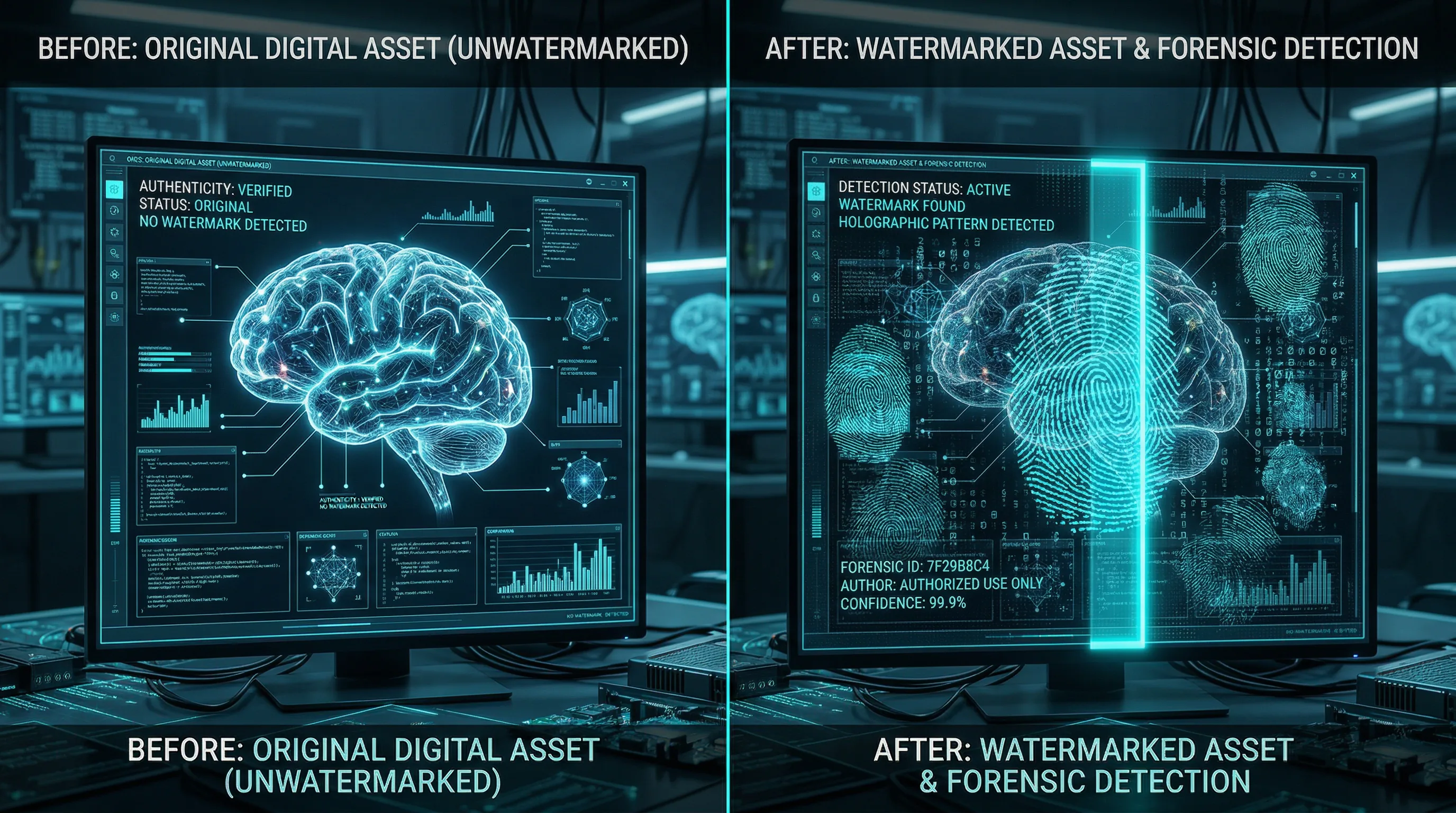
AI content watermarking is the practice of embedding invisible digital signatures into AI-generated text, images, audio, and video so that the content's origin can be identified later.

The Artifio editorial team publishes research, tutorials, and release notes covering image, video, and audio generation models. All posts are reviewed by an editor before publishing.
AI content watermarking is the practice of embedding invisible digital signatures into AI-generated text, images, audio, and video so that the content's origin can be identified later. Major AI providers are now building these invisible markers directly into their output — and as a creator, understanding how watermarking works helps you make informed decisions about your tools and content strategy.
How AI Watermarking Works
Watermarking techniques vary significantly across content types. Each approach embeds information differently, with different strengths and limitations.
Text Watermarking: Statistical Fingerprints
Text watermarking is subtle and clever. Instead of inserting visible markers, the watermarking system slightly adjusts the probability distribution of word choices during text generation. For example, when the AI faces a choice between two equally valid words ("big" vs. "large"), the watermark system biases toward one option based on a hidden pattern.
These adjustments are imperceptible to human readers — both words work perfectly in context. But when analyzed with the corresponding detection tool, the pattern of word choices reveals a statistical fingerprint. It's like a secret code hidden in otherwise normal text.
The limitation? Heavy editing, paraphrasing, or rewriting can destroy text watermarks because the specific word choices that carry the signal get replaced.
Image Watermarking: Pixel-Level Signatures
Image watermarks work differently. They modify pixel values at levels invisible to the human eye — tiny changes to color values, frequency-domain adjustments, or noise patterns that are imperceptible visually but detectable by software. Think of it as hiding data in the "noise" of an image that humans filter out naturally.
Image watermarks tend to be more solid than text watermarks. They can survive moderate resizing, compression, and cropping. However, significant editing, applying filters, or converting between formats can degrade or remove them.
Video and Audio Watermarking
Audio watermarks use spectral embedding — hiding information in frequencies that are either inaudible to humans or masked by the primary audio content. Video watermarks typically combine image-level techniques applied per frame with temporal patterns across frame sequences.
Both audio and video watermarking are more complex than text or image approaches because the content is temporal — it changes over time. This creates both more hiding places for watermark data and more opportunities for the watermark to be disrupted by editing.
Who's Applying AI Watermarks
The watermarking ecosystem is growing rapidly, driven by both voluntary initiatives and regulatory pressure.
Major Provider Initiatives
Several major AI providers have implemented or announced watermarking programs. Google's SynthID watermarks images and text from its AI models. Other major providers have similar programs at various stages of deployment. The specifics of each deployment differ — some watermark all output automatically, others make it configurable.
Worth flagging: not all providers watermark their output. The landscape is fragmented, and coverage is far from universal.
Industry Standards Development
The C2PA (Coalition for Content Provenance and Authenticity) is developing open standards for content provenance — including but not limited to AI watermarking. C2PA standards create a broader framework for tracking content creation history, combining watermarking with metadata and digital signatures.
C2PA members include major technology companies, media organizations, and camera manufacturers. Their standards aim to create an interoperable system where content provenance can be verified across platforms and tools. This is the most promising path toward industry-wide consistency.
What Watermarking Means for Content Creators
As a creator using AI tools, watermarking affects your workflow in several practical ways.
Impact on Edited and Remixed Content
If you generate an AI image and then edit it significantly — cropping, adding text overlays, color grading, compositing with other elements — the watermark may partially or fully degrade. The same applies to text that you substantially rewrite. This means heavily edited AI content may not carry detectable watermarks, even if the original output was watermarked.
For many creators, this is the normal workflow. You generate a starting point, then transform it into something substantially different. The watermark question becomes less relevant the more you edit and transform the original AI output.
Watermark Persistence and Removal
Some watermarks are designed to be strong — surviving compression, resizing, format changes, and moderate editing. Others are more fragile. The robustness depends on the specific watermarking technique used by each provider.
Deliberately removing watermarks may violate the terms of service of the AI tool you're using. But it's also important to know that watermark removal through normal editing (not deliberate circumvention) is generally not a terms-of-service issue. When you use multiple models through Artifio, understanding each provider's watermarking approach helps you make informed choices for your content strategy.
Practical Implications for Your Workflow
For most creators, watermarking shouldn't change your workflow significantly. Continue creating, editing, and publishing as normal. Be aware that some of your AI-generated content may carry watermarks, and factor this into your disclosure decisions. Our guide on AI content disclosure requirements explains when and how to disclose AI use.
The Future of AI Content Provenance
Watermarking is part of a broader trend toward content provenance — tracking the creation history of digital content from origin to publication.
Expect more standardized approaches across the industry as C2PA and similar initiatives mature. Platforms are likely to integrate provenance checking into their publishing tools. Regulations like the EU AI Act may eventually require provenance tracking for certain content types.
For creators, this trend favors transparency. If content provenance becomes standard, being upfront about your AI use becomes natural rather than optional. Creators who build transparent practices now — documenting their process, disclosing AI use, and focusing on quality — will be well-positioned for a future where provenance tracking is the norm. Our article on AI detection false positives provides additional context on how the detection and provenance landscape keeps moving.
Watermarking and Your Content Rights
A common concern among creators: does a watermark in AI-generated content affect your ability to use that content? The short answer is no — watermarks are about provenance identification, not ownership restriction. A watermarked AI-generated image can still be used in your content, edited, shared, and published according to the AI tool's normal terms of service.
However, the intersection of watermarking and content rights is worth understanding. Some AI providers' terms of service grant different rights for different use cases. Watermarks may serve as evidence in potential copyright or intellectual property disputes. And as regulations evolve, watermark status may factor into compliance requirements.
For most creators, the practical impact is minimal. Continue creating content as normal. Be aware that some of your AI-generated content carries watermarks. Factor this into your disclosure decisions. And stay informed as the regulatory environment evolves.
The content credentials movement — which includes watermarking as one component — represents a broader shift toward transparency in digital content. Rather than viewing this as surveillance, forward-thinking creators see it as validation: your content has a verifiable creation history that demonstrates your process and protects your work.
Creators who embrace provenance tracking gain a trust advantage. When you can demonstrate your content creation process — including which AI tools were used and how human expertise was applied — you build credibility that opaque content operations can't match.
Comparing Watermarking Approaches
Not all watermarking implementations are created equal. Understanding the differences helps you make informed decisions about your AI tool selection.
Provider-embedded watermarks are built into the model's generation process. They're typically more reliable because they're woven into the content at creation time. However, they're also provider-specific, meaning different tools use different (and often incompatible) watermarking systems.
Post-processing watermarks are applied after content is generated. They can be added to any content but may be less well-built because they're applied as an overlay rather than embedded in the generation process.
Standard-based watermarks follow industry standards like C2PA, aiming for interoperability across platforms and tools. These represent the future of content provenance but are still in relatively early adoption. As the standards mature and adoption grows, they'll provide the most reliable and universal provenance tracking.
Frequently Asked Questions
Do AI tools add watermarks to generated content?
Some do. Major providers like Google have implemented watermarking for text and images. Implementation varies by provider — some watermark all output, others make it optional. Check your provider's policies.
Can I remove AI watermarks?
Some watermarks are thorough against modification, while others degrade with editing. Heavy editing, reformatting, and remixing can remove certain types of watermarks. However, attempting to remove watermarks may violate terms of service.
Are AI watermarks visible?
No. AI watermarks are designed to be invisible to humans. Text watermarks work by subtly influencing word choices. Image watermarks are embedded in pixel data imperceptible to the human eye. They're only detectable by specialized tools.
Will AI watermarks affect my content quality?
Properly implemented watermarks should have no perceptible impact on content quality. Text watermarks make microscopic adjustments to word probabilities. Image watermarks use changes below the threshold of human perception.
Do I need to worry about AI watermarks?
Not in terms of content quality. Watermarks are about provenance and transparency. If you're using AI ethically and disclosing appropriately, watermarks simply provide additional verification of what you're already being transparent about.
Stay Ahead of AI Content Trends
Artifio gives you access to 100+ models from 20+ providers with full transparency into your content creation process. Stay informed, stay transparent, and create with confidence.