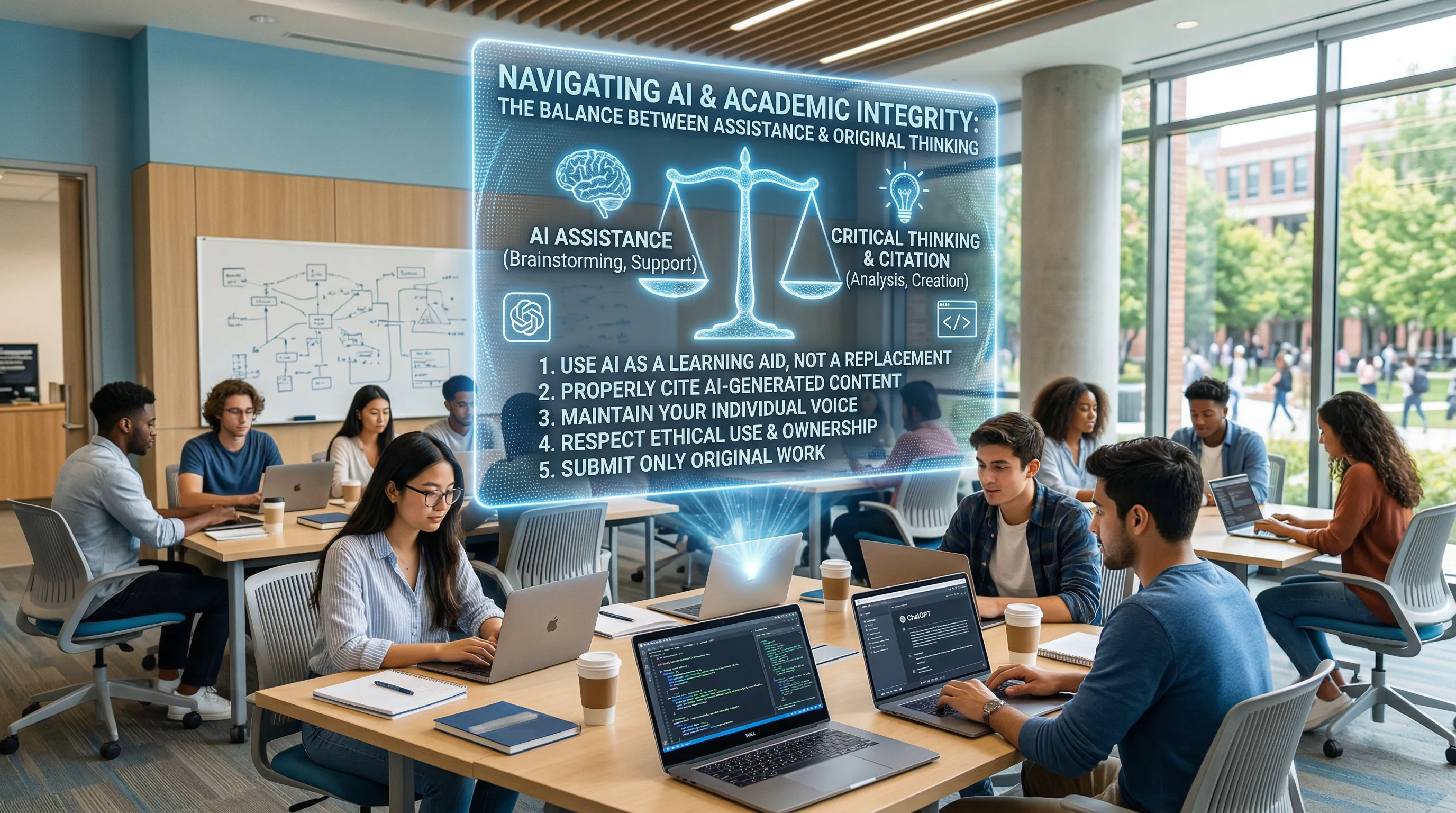
AI Content in Education: Navigating Detection, Disclosure, and Academic Integrity
AI content in education sits at the intersection of technology, learning, and academic integrity — and the landscape is still being sorted out. Schools scramble to create policies. Teachers rely on detection tools that frequently give wrong results. Students get caught in the crossfire.

The Artifio editorial team publishes research, tutorials, and release notes covering image, video, and audio generation models. All posts are reviewed by an editor before publishing.
AI content in education sits at the intersection of technology, learning, and academic integrity — and the landscape is still being sorted out. Schools scramble to create policies. Teachers rely on detection tools that frequently give wrong results. Students get caught in the crossfire. This guide helps educators and learners navigate AI content tools, detection accuracy, and integrity in a moving fast academic environment.
The AI Detection Problem in Education
Academic institutions have adopted AI detection tools aggressively, but the tools themselves carry significant limitations that many educators don't fully understand.
Why School AI Detectors Are Unreliable
The AI detectors used in academic settings have the same fundamental limitations as all AI detection tools. They measure statistical patterns in text — perplexity and burstiness — and make probabilistic guesses about authorship. Under ideal conditions (pure, unedited AI text), accuracy reaches 70–90%. But in real academic contexts, conditions are rarely ideal.
Students use a mix of their own writing, AI assistance, research material, and peer feedback. The resulting text doesn't fit neatly into "human" or "AI" categories. Detection tools forced into a binary classification produce unreliable results for this meshed content. Our in-depth guide to AI content detection explains the technical reasons in detail.
The consequences of false positives in education are particularly severe: failing grades, academic misconduct charges, and damaged records that follow students for years. Using a tool with a 10–20% false positive rate to make these high-stakes decisions is, frankly, irresponsible.
Disproportionate Impact on Non-Native Speakers
Research consistently shows that AI detectors flag non-native English speakers at dramatically higher rates. According to guidance from UNESCO's AI in education initiative, this creates a significant equity issue. ESL students already face additional academic challenges; being falsely accused of AI cheating adds an unfair burden.
The technical reason is straightforward: non-native English writers tend to use simpler vocabulary, more consistent sentence structures, and more predictable grammatical patterns — exactly the characteristics that AI detectors associate with machine-generated text. A well-written ESL essay and an AI-generated essay can look statistically identical to these tools, even though one represents genuine human effort and learning.
Building Ethical AI Policies
The most forward-thinking institutions are moving from detection-focused approaches to policy-based frameworks that acknowledge AI as a reality of modern academic life.
What Leading Institutions Are Doing
Progressive universities and school systems are adopting nuanced approaches:
- Clear AI use policies: Defining exactly what AI assistance is acceptable for each assignment type
- Tiered permission levels: Some assignments allow AI for brainstorming but not drafting; others allow drafting but require disclosure; some prohibit AI entirely
- Emphasis on process over product: Requiring students to submit outlines, drafts, and revision history alongside final work
- AI literacy curriculum: Teaching students how to use AI tools effectively and ethically as a core skill
This approach acknowledges that AI is a tool students will use throughout their careers. Teaching them to use it responsibly is more valuable than trying to catch them using it.
Frameworks for Appropriate AI Use
A practical framework defines AI use on a spectrum:
- Level 0 — No AI: The student completes all work independently. Appropriate for exams and core competency assessments.
- Level 1 — AI for ideation: Students can use AI for brainstorming and outlining. All writing is their own.
- Level 2 — AI for assistance: AI can be used for grammar checking, proofreading, and research support. Writing is primarily the student's.
- Level 3 — AI as collaborator: Students can use AI for drafting with full disclosure. The final work reflects significant human editing and original thought.
- Level 4 — AI as tool: Full AI use is permitted. Assessment focuses on the student's ability to use AI effectively, evaluate output, and demonstrate understanding.
Each assignment is labeled with its AI permission level, removing ambiguity. Students know exactly what's expected, and teachers evaluate accordingly.
AI as a Learning Tool, Not a Shortcut
The most productive framing of AI in education isn't about cheating prevention — it's about learning enhancement.
How AI Can Enhance Learning
AI genuinely excels at several educational functions:
- Concept explanation: AI can explain complex topics in multiple ways until the student understands
- Practice generation: Creating custom practice problems, quizzes, and exercises
- Feedback provision: Giving detailed feedback on drafts and writing
- Research assistance: Helping students find relevant sources and synthesize information
- Language learning: Providing conversational practice and grammar correction
When used this way, AI acts as a tireless tutor that supplements teacher instruction. Platforms like Artifio that offer transparent, pay-as-you-go access make it easy for educational institutions to provide controlled AI access for legitimate learning purposes.
Where AI Use Undermines Learning
AI becomes counterproductive when it replaces the cognitive work that constitutes learning:
- Having AI write an essay skips the critical thinking the assignment was designed to develop
- AI-generated lab reports bypass the scientific reasoning students need to practice
- Using AI to answer homework questions without engaging with the material defeats the purpose of practice
The distinction is clear: using AI to learn more is good. Using AI to learn less is harmful. The framing matters for both policy and student guidance.
Practical Guidelines for Students
If you're a student navigating AI use, here's your practical guide:
- Check your institution's policy first. AI policies vary dramatically between schools, departments, and individual professors. Always know the rules before you start.
- Document everything. Keep your outlines, drafts, research notes, and revision history. If your work is ever questioned, this evidence proves your process.
- Use AI for learning, not avoidance. Ask AI to explain concepts you don't understand. Don't ask it to write the assignment.
- Disclose when required. If the policy asks for AI disclosure, provide it honestly. Specificity helps: "I used AI to brainstorm topic ideas and check grammar" is better than vague disclosure.
- Be prepared to demonstrate understanding. If questioned, being able to discuss your work in depth proves it's genuinely yours, regardless of what any detector says.
For more on how AI detection false positives affect students, see our detailed breakdown of the detection accuracy problem.
Resources for Educators Navigating AI
The AI-in-education conversation is moving fast, and staying informed requires ongoing engagement with the right resources.
Professional organizations including the International Society for Technology in Education (ISTE), the National Education Association (NEA), and discipline-specific bodies are publishing and regularly updating AI guidance. These resources reflect the collective thinking of educators who are working through the same challenges you face.
Peer institution policies provide practical frameworks. Many universities and school districts publish their AI policies publicly. Reviewing how peer institutions approach AI use gives you both practical templates and comparative context for your own policy development.
Student perspectives matter too. Surveys consistently show that students are using AI tools at higher rates than most institutions realize. Understanding their actual usage patterns — rather than assumed patterns — leads to more realistic and effective policies. Anonymous surveys of your own students provide the most relevant data.
The key insight from institutions that have navigated this successfully: policies that students understand, believe are fair, and can follow without ambiguity produce the best outcomes. Policies that are overly restrictive, vaguely worded, or inconsistently enforced tend to encourage circumvention rather than compliance.
The most effective institutional approaches treat AI literacy as a core competency — something students should learn, not something they should avoid. This framing shifts the conversation from discipline to education, which is where schools operate most effectively.
The Future of AI in Classroom Practice
Looking ahead, the most likely trajectory for AI in education is integration rather than prohibition. Just as calculators evolved from "banned" to "required" in math classes, AI tools are likely to follow a similar path in writing and content creation.
Forward-thinking educators are already designing assignments that incorporate AI as a tool. "Use AI to generate three different perspectives on this topic, then write a critical analysis evaluating which perspective is best supported by evidence" teaches critical thinking, AI literacy, and subject matter knowledge simultaneously.
Assessment design is in flux too. Process-based assessment — evaluating how students develop ideas, not just the final product — naturally accommodates AI use while still measuring genuine learning. Oral defenses, portfolio reviews, and iterative reflection assignments are harder to fake with AI and better at measuring understanding.
Frequently Asked Questions
Can teachers detect AI-generated essays?
Teachers and AI detection tools can often identify fully AI-generated essays, but accuracy drops significantly for edited AI content. Detection should never be the sole basis for academic misconduct charges due to high false positive rates.
Is using AI for school assignments cheating?
It depends on your institution's policy and the assignment's purpose. Many schools now permit AI with disclosure for brainstorming, editing, and research. Using AI to generate work you submit as entirely your own typically violates academic integrity policies.
How should schools handle AI content?
Leading institutions are creating clear AI use policies, teaching responsible AI skills, redesigning assessments to evaluate understanding over output, and treating AI as a tool to be mastered rather than an adversary to be defeated.
Are AI detectors biased against ESL students?
Research suggests yes. Non-native English speakers are flagged at higher rates because their writing patterns (simpler vocabulary, more consistent structure) resemble AI output. This is a significant equity concern in academic AI detection.
What's the future of AI in education?
Most experts predict a shift toward AI literacy and integration rather than prohibition. Students who learn to use AI tools effectively and ethically will be better prepared for workplaces where AI is standard.
AI for Learning Done Right
Whether for learning or creating, AI works best with the right tools. Explore Artifio's transparent, affordable platform for educational content creation — pay only for what you use, with no hidden surprises.