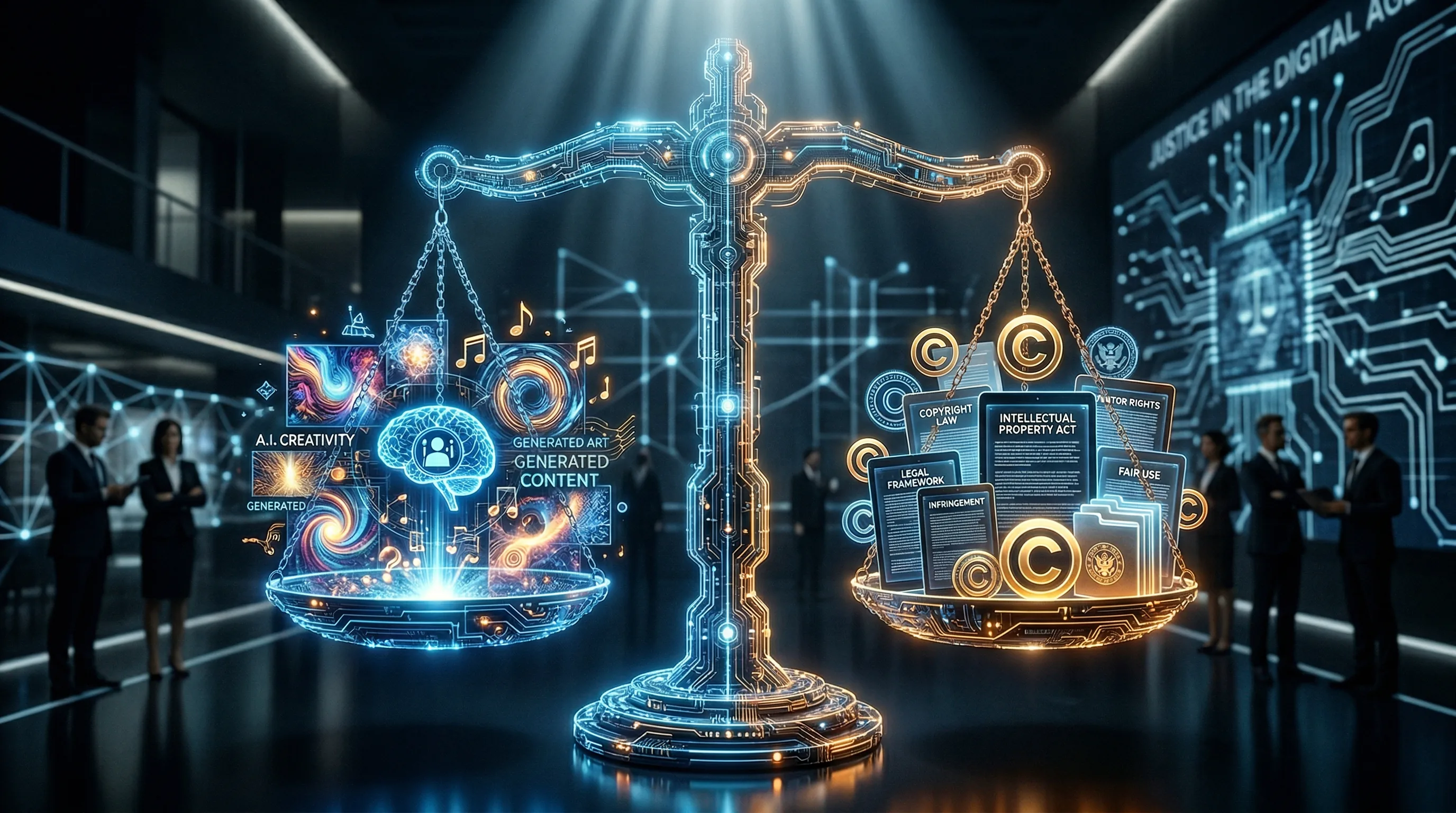
AI Content Copyright and Legal Issues: The Complete Guide for Creators in 2026
Who owns AI-generated content? In most jurisdictions today, pure AI-generated output lacks copyright protection because copyright law requires human authorship. But the full picture is far more nuanced.

The Artifio editorial team publishes research, tutorials, and release notes covering image, video, and audio generation models. All posts are reviewed by an editor before publishing.
Who owns AI-generated content? In most jurisdictions today, pure AI-generated output lacks copyright protection because copyright law requires human authorship. But the full picture is far more nuanced. As AI content creation explodes — with millions of images, articles, and videos generated daily — the legal situation is shifting rapidly. Creators who don't understand these shifts risk significant financial exposure, lost intellectual property rights, and potential lawsuits they never anticipated.
This complete guide breaks down everything you need to understand about AI content copyright, intellectual property ownership, and the legal risks of publishing AI-generated work in 2026. If you're a freelancer generating blog posts, an agency producing client deliverables, or a marketing team scaling content production, this is the legal foundation every AI-powered creator needs to build a sustainable, legally sound content practice.
Copyright and AI: The Current Legal Framework
Can AI Content Be Copyrighted?
Under current U.S. law, pure AI-generated work likely cannot be copyrighted. The U.S. Copyright Office AI registration guidance consistently holds that copyright requires human authorship — a principle rooted in the Constitution's protection of human creative expression. In its most significant ruling, the Office denied registration for an image created entirely by AI, stating it lacked the human authorship copyright demands.
But this didn't close every door. The Office has clearly signaled that the degree of human involvement is the critical factor — not simply whether AI was used in the creation process. This distinction between "purely AI-generated" and "AI-assisted" content is now the most important legal dividing line in the AI creative industry. AI-assisted works where humans provide significant creative direction, carefully select from many generated outputs, and edit substantially have a much stronger case for protection under existing law.
This isn't an academic question. It determines whether you can legally prevent others from copying your work, whether you can register works for federal protection, what legal recourse exists if someone uses your content without permission, and whether your creative output enjoys the same protections as traditionally created work. For any creator building a business on AI-generated content, understanding this framework is foundational.
The Human Authorship Requirement
Copyright law compares AI output to natural phenomena: a sunset is beautiful but isn't "authored." A photograph of that sunset is copyrightable because the photographer made creative choices — framing, timing, lens selection, exposure settings, post-processing decisions. The sunset itself receives no protection; the photographer's creative choices do.
Applied to AI content, this creates a spectrum of protection possibilities:
- Minimal human input (simple prompts like "write a blog post about dogs") — almost certainly not copyrightable because human creative contribution is negligible
- Moderate human input (detailed prompts specifying style, tone, structure, audience, and examples) — gray area that courts and the Copyright Office haven't fully resolved
- Substantial human input (detailed creative direction, careful selection from dozens of outputs, significant editing and rewriting, creative arrangement into a larger work) — strongest case for copyright protection
- AI as one tool among many (AI for initial drafts that humans substantially rewrite, restructure, and enhance) — final work very likely copyrightable because human contribution dominates
The degree of human involvement is everything. Think sliding scale, not binary switch. The more documented human creative choices you can demonstrate — and the more those choices shaped the final work's character and expression — the stronger your legal position becomes.
Key Court Cases and Rulings
The "Zarya of the Dawn" graphic novel case established a crucial precedent: individual AI-generated images weren't copyrightable, but human-authored text and creative arrangement of the overall work were protected. This framework for "mixed" works is critical because most professional AI content is exactly that — a combination of human and AI contributions.
Additional rulings reinforced human authorship requirements while leaving room for substantial human direction to qualify. Courts are considering whether highly detailed prompts with iterative refinement constitute sufficient creative contribution. The judicial trend appears to recognize more forms of human involvement as protectable, but universal standards haven't crystallized.
Meanwhile, training data litigation tests whether AI companies can legally use copyrighted works for model training without permission. These major cases involve publishers, artists, and musicians. Their outcomes will reshape AI content law for decades. Every creator using AI tools has a stake in these proceedings.
Ownership of AI-Generated Content
Who Owns What You Generate?
Content ownership has three layers most creators overlook: copyright law (can the work be protected?), platform terms of service (what contractual rights do you have?), and employment or client contracts (who owns AI content created during work?). Even without copyright, platform terms may grant exclusive usage rights or commercial licenses providing real practical value. Understanding AI platform terms of service is essential for every professional creator.
Platform Terms of Service
Every platform handles ownership differently. Some grant full ownership and unrestricted commercial rights. Others retain broad licenses to use, display, and sublicense your content. Some differentiate by subscription tier — paid users get substantially more generous terms. Review output ownership clauses, commercial restrictions, exclusivity provisions, training data policies, and termination effects before committing your workflow to any platform. The few minutes this review takes prevents expensive surprises.
Work-for-Hire and Employee Considerations
Work-for-hire doctrine generally means employers own AI-generated output created during employment. Smart organizations are updating employment agreements to address AI usage explicitly. Freelancers should disclose AI usage in contracts and clarify ownership. Teams and agencies need clear internal policies addressing ownership, attribution, quality standards, and client disclosure to prevent confusion and protect business relationships.
Legal Risks of AI Content Creation
Defamation and Misinformation Liability
AI models hallucinate — generating plausible but entirely false information about real people and companies. Published AI content containing defamatory statements makes you legally liable. "The AI wrote it" provides no defense. High-risk areas include biographical content with fabricated quotes or criminal history, business descriptions with false claims, health content with dangerous misinformation, financial advice with inaccurate guidance, and legal information with fabricated citations. Put in place rigorous fact-checking workflows for every piece before publication. For specialized domains, see guides on AI medical content safety and AI financial content accuracy.
Trademark Infringement Risks
AI trained on internet data generates output that can include or mimic existing trademarks, brand names, slogans, and visual elements. Review all AI output for unintended trademark references in commercial content. Liability falls on you as publisher regardless of how the infringing content was generated. This risk is especially high in marketing copy, product descriptions, and visual content where brand elements appear frequently in training data.
Right of Publicity Concerns in AI Images
AI image generators create images resembling real people — sometimes deliberately, sometimes accidentally from training data patterns. Using someone's likeness without permission violates right of publicity laws in most states. Avoid prompts targeting specific real people and review all generated images for unintentional likenesses, especially for commercial use. Understanding AI image copyright and ownership is crucial for visual content creators.
International AI Content Law
The EU AI Act and European Approach
The EU AI Act imposes mandatory labeling and disclosure requirements for AI-generated content with substantial penalties calculated as percentages of global revenue. Crucially, it applies to anyone whose content reaches EU audiences regardless of where the creator is located. If your blog, social media, or marketing materials have European readers, EU regulations apply. For jurisdiction-by-jurisdiction requirements, see AI disclosure laws around the world.
Other Global Jurisdictions
The UK includes provisions for "computer-generated works" — more accommodating than the U.S. position. Canada is developing its framework. China has rulings suggesting certain AI content may be protectable. For international audiences, comply with the most restrictive applicable law and maintain transparent disclosure practices across all jurisdictions where your content appears.
Protecting Your AI-Assisted Content
Documenting Your Creative Contribution
Documentation is everything for strengthening copyright claims. Build evidence files demonstrating human creative contribution: detailed creative briefs and instructions, iteration records showing selection decisions from multiple outputs, editorial documentation of every revision and rewrite, arrangement decisions for combining elements, and all original content you personally added. Artifio's platform provides clear records of which models you used and when, supporting documentation of your creative process for potential legal purposes. This transparent attribution forms the foundation of legal protection claims.
Registering AI-Assisted Works
The Copyright Office now requires disclosure of AI involvement in registration applications. Full transparency about AI assistance combined with documented human contributions is the recommended approach. Works with significant human editorial input, creative arrangement, and original additions have increasingly strong registration prospects as the legal framework develops and precedent accumulates.
Best Practices for Legal Protection
Beyond copyright, protect AI-assisted content through explicit ownership contract clauses, published terms of use on your website, consistent brand building for market recognition, speed-to-market advantage, trade secret protection for prompt libraries and workflows, and NDAs when sharing creative processes with staff or contractors. These practical protections work regardless of copyright status and provide meaningful defense in the current uncertain legal environment.
Compliance Checklist for AI Content Creators
Apply this checklist before publishing any AI-generated content:
- Review platform ToS — Confirm commercial usage rights for your tier and content type
- Check disclosure requirements — Verify labeling obligations for your jurisdiction and platform
- Fact-check all claims — Verify every statement about real people and organizations
- Scan for trademark issues — Check for unintended brand references in text and images
- Review images for likenesses — Make sure no resemblance to identifiable real people
- Document creative process — Record human contributions for potential disputes
- Run plagiarism checks — Verify output doesn't reproduce copyrighted training data
- Consider legal counsel — For high-stakes content, consult a qualified IP attorney
The interplay between AI content and plagiarism concerns, liability insurance considerations, and evolving copyright law creates complexity that benefits from professional legal guidance. Invest in counsel now to prevent far more expensive problems later.
Building a Sustainable AI Content Legal Strategy
Beyond individual compliance checks, creators need a long-term legal strategy for AI content. This means establishing relationships with IP attorneys who understand AI law, setting up systematic documentation processes that capture your creative contributions automatically, and creating internal policies that scale as your content production grows. The creators who invest in legal infrastructure now will have significant advantages as the rules crystallizes.
Consider forming or joining creator coalitions that advocate for clear, fair AI content laws. The current legal ambiguity hurts everyone — creators, platforms, and audiences alike. Industry associations, professional organizations, and advocacy groups are actively working to shape the legal framework. Having a voice in these conversations protects your interests and helps build a legal environment that supports responsible AI content creation.
Monitor legislative developments at federal, state, and international levels. AI content law is shifting faster than almost any other legal domain. Subscribe to legal newsletters focused on IP and technology law, follow relevant Congressional committees and regulatory agencies, and attend industry conferences where legal experts discuss emerging trends. The investment in staying informed prevents costly surprises and positions you to adapt quickly when new rules take effect.
Build relationships with other creators navigating the same legal landscape. Shared experiences, practical tips, and collective advocacy create value that no individual creator can achieve alone. Online communities, professional associations, and industry events provide opportunities to learn from others' experiences and share your own insights about navigating AI content law effectively.
The Business Case for Legal Compliance
Legal compliance isn't just about avoiding penalties — it's a competitive advantage. Clients increasingly ask about AI content practices, disclosure policies, and legal compliance. Creators who can demonstrate systematic compliance practices win business over those who can't articulate their legal position. Documentation of your creative process, clear disclosure practices, and proactive compliance create trust that translates directly into revenue.
Insurance providers are beginning to differentiate pricing based on AI content practices. Creators with documented compliance workflows, fact-checking processes, and disclosure protocols may qualify for lower premiums. Building these practices now creates both legal protection and financial benefit as the insurance market develops specific products for AI content creators.
The bottom line: investing in legal compliance for AI content isn't a cost center — it's a business strategy that reduces risk, builds client trust, improves content quality, and positions you favorably in an increasingly regulated market. The creators who treat legal compliance as a core business practice rather than an afterthought will thrive as the AI content industry matures.
Looking Ahead: AI Copyright in 2027 and Beyond
The AI copyright landscape will look significantly different by 2027. Several pending court cases will have produced rulings that establish clearer precedent for how AI-generated content is treated under intellectual property law. Legislative action at both federal and state levels will likely introduce new requirements for AI content registration, disclosure, and ownership documentation. International harmonization efforts may begin producing frameworks that align disparate national approaches to AI content regulation.
The Copyright Office is expected to issue more detailed guidance on the human authorship threshold, potentially providing specific criteria that define what level of human creative contribution qualifies AI-assisted works for registration. This guidance will give creators much clearer standards to work toward when building copyright protection for their AI-assisted content. Early adoption of documentation practices positions you to meet whatever standards emerge.
AI platforms themselves will likely evolve their terms of service in response to legal developments, potentially offering more creator-friendly ownership provisions as competition for professional users intensifies. Platforms that provide clear ownership rights, transparent data practices, and well-built documentation features will have competitive advantages in attracting serious content creators. The market is already moving in this direction, with platforms like Artifio leading on transparency and creator rights.
The most important thing creators can do right now is build habits that will serve them regardless of how how the law works here develops. Document your creative process. Maintain transparent disclosure practices. Invest in original creative contributions that add value beyond what AI can generate alone. These practices protect you today and prepare you for whatever tomorrow's legal framework requires. The creators who invest in building these foundations now will be the ones best positioned when clearer rules emerge.
Practical Steps You Can Take Today
Don't wait for the legal picture to crystallize before taking action. Several steps you can apply immediately strengthen your legal position regardless of how AI copyright law develops. First, start documenting your creative process for every significant AI-assisted project. Keep a simple log of your prompts, the creative decisions behind them, how many outputs you reviewed, why you selected specific results, and what edits you made. This documentation habit takes minutes per project and builds a valuable evidence file over time.
Second, review the terms of service for every AI platform you use regularly. Focus on the five critical areas outlined in this guide: content ownership, data training usage, commercial rights, terms change notification, and cancellation policies. If any terms concern you, look for alternatives or negotiate enterprise terms that better protect your interests. Understanding your contractual rights is the most immediate, hands-on step you can take.
Third, establish a disclosure practice that exceeds current minimum requirements. Proactive transparency about AI involvement protects you against future disclosure mandates and builds audience trust now. A simple standard practice — noting AI assistance in your editorial process — costs nothing and creates goodwill that compounds over time. The creators who embrace transparency early will have significant trust advantages as disclosure expectations become universal.
Fourth, consider consulting an intellectual property attorney for a brief review of your AI content practices. A single consultation can identify risks you haven't considered, suggest documentation improvements, and provide peace of mind about your current approach. Many IP attorneys now offer specific AI content consultations tailored to creators and content businesses. The investment is modest compared to the value of informed, legally sound content practices.
Frequently Asked Questions
Who owns AI-generated content?
It depends on jurisdiction, the degree of human creative involvement, and the platform's terms of service. The U.S. Copyright Office requires human authorship for copyright protection. Pure AI output may not be copyrightable, but content with significant human creative direction — detailed prompting, careful selection, substantial editing — may qualify for protection. Platform terms also grant contractual usage rights regardless of copyright status.
Can I copyright AI-generated images?
Possibly. If you provided significant creative direction through detailed prompts, selected carefully from many generated options, and made substantial post-generation edits, the human creative contribution may qualify for copyright protection. Pure AI generation without meaningful human input likely isn't protectable. The Copyright Office evaluates each case on its specific facts and the demonstrable degree of human involvement.
Am I liable for AI-generated content?
Yes, absolutely. You're legally responsible for content you publish regardless of how it was created. This includes liability for defamation, misinformation, trademark infringement, and all other legal issues present in AI-generated output. "The AI wrote it" provides no defense in any jurisdiction. Publishers are responsible for what they publish, period.
Do I need to disclose AI-generated content?
Increasingly, yes. The EU AI Act mandates certain disclosures with significant penalties for non-compliance. Major social media and publishing platforms have their own AI content labeling requirements. Some industries and jurisdictions mandate disclosure. When in doubt, disclose — the reputational damage from discovered undisclosed AI use far outweighs any perceived benefit of concealment.
Can AI-generated content infringe copyright?
Potentially. AI models may generate content that closely resembles copyrighted works from their training data. This area is under active litigation with several major pending cases that could set definitive precedent. Running AI output through plagiarism detection tools before publication is a prudent standard practice for all professional creators using AI tools.
What should be in my AI content legal policy?
A in-depth policy should include platform ToS review procedures, mandatory human editorial review for published content, systematic fact-checking workflows, disclosure protocols for various publishing contexts, clear liability ownership rules, creative process documentation standards, and a schedule for quarterly review as laws and industry standards continue to evolve rapidly.
Create with clarity and confidence. Artifio's transparent platform helps you document your AI content creation process and stay compliant. With clear model attribution and usage tracking across 100+ AI models, you always know exactly what tools you used and when — building the documentation foundation that legal protection requires. Start creating responsibly today.