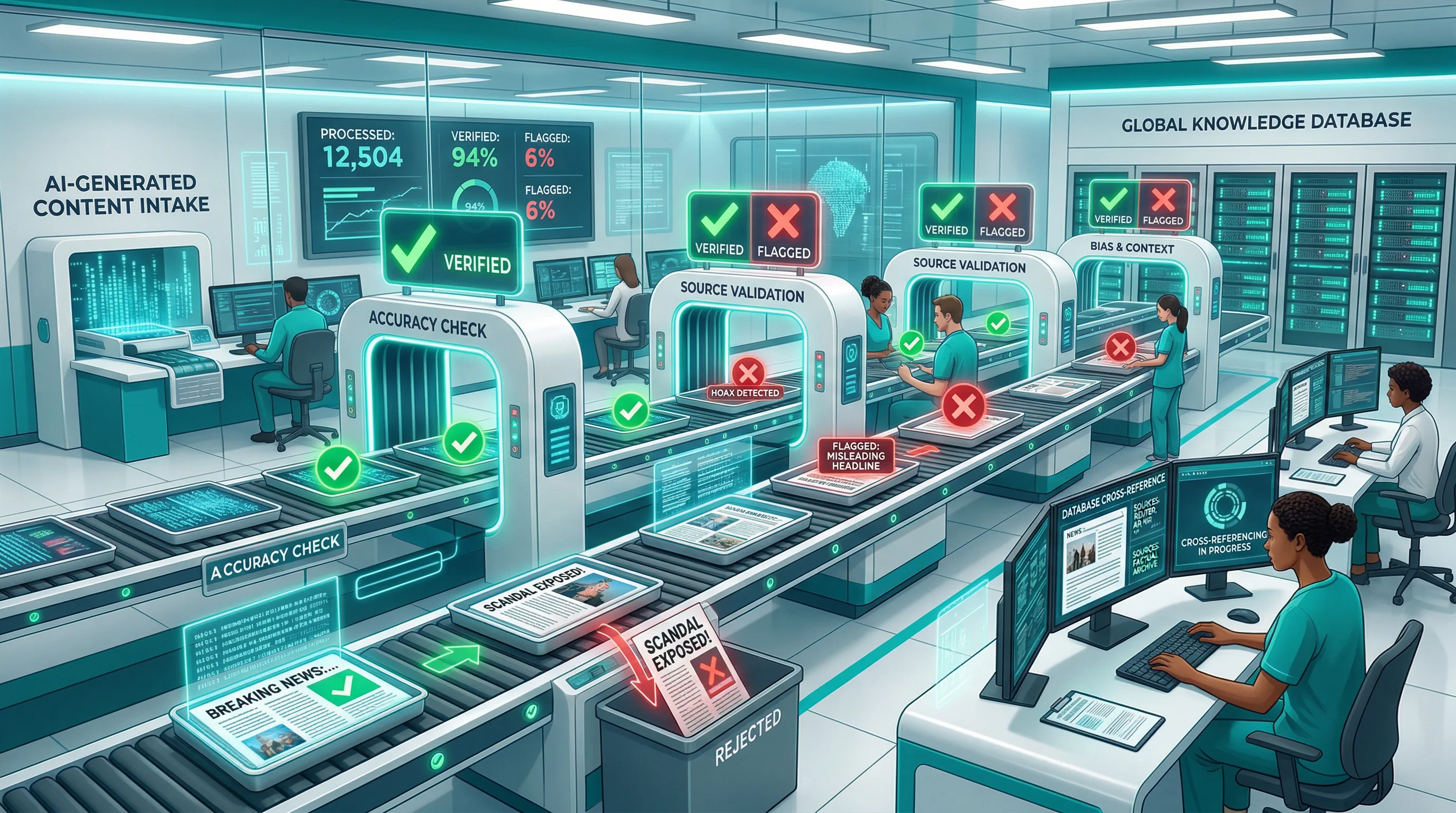
The AI Content Fact-Checking Workflow: Catch Errors Before They Damage Your Reputation
AI content fact-checking is the systematic process of verifying every factual claim in AI-generated text before publication. Every piece of AI-generated content contains potential inaccuracies — from subtly wrong dates to completely fabricated statistics.

The Artifio editorial team publishes research, tutorials, and release notes covering image, video, and audio generation models. All posts are reviewed by an editor before publishing.
AI content fact-checking is the systematic process of verifying every factual claim in AI-generated text before publication. Every piece of AI-generated content contains potential inaccuracies — from subtly wrong dates to completely fabricated statistics. The question isn't whether to fact-check; it's how to do it efficiently without negating the time savings AI provides. This workflow balances thoroughness with speed.
Why Standard Editing Isn't Enough for AI Content
If you're editing AI content the same way you edit human writing, you're missing the most dangerous errors.
How AI Errors Differ from Human Errors
Human writers make typos, grammatical mistakes, and logical inconsistencies. These errors are usually visible — a misspelled word, an awkward sentence, a paragraph that contradicts the one before it. Standard proofreading catches them effectively.
AI errors are fundamentally different. AI fabricates entire facts with perfect grammar and coherent logic. A sentence like "According to a 2024 McKinsey report, 73% of enterprises have adopted AI in at least one business function" reads perfectly. The grammar is fine. The source is plausible. The statistic sounds right. But the specific number, the specific year, or even the entire claim might be fabricated. Standard proofreading would pass this without hesitation.
The Confidence Problem
The core challenge is that AI presents true and false information with identical confidence. There are no stylistic tells, no hedging language, no subtle signals that a claim is uncertain. As explained in our in-depth guide to AI hallucinations, this uniform confidence makes every factual claim suspect until verified.
This means fact-checking AI content requires a different mindset than editing human writing. With human content, you trust by default and investigate anomalies. With AI content, you verify by default and trust after confirmation.
The 4-Step Fact-Checking Process
This workflow is designed to be thorough but efficient. With practice, it adds 15–30 minutes to a 2,000-word article — a worthwhile investment for content you'll publish under your name.
Step 1: Flag All Factual Claims
Read through the entire AI output and highlight every statement that could be verified or falsified. This includes:
- Statistics and percentages
- Specific dates and timelines
- Named individuals and their attributed actions or quotes
- Named organizations and their attributed positions
- Claims about laws, regulations, or policies
- Technical specifications or scientific claims
- Historical events and their details
Don't evaluate yet — just flag. You'll prioritize in the next step. For a 2,000-word article, expect 15–30 flagged claims.
Step 2: Verify High-Risk Claims First
Not all claims carry equal risk. Prioritize verification based on potential consequences:
- Highest priority: Specific statistics, direct quotes, academic citations, medical/legal/financial claims
- High priority: Historical dates, named people or organizations, technical specifications
- Medium priority: General industry trends, widely-known facts, established concepts
- Lower priority: General knowledge, common sense claims, opinion statements
Start with the highest-risk claims. If time is limited, these are the non-negotiable verifications. Reference the International Fact-Checking Network standards for professional verification principles that apply to all content.
Step 3: Check Sources and Citations
If the AI output includes any citations or source references, verify each one independently. Search the exact paper title in Google Scholar. Check DOIs at doi.org. Visit cited URLs directly. Read our detailed guide on spotting AI fabricated sources for the full verification methodology.
Remember: AI frequently constructs citations that look perfect — real journal names, plausible paper titles, reasonable dates — but are entirely fabricated. The more specific and authoritative a citation looks, the more important it is to verify.
Step 4: Cross-Reference Against Authority Sources
For key claims that anchor your content's arguments, verify against at least two independent, authoritative sources. Use primary sources whenever possible: government data portals for statistics, official company reports for business data, and peer-reviewed research for scientific claims.
If a claim can only be found in other AI-generated content or in sources that themselves lack citations, that's a major red flag. The claim may have originated as an AI hallucination that's been replicated across the web.
Tools That Speed Up AI Fact-Checking
Manual fact-checking is essential, but several tools and techniques can make the process more efficient.
Search-Based Verification
Google remains the fastest verification tool. Copy a specific claim or statistic, put it in quotes, and search. If it returns authoritative primary sources that confirm the claim, you're good. If it only returns AI-generated articles making the same unsourced claim, that's a warning sign.
Cross-Model Verification
One of the most powerful fact-checking techniques is using a different AI model to critique the first model's output. Generate content with one model, then prompt a second model: "Review this content for factual accuracy. For each specific claim (statistics, dates, sources), evaluate whether it appears accurate or potentially fabricated."
Artifio's multi-model platform is ideal for cross-model verification — generate with one model, fact-check with another, all in the same dashboard. This catches errors that either model alone would miss. See our guide to cross-model verification for the detailed setup.
Automated Fact-Check Services
Emerging AI fact-checking services can scan content and flag claims that appear unsupported or statistically unlikely. These are supplements to human verification, not replacements. They're useful for quickly identifying the highest-risk claims in long documents.
Building Fact-Checking Into Your Content Pipeline
The most effective approach makes fact-checking a required step in your content workflow, not an optional add-on.
Make it mandatory: No AI-generated content publishes without completing the verification workflow. This is a non-negotiable rule. Build it into your content calendar and time estimates.
Track hallucination rates: Keep a simple log of how many hallucinations you catch per piece, per model, and per topic. Over time, patterns emerge — you'll learn which models are more reliable for which topics and where to focus your verification effort.
Create a red flag list: Document topics where your AI models hallucinate most frequently. For some teams, this might be recent statistics. For others, it might be technical specifications or legal details. Your red flag list tells you where to spend the most verification time.
Common Fact-Checking Shortcuts (and Why They Fail)
Many creators develop fact-checking habits that feel thorough but leave significant gaps. Knowing these common pitfalls helps you avoid them.
"It sounds right" is not verification. The most common shortcut is reading an AI-generated claim, thinking "that sounds about right," and moving on. This is precisely how hallucinations survive into published content. AI-generated claims sound right by design — the model is optimized to produce plausible-sounding text. Sounding right and being right are completely different things.
Finding the claim elsewhere online isn't sufficient. If you Google an AI-generated statistic and find it on another website, that doesn't mean it's verified. The other website may also have gotten it from AI. AI-generated "facts" can spread through the internet as multiple AI-generated articles reference the same fabricated claim, creating a false consensus. Always trace claims to primary sources: the original study, report, or dataset.
Checking one fact doesn't validate the rest. Some creators verify the first few claims in an article, find them accurate, and assume the rest are fine. This is sampling bias. AI hallucination isn't uniform — the model might get 90% of claims right and hallucinate the remaining 10% randomly throughout the piece. Every verifiable claim needs individual attention.
Using the same AI model to verify is circular. Asking the model that generated a claim to confirm it is not verification — it's asking the model to agree with itself. Always use independent sources (or at minimum, a completely different AI model) for verification. This is why cross-model verification is so valuable for content teams.
The 15–30 minutes required for proper fact-checking of a 2,000-word article is a small investment compared to the potential cost of publishing hallucinated content under your name or brand.
Frequently Asked Questions
How do I fact-check AI-generated content?
Flag every factual claim (statistics, dates, names, quotes). Verify high-risk claims first using search engines and authoritative sources. Check that all cited sources actually exist and say what's claimed. Use a second AI model to critique the first.
How long does fact-checking AI content take?
For a 2,000-word article, budget 15–30 minutes for fact-checking. This varies based on the topic's complexity and the density of factual claims. Factual topics (science, history, statistics) take longer than opinion or how-to content.
What AI facts are most likely to be wrong?
Specific statistics and percentages, direct quotes attributed to real people, academic citations, historical dates, and claims about current events. The more specific the claim, the more likely it needs verification.
Can I use AI to fact-check AI?
Partially. A different AI model can identify claims that seem suspicious and flag potential inaccuracies. But AI can't be the sole fact-checker — it may confirm another model's hallucination. Always verify critical claims against human-curated sources.
What happens if I publish AI content with false information?
Consequences range from audience trust damage and SEO impact to legal liability, depending on the context. In regulated industries (health, finance, legal), publishing false AI-generated claims can have serious legal implications.
Build Accuracy Into Your AI Workflow
Explore Artifio's multi-model platform and use cross-model verification to catch errors before they go live. With 100+ models at your fingertips, you always have a second opinion ready.