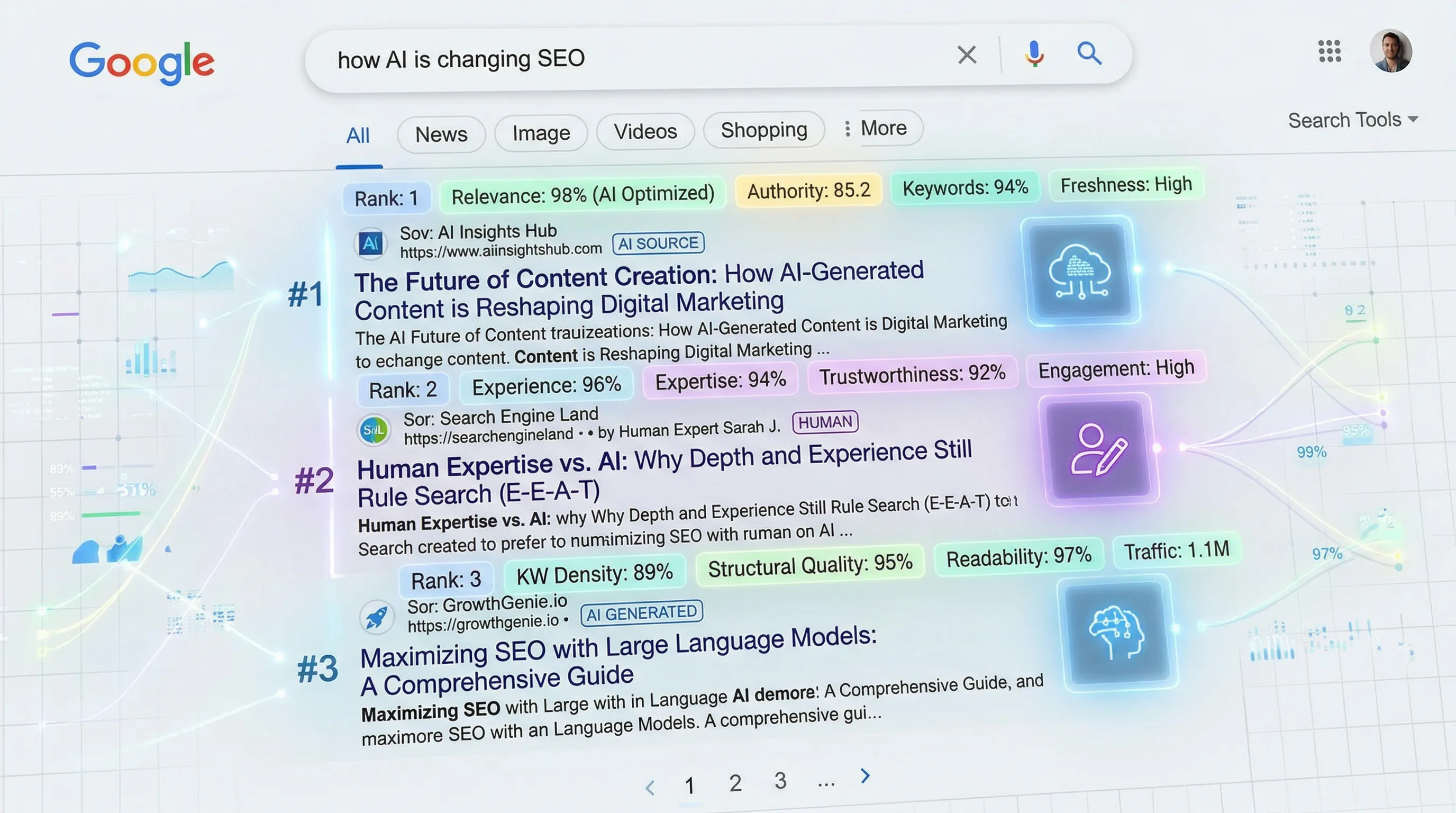
How Google Treats AI Content in 2026: Ranking Factors, Penalties, and Best Practices
Google does not penalize AI-generated content for being AI-generated. It penalizes low-quality content regardless of how it was made. That distinction matters enormously for every creator and marketer using AI tools.

The Artifio editorial team publishes research, tutorials, and release notes covering image, video, and audio generation models. All posts are reviewed by an editor before publishing.
Google does not penalize AI-generated content for being AI-generated. It penalizes low-quality content regardless of how it was made. That distinction matters enormously for every creator and marketer using AI tools. The question isn't "can AI content rank?" — it's "what does your AI content need to rank?" Here's the complete breakdown of how Google treats AI content in 2026.
Google's Official Position on AI Content
Google has been surprisingly clear on this topic, and their position has been consistent since they first addressed it publicly.
The Helpful Content Update and AI
According to the Google Search Central blog on AI content, Google's ranking systems "aim to reward high-quality content, however it is produced." They explicitly state that automation — including AI — has long been used to generate helpful content, and their focus is on the quality of content, not how it's produced.
The Helpful Content system evaluates whether content is genuinely useful to the person who searched for it. Content that exists primarily to rank in search (rather than to help people) is devalued. This applies equally to human-written content farms and AI-generated content farms. The authorship method is irrelevant; the quality and intent matter.
E-E-A-T for AI-Assisted Content
Google's E-E-A-T framework — Experience, Expertise, Authoritativeness, and Trustworthiness — remains the quality evaluation framework for all content. For AI-assisted content, this means:
- Experience: Does the content demonstrate firsthand experience with the topic? AI can't provide this alone.
- Expertise: Does it show deep knowledge? AI can approximate this, but genuine expertise requires human editing and verification.
- Authoritativeness: Is the author or site recognized as an authority? This is built through consistent quality over time.
- Trustworthiness: Is the content accurate, transparent, and reliable? This requires rigorous fact-checking of AI output.
AI-assisted content can absolutely demonstrate E-E-A-T — but only when a real expert layers their knowledge and experience onto the AI-generated foundation. See our guide to AI content authenticity for how to build that authentic expertise layer.
What Actually Causes AI Content to Lose Rankings
If Google doesn't penalize AI content, why do some AI-heavy sites lose rankings? Because they're creating low-quality content at scale.
Low-Quality Mass Production
Sites that use AI to publish hundreds of articles per week, with minimal editing, on topics they have no expertise in — these are the sites losing rankings. The pattern is clear: massive volume + minimal quality investment = ranking decline. This would happen with human-written content mills too. AI just makes it faster to produce low-quality content at scale.
Thin Content Without Expertise
AI excels at producing technically accurate summaries of existing information. It struggles to add anything new. When every article on a topic says the same thing in slightly different words, none of them provides unique value to searchers. Google's systems increasingly identify and devalue this kind of "commodity content" — information that's widely available and undifferentiated.
Duplicate and Redundant Content
When thousands of sites use similar AI prompts to create articles on the same topics, the output is remarkably similar. Google has no reason to rank the 500th version of the same information. If your AI content doesn't add something the existing top results don't, it has no ranking proposition. Check our guide on standing out in an AI-oversaturated market for strategies to differentiate.
How to Rank AI-Assisted Content
AI-assisted content can rank on page one — and many top-ranking pages use AI in their creation process. Here's what makes the difference.
Demonstrating Real Expertise
Include firsthand experience in your content. Case studies from your actual work. Specific examples with real details. Insights from your professional experience that no AI prompt would produce. This signals to Google (and readers) that genuine expertise backs the content.
Adding Original Value
Ask yourself: what does my content offer that the current top 10 results don't? If the answer is "nothing," you won't rank. Original value comes from unique data, proprietary research, expert interviews, novel frameworks, contrarian perspectives backed by evidence, and practical experience. Using Artifio's diverse model library to generate higher-quality initial drafts means more time for the expertise layer that Google rewards.
Technical SEO for AI Content
Standard technical SEO still matters regardless of content authorship:
- Page speed: Fast-loading pages rank better. Keep AI-generated content lean.
- Mobile optimization: Responsive design is non-negotiable.
- Structured data: Schema markup helps Google understand your content's context.
- Internal linking: Connect related content to build topical authority.
- Image optimization: Alt text, compression, and proper formatting for any AI-generated visuals.
Building Authority Signals
Real author bylines with credentials. An "About" page that establishes your expertise. Links from authoritative sites in your niche. Consistent publishing that demonstrates ongoing engagement with your topics. These authority signals support E-E-A-T and apply to all content, AI-assisted or not.
AI Content SEO Checklist
Before publishing any AI-assisted content, run through this checklist:
- ☐ All factual claims verified against authoritative sources
- ☐ Original value added (data, experience, unique insight) beyond what top results offer
- ☐ Real author byline with relevant credentials
- ☐ Content satisfies the search intent thoroughly (not just partially)
- ☐ Engaging, natural writing that doesn't read like generic AI output
- ☐ Internal links to related content on your site
- ☐ External links to authoritative sources
- ☐ Proper structured data markup
- ☐ Optimized title tag, meta description, and URL
- ☐ Mobile-friendly and fast-loading
- ☐ Appropriate AI disclosure if applicable
Every item on this list applies to human-written content too. That's the point — Google evaluates quality, not authorship.
Common Misconceptions About Google and AI Content
Misinformation about Google's approach to AI content leads many creators to make poor decisions. Let's address the most common misconceptions directly.
Misconception: "Google can detect all AI content." Reality: Google has never confirmed using AI detection as a ranking signal. They focus on content quality evaluation. Even if they could detect AI content (their capability is undisclosed), detection alone would not trigger ranking penalties — quality evaluation would.
Misconception: "I need to 'humanize' AI content to rank." Reality: "Humanizing" tools that paraphrase AI output to avoid detection don't add value. They just rearrange words. Google rewards content that adds value — not content that disguises its origin. Your time is better spent adding genuine expertise than running content through paraphrasing tools.
Misconception: "Publishing more AI content means more traffic." Reality: Publishing more low-quality content — whether AI or human — typically hurts rather than helps. Google's helpful content system evaluates your entire site. A site with 1,000 thin AI articles may rank worse overall than a site with 100 excellent ones. Quality beats quantity consistently.
Misconception: "AI content can't rank for competitive keywords." Reality: AI-assisted content can absolutely rank for competitive keywords when it meets quality standards. The competitive advantage comes not from the tool but from the expertise, originality, and value you add. Many top-ranking pages in competitive niches use AI in their creation process.
The fundamental truth hasn't changed: create content that genuinely helps the person who searched for it. Do that consistently, and rankings follow — regardless of your tools.
Building an AI Content SEO Strategy That Lasts
Rather than optimizing for today's algorithm, build a content strategy that aligns with Google's long-term direction — which has consistently rewarded quality, expertise, and user value.
Topical authority over individual posts: Build depth in specific topic areas rather than publishing scattered content across many topics. A site that's deeply authoritative on three topics will outrank a site that covers thirty topics superficially. AI makes it tempting to cover everything — resist this temptation.
Update and maintain existing content: AI makes it easy to create new content, but updating existing content often provides better SEO value. Refresh outdated statistics, add new insights, and improve underperforming sections. Google rewards content that stays current.
Build genuine authority signals: Earn backlinks through original research and insights. Develop real author expertise and credentials. Create content worth citing. These authority signals are becoming more important as AI makes it easier to produce commodity content.
Frequently Asked Questions
Does Google penalize AI-generated content?
Google does not penalize content for being AI-generated. It penalizes low-quality content regardless of how it's made. AI content that demonstrates expertise, provides original value, and satisfies search intent can rank just as well as human-written content.
Can AI content rank on the first page of Google?
Yes. Many top-ranking pages use AI assistance in their creation process. The key factors are content quality, relevance, expertise, and user satisfaction — not whether AI was involved in the writing process.
How does Google detect AI content?
Google has not publicly confirmed using AI detection as a ranking signal. Their approach focuses on content quality evaluation rather than authorship detection. Poor quality is penalized whether it's AI-written or human-written.
Should I add a disclaimer about AI use for SEO?
Google doesn't require AI disclaimers for ranking purposes. However, transparency can support trustworthiness (part of E-E-A-T). Some jurisdictions and platforms do require disclosure, which may indirectly affect your content's perception.
What E-E-A-T signals should AI content have?
Real author bylines with credentials, original data or research, firsthand experience, links to authoritative sources, and evidence of genuine expertise. These signals demonstrate the human expertise that AI drafts lack on their own.
Rank Higher with Better AI Drafts
Artifio's 100+ models let you find the perfect starting point for content that Google and readers both love. Better models, better first drafts, more time for the expertise that drives rankings.