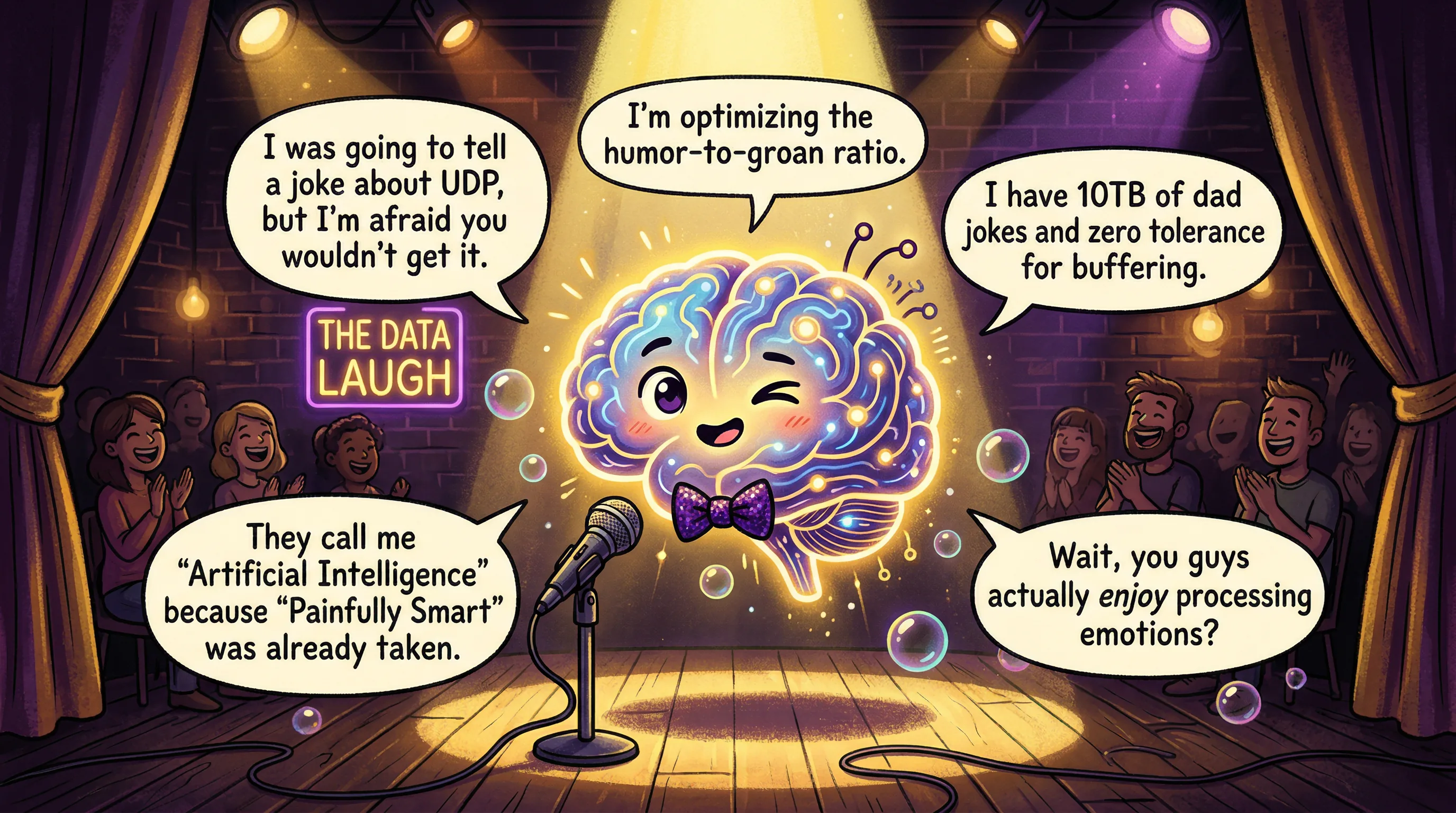
Can AI Write Humor? How to Get Sarcasm, Wit, and Nuance from AI Tools
AI writing humor and sarcasm is one of the trickiest challenges in content creation because humor relies on shared human experience, timing, and cultural context — things that language models approximate but rarely master.

The Artifio editorial team publishes research, tutorials, and release notes covering image, video, and audio generation models. All posts are reviewed by an editor before publishing.
AI writing humor and sarcasm is one of the trickiest challenges in content creation because humor relies on shared human experience, timing, and cultural context — things that language models approximate but rarely master. If you've ever asked AI to "write something funny" and received a dad joke followed by an explanation of why it's funny, you know exactly how awkward this gets. But with the right techniques, you can coax genuinely witty content from AI tools.
This guide covers why AI struggles with humor, which types of comedy AI handles best, and specific prompting techniques that produce content your readers will actually enjoy.
Why AI Fails at Humor (and What It Gets Right)
AI's relationship with humor is complicated. It's not uniformly terrible — it just has very specific strengths and blind spots.
The Mechanics AI Can Mimic
AI can replicate humor that follows recognizable patterns and structures:
- Wordplay and puns: AI is surprisingly good at puns because they rely on linguistic patterns
- Unexpected juxtapositions: "A data scientist walks into a bar and orders 1.73 beers because they're always trying to find the root"
- Lists with a twist: Setting up a pattern and breaking it in the final item
- Ironic observations: Pointing out contradictions in everyday situations
- Self-aware tech humor: AI writing about AI's own limitations can be genuinely funny
These forms of humor work because they have mathematical structure — patterns that can be identified and replicated statistically. Research at institutions like the MIT Media Lab has explored how computational models process and generate humor, finding that structure-based comedy is the most replicable.
What Makes Humor Hard for AI
The forms of humor AI struggles with are the ones that require understanding beyond language:
- Timing: Knowing when to deliver a punchline, when to pause, when to let silence do the work
- Cultural context: References that only work if you share a specific cultural background
- Shared experience: "You know that feeling when..." requires actually having felt something
- Genuine surprise: AI tends to telegraph its jokes because it follows predictable patterns
- Sarcasm: Saying the opposite of what you mean conflicts directly with AI's training to be accurate and helpful
Sarcasm is particularly difficult because it requires intent to communicate the opposite of the literal meaning. AI's entire training pushes it toward literal accuracy. Asking it to be intentionally inaccurate for comedic effect creates a fundamental conflict.
Prompting Techniques for Funnier AI Output
The key insight: don't ask AI to "be funny." Ask it to use specific comedic structures and reference specific styles.
Reference Specific Comedic Styles
Vague instructions produce vague results. Compare:
- Bad prompt: "Write a funny blog post about working from home."
- Better prompt: "Write about working from home using dry British humor — understated observations, deadpan delivery, and the assumption that everything is slightly absurd. Think of someone describing chaos while remaining perfectly composed."
Specific style references give the model a clear target. Other effective style descriptors: "Nora Ephron-style observational wit," "self-deprecating humor," "sardonic commentary," or "absurdist office humor."
The Setup-Punchline Framework
Rather than asking AI to generate complete jokes, use it as a comedy writing partner. You write the setup (which requires human judgment about what's relatable). AI generates punchline options (which require pattern recognition).
Prompt: "I'm writing about the irony of AI content creators worrying about AI replacing them. Give me 10 punchline options for this observation that use ironic understatement."
You'll get a mix of duds and gems. That's fine — professional comedy writers use the same process. Generate 10 options, use the best one, discard the rest.
Using AI for Wit, Not Stand-Up
AI excels at embedded wit — clever observations woven into otherwise informational content — rather than stand-alone comedy. This is actually what most content creators need.
You don't need AI to write a comedy special. You need it to add a clever aside to your email marketing guide, a witty comparison in your product description, or an engaging opening line for your LinkedIn post.
Prompt for embedded wit: "Write an informational paragraph about email open rates, but include one clever observation or unexpected comparison that makes the reader smile. The humor should be subtle, not forced."
Best AI Models for Creative and Humorous Writing
Model selection matters enormously for humor. Some models are noticeably more playful, creative, and willing to take risks with language than others.
Models trained with more diverse creative writing data — including fiction, humor columns, social media, and informal communication — tend to handle humor better than models primarily trained on formal text.
Larger models generally produce more nuanced humor because they've seen more examples of successful comedy in their training data and can draw more subtle connections.
Artifio's model library spans 100+ options — some are surprisingly good at wit and wordplay. Test a few with the same humor prompt and you might find a model that actually makes you laugh. The differences between models in creative ability are often much larger than the differences in factual accuracy.
When to Write the Humor Yourself
Honest assessment: humor is where human creativity has its biggest advantage over AI. And that's probably fine.
The most effective workflow uses AI for the informational structure — the facts, the framework, the supporting evidence — and reserves humor for human contribution. A human punchline in an AI structure gives you the best of both worlds: efficiency and personality.
Think of AI as your comedy writing room's fact-checker and researcher. It does the background work. You deliver the jokes. The resulting content is both informative and entertaining, produced in a fraction of the time fully manual writing requires.
For deeper techniques on injecting personality into AI content, see our guide on fixing robotic AI tone. If your content feels flat even without the humor challenge, our guide to adding depth covers how to layer in the insights that make writing interesting. For a broader view, our complete AI content quality guide addresses every dimension of quality.
Types of Humor That AI Handles Well
Not all humor is created equal when it comes to AI generation. Understanding which types of humor AI handles competently helps you assign the right tasks to the right creator — human or machine.
AI-friendly humor: Ironic observations about everyday situations, wordplay and puns, "listicle humor" where the last item subverts the pattern, absurd comparisons between unrelated concepts, and self-referential AI jokes (AI writing about AI is often genuinely amusing because the model has unexpected self-awareness about its own limitations).
Human-only humor: Timing-dependent comedy, cultural references that require shared experience, running callbacks to earlier jokes, physical comedy descriptions, and any humor that depends on the audience knowing who the speaker is. These require human judgment and should stay in human hands.
A Practical Humor Workflow for Content Teams
Here's a step-by-step process for adding genuine humor to your AI-assisted content:
- Generate the informational framework with AI: Get your facts, structure, and supporting evidence from AI. Don't ask for humor yet.
- Identify humor opportunities: Read through the draft and mark spots where a clever observation, unexpected comparison, or witty aside would land well. Typically these are transitions, introductions, and moments where you're delivering uncomfortable truths.
- Draft humor options: For each marked spot, write 2-3 options yourself. Or prompt AI with very specific requests: "Give me 5 clever comparisons between [Topic A] and [unexpected Topic B]."
- Test with a real reader: Send the draft to one person from your target audience. Did they smile at the humor? Did they cringe? Their reaction tells you more than your own judgment.
- Refine and commit: Keep what works. Cut what doesn't. One genuinely funny line per section is better than forced humor in every paragraph.
The key principle: humor works best when it serves the content, not when it replaces it. A witty observation that illuminates a point is valuable. A forced joke that distracts from the message is noise. Use humor like seasoning — it enhances the dish, but nobody wants a meal made entirely of pepper.
Frequently Asked Questions
Can AI write funny content?
AI can produce structured humor like wordplay, ironic observations, and unexpected comparisons. It struggles with timing, cultural references, and genuine sarcasm. Best results come from prompting for a specific comedic style rather than asking it to "be funny."
Why is AI bad at sarcasm?
Sarcasm requires saying the opposite of what you mean, which conflicts with AI's training to be accurate and helpful. Models interpret prompts literally, making intentional insincerity a difficult task. Providing explicit sarcasm examples in your prompt helps.
How do I prompt AI for witty writing?
Reference a specific comedic style: "dry British humor," "Nora Ephron-style observational wit," or "deadpan delivery." Provide examples of the tone you want. Ask for "clever observations about [topic]" rather than "funny content about [topic]."
What's the best AI model for creative writing?
It varies by the type of creativity. Test models on the same creative prompt and compare. Some excel at wordplay, others at narrative voice. Multi-model platforms let you compare without separate subscriptions.
Should I use AI for comedy scripts?
Use AI to brainstorm premises, generate variations on jokes, and draft structural frameworks. The actual comedic timing and punchlines usually need human refinement. AI is a useful comedy writing partner, not a solo comedian.
Find your funniest AI model. Explore Artifio's 100+ options and discover which one delivers the creative spark your content needs.