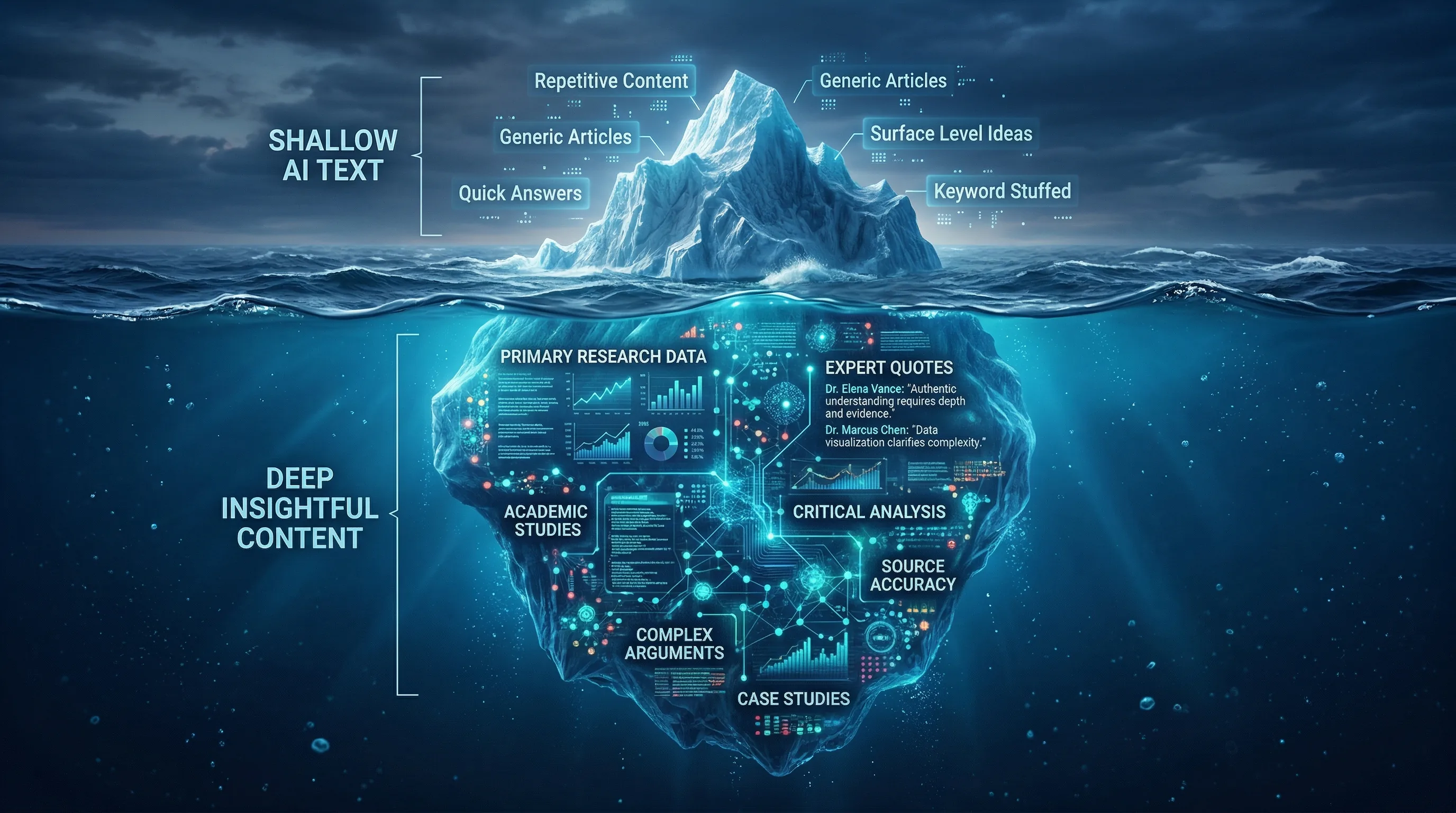
Your AI Content Lacks Depth — Here's How to Add Real Insight and Expertise
AI content lacks depth when it restates what everyone already knows without adding new perspective, data, or concrete insight.

The Artifio editorial team publishes research, tutorials, and release notes covering image, video, and audio generation models. All posts are reviewed by an editor before publishing.
AI content lacks depth when it restates what everyone already knows without adding new perspective, data, or concrete insight. If your AI drafts read like a summary of the top ten Google results — technically accurate but completely forgettable — you're experiencing the most common quality gap in AI-assisted writing. Here's how to fix it.
The core problem is simple: AI is a synthesis engine. It combines and paraphrases existing information. It cannot generate original research, share personal experience, or develop a unique point of view. That's your job. But with the right framework, AI handles the heavy lifting while you provide the parts that actually matter.
Why AI Content Defaults to Surface-Level Writing
Understanding the root cause helps you fix it faster. AI's shallow output isn't a bug — it's a predictable result of how language models work.
The Averaging Effect of Training Data
Language models learn from billions of text samples. When you ask about a topic, the model generates the statistical average of everything it's learned about that topic. Think of it as the median opinion — not wrong, but not distinctive either.
If a thousand articles say "email subject lines should be under 50 characters," AI will repeat that claim. It won't tell you that your specific audience in enterprise B2B actually responds better to 60-70 character subject lines — because that insight comes from experience, not aggregated data.
According to Google's E-E-A-T guidelines, content that demonstrates first-hand experience and genuine expertise ranks better than content that simply restates existing information. AI content needs your expertise to meet this standard.
AI Cannot Generate Original Research or Experience
AI cannot interview customers. It cannot run A/B tests. It cannot attend conferences, observe trends firsthand, or develop a contrarian thesis based on years of industry experience. These are the exact things that separate shallow content from insightful content.
The best content on any topic adds something new: an unexpected data point, a personal failure story, a counterintuitive lesson, or a framework nobody else has published. AI can't generate any of these. You can.
The Expert Layer Method: Adding Depth to AI Drafts
The Expert Layer Method is a three-step process that uses AI for what it does well and adds human expertise where AI falls short.
Step 1: Generate the Framework
Use AI to create the structural skeleton of your content. Ask for: an outline, the main arguments, key subtopics, and a logical flow. AI is excellent at organizing information and identifying what a full piece should cover.
At this stage, don't worry about depth. You're building the scaffolding. The insight comes next.
Step 2: Layer in Your Expertise
This is where your content becomes worth reading. Go section by section and add:
- Case studies: "When we implemented this for a client, here's what happened..."
- First-party data: "We analyzed 200 campaigns and found that..."
- Contrarian takes: "Most guides recommend X, but we've found the opposite works better because..."
- Lessons from failure: "We tried this approach and it failed spectacularly. Here's why..."
- Expert quotes: Insights from industry leaders that AI cannot fabricate
If you can't add at least one unique insight per section, the section might not be worth including. Cut aggressively — depth beats breadth every time.
Step 3: Add Data and Evidence
Surface-level content makes claims without evidence. Deep content backs everything up. For every major point, add:
- A specific statistic or data point (with source)
- A concrete example showing the principle in action
- A clear "so what" — explaining why this matters to the reader
AI can help find supporting data, but you need to verify it. AI models hallucinate statistics and citations frequently — never publish an AI-generated data point without checking the source yourself.
Prompt Engineering for Deeper Content
Better prompts produce deeper first drafts, which means less work for you in the expertise layer. Here's how to prompt for depth instead of breadth.
The Depth Prompt Framework
Instead of "Write about email marketing best practices," try this structure:
"Write about email marketing for B2B SaaS companies with 100-500 employees. Focus on what most standard guides get wrong. Include specific frameworks with named steps. For each recommendation, explain why it works using marketing psychology principles. Assume the reader already knows the basics and wants advanced, usable techniques."
Key elements that produce depth:
- "What most guides get wrong" — forces contrarian angles
- "Specific frameworks with named steps" — prevents vague generalities
- "Explain why it works" — adds causal reasoning, not just instructions
- "Assume the reader knows the basics" — eliminates beginner-level filler
Using Contrarian and Nuanced Angles
Ask AI to argue against common advice: "What are the strongest arguments against the standard approach to [topic]?" This forces the model to surface less obvious perspectives buried in its training data.
Ask for nuance: "What are the situations where this advice does NOT apply?" Every piece of advice has exceptions. Exploring those exceptions adds the kind of depth that readers genuinely value.
Different models handle nuance differently. Artifio lets you test depth-focused prompts across multiple AI models to find which delivers the most substantive output for your niche. Some models are notably better at generating contrarian perspectives and detailed analysis.
Content Depth Checklist: Is Your Post Worth Publishing?
Before publishing any AI-assisted content, run it through this checklist:
- ☐ Does it contain at least one insight not found in the top 5 search results for this topic?
- ☐ Does every section include a specific example, data point, or case study?
- ☐ Would a genuine expert in this field find something new or useful here?
- ☐ Does it answer "so what?" — not just explaining what something is, but why it matters and what to do about it?
- ☐ If you removed the generic advice, would there still be a substantial article?
- ☐ Does it take at least one clear stance or offer one opinion that not everyone would agree with?
If you can't check at least four of six boxes, the piece needs more work. Shallow content damages your credibility more than publishing nothing at all.
For more on building your voice into AI content, see our guide on fixing robotic AI tone. And for a broader quality perspective, our complete AI content quality guide covers the full picture. If you're tackling longer pieces, our AI long-form content guide explains how to maintain depth across 2,000+ words.
Real-World Examples of Depth vs. Shallow Content
Let's make this concrete with a side-by-side comparison.
Topic: "How to Improve Email Open Rates"
Shallow AI version: "To improve email open rates, focus on writing compelling subject lines. Keep them short and relevant. Personalization can also help improve open rates. Testing different subject lines is important for optimization."
Deep version with expertise layered in: "After analyzing 347 campaigns across 12 B2B SaaS clients, we found that subject lines between 41-50 characters consistently outperformed both shorter and longer alternatives by 12-18%. But the real surprise: personalization beyond first name — like referencing a specific metric from their account — improved opens by 34%. The counterintuitive lesson: most teams under-personalize. 'Sarah, your conversion rate dropped 8%' beats 'Sarah, improve your conversions' every time."
The shallow version restates common knowledge. The deep version includes specific data, a named sample size, a surprise finding, and a concrete example. The second version took longer to create, but it's the only one worth reading. This is the kind of depth that earns backlinks, builds authority, and keeps readers coming back.
When you're layering in expertise, remember that specificity is the ultimate trust signal. Vague claims like "studies show" or "experts agree" actively reduce credibility because readers have learned to associate these phrases with content that has nothing substantive to say.
Frequently Asked Questions
How do I make AI-generated content more insightful?
Use AI for structure and synthesis, then layer in your expertise manually. Add original data, case studies, contrarian viewpoints, and specific examples. The best AI content uses the model as a writing partner, not a replacement.
Can AI write thought leadership content?
AI can draft thought leadership frameworks, but genuine thought leadership requires original ideas, unpublished data, and personal experience. Use AI to structure and polish your unique insights, not to generate them.
Why does AI content just repeat what's already online?
AI models are trained on existing text, so they synthesize and paraphrase what's already published. They cannot create new knowledge. Adding depth requires human input: your data, your experiences, your contrarian takes.
How do I prompt AI for deeper analysis?
Ask specifically for depth: "Provide a counterargument," "What do most guides miss?" "Give me a framework with specific steps and metrics." Vague prompts produce vague output — precision in prompting creates precision in results.
What makes content feel shallow?
Lack of specifics (no data, no examples, no names), hedging language ("it depends," "in many cases"), restating obvious advice, and missing the "so what" — explaining implications rather than just facts.
Great content starts with the right AI model. Explore Artifio's library of 100+ models and find one that delivers the depth your audience deserves.