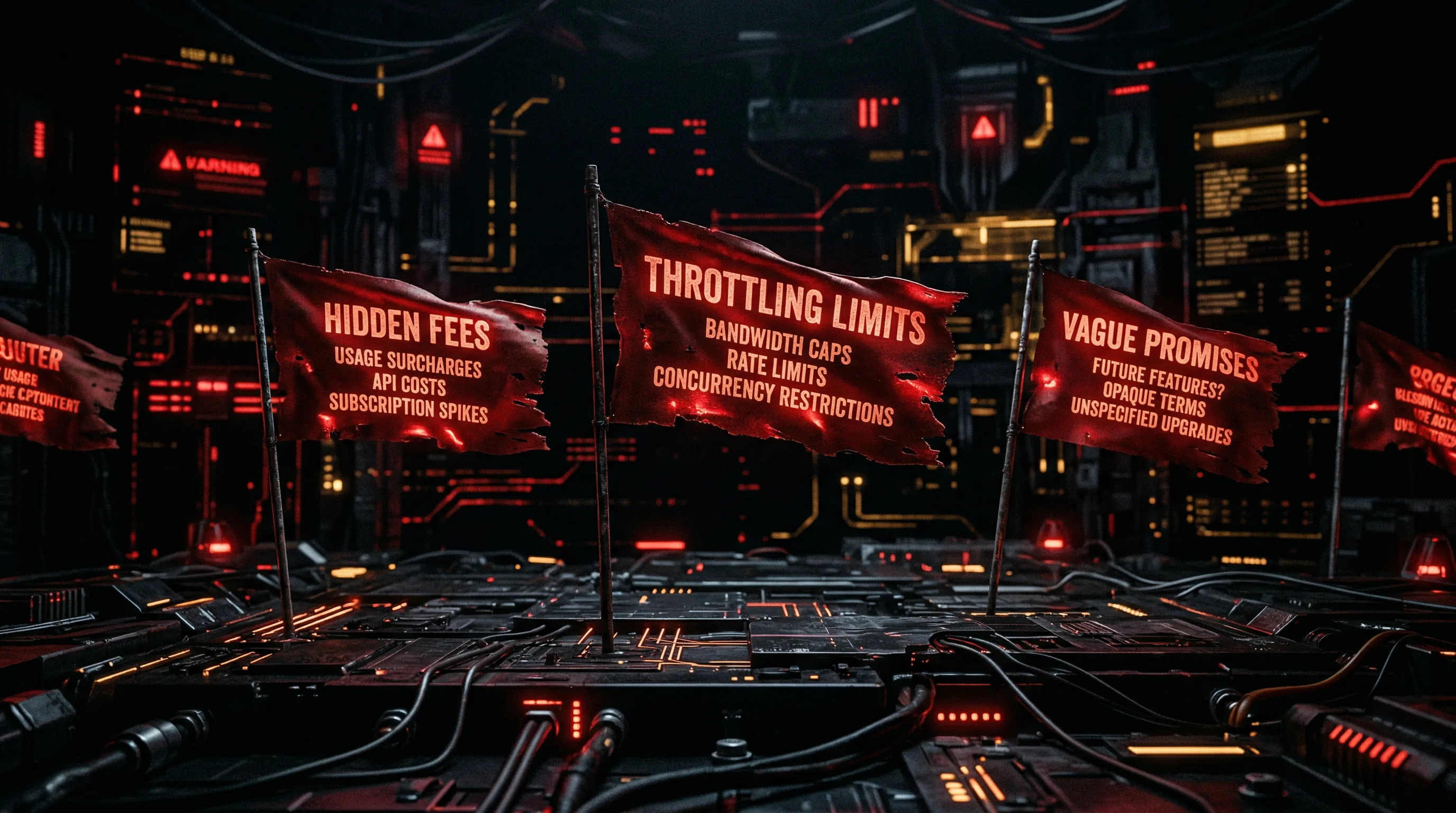
9 Red Flags to Check Before Subscribing to Any AI Platform
Not all AI platforms deserve your money — or your trust. Some hide throttling behind "unlimited" labels that mean nothing in practice. Others make cancellation nearly impossible through deliberate friction.

The Artifio editorial team publishes research, tutorials, and release notes covering image, video, and audio generation models. All posts are reviewed by an editor before publishing.
Not all AI platforms deserve your money — or your trust. Some hide throttling behind "unlimited" labels that mean nothing in practice. Others make cancellation nearly impossible through deliberate friction. Some replace human customer support entirely with AI chatbots that loop endlessly without resolving anything. Here are 9 specific red flags to check before committing to any AI platform — whether you're signing up for the first time or evaluating whether to renew an existing subscription.
These red flags are drawn from real patterns observed across the AI platform industry, documented in consumer advocacy resources like the Better Business Bureau and reinforced by thousands of user reports across community forums. A platform displaying even two or three of these warning signs warrants serious caution before you hand over your credit card information.
Pricing Red Flags
Pricing problems are the most common and most costly red flags. They directly affect your budget every single month.
Red Flag 1: "Unlimited" Without Clear Usage Policies
If a platform advertises "unlimited" anything — unlimited generations, unlimited access, unlimited creativity — but doesn't publish a clear, specific fair use policy with concrete numbers, expect throttling. Every infrastructure has capacity limits. Platforms that claim unlimited without documenting their fair use thresholds are hiding the limits they'll enforce once you rely on the tool for production work. See our thorough look on unlimited plan throttling for the specific mechanisms they use.
Red Flag 2: Annual Billing as the Default
Platforms that default to annual billing at checkout — requiring extra clicks or careful reading to select monthly — are betting you'll forget to cancel before the year is up. This is a deliberate conversion tactic, not a layout accident. Confident platforms that deliver genuine value make monthly billing easy and prominent because they know satisfied customers will stay voluntarily without being locked into contracts.
Red Flag 3: Opaque Credit or Token Costs
If you can't calculate your expected cost per generation from the platform's public pricing page — without signing up, without contacting sales, without generating content to discover the price after the fact — that opacity is intentional. Transparent platforms publish complete credit cost tables for every model and content type because they're not hiding unfavorable economics. Opaque platforms hide costs because informed comparison shopping would reveal their pricing isn't competitive.
Support and Reliability Red Flags
When things go wrong with billing, generation quality, or technical access, the support experience determines whether problems get resolved or you simply lose money and time.
Red Flag 4: AI-Only Customer Support
Ironic but increasingly common: AI platforms that use AI chatbots as their only customer support channel. When you have a billing dispute, a generation failure that consumed credits without producing output, or a technical issue preventing access, you need a human who can investigate, make exceptions, and actually resolve problems. AI support chatbots excel at answering FAQ-type questions but fail catastrophically at resolving the non-standard problems that actually require support intervention.
Red Flag 5: No Documentation or Tutorials
A platform without clear documentation, model descriptions, pricing tables, or getting-started guides is one that prioritizes customer acquisition over customer success. Good documentation demonstrates that the platform team understands their product deeply enough to explain it clearly and cares enough about user experience to invest in helping customers succeed. Its absence signals either early-stage immaturity or deliberate neglect of post-purchase customer experience.
Red Flag 6: Frequent Outages or Generation Failures
Check the platform's status page history (if one exists) and search community forums for reports of downtime, generation failures, or reliability problems. A platform that's frequently unavailable or produces errors that consume credits without delivering output is unreliable infrastructure that will cost you productivity, missed deadlines, and wasted budget. Some tolerance for occasional issues is reasonable — all software has downtime — but patterns of recurring problems indicate systemic infrastructure or management issues.
Product Red Flags
Beyond pricing and support, the product itself can show warning signs of a platform that may not serve your needs reliably over time.
Red Flag 7: Models Disappearing Without Notice
AI model availability changes — that's the nature of a in flux technology ecosystem. But reputable platforms provide advance notice before removing or replacing models, offer migration guidance to alternative models, and don't break workflows that depend on specific model availability overnight. Platforms that silently remove models, suddenly swap one model for another without communication, or deprecate popular features without explanation demonstrate disregard for the users who depend on their product for professional work.
Red Flag 8: Forced Paid Upgrades Breaking Existing Work
Upgrading to a new platform version or pricing tier should never break your existing workflows, delete your generation history, or remove access to features you were previously using. Platforms that make these changes — especially without adequate notice and migration support — are prioritizing revenue extraction over customer retention and trust. If upgrading feels like a hostage negotiation, that's a fundamental red flag about the platform's relationship with its users.
Red Flag 9: No Free Trial or Extremely Restrictive Trial
Any AI platform confident in the quality of its product and the fairness of its pricing offers a meaningful free trial — one that lets you test at realistic production volume with access to the models you'd actually use as a paying customer. A platform with no trial, a trial limited to 3 generations, or a trial restricted to outdated models is telling you they don't believe their product sells itself on merit. That's valuable information about their confidence level.
What to Look For Instead
The opposite of red flags are green flags — indicators that a platform respects your money, time, and trust as a customer.
- Transparent pricing: Complete cost tables, clear credit ratios, no hidden multipliers, pricing calculators
- Human support: Accessible human customer service with documented response time commitments
- Clear documentation: Thorough model library, detailed feature descriptions, getting-started guides, API documentation
- Stable model availability: Advance notice of changes, migration support, versioned model access
- Monthly billing without penalty: No lock-in, easy self-service cancellation, no downgrade penalties
- Meaningful free trial: Enough credits and model access to genuinely evaluate the platform at production volume
Artifio checks every box on this list: transparent credit pricing with every cost visible upfront, real human support, a documented model library with clear per-model pricing, stable model access with advance notice of changes, and no-penalty monthly billing you can cancel any time from your dashboard.
For a broader evaluation framework, see our complete AI pricing guide. And for specific guidance on avoiding deceptive pricing patterns, our unlimited plans analysis covers the most common traps in detail.
How to Research an AI Platform Before Committing
Beyond checking for red flags, proactive research before subscribing protects you from platforms that look good on the surface but disappoint in practice.
Search for honest reviews beyond the platform's own testimonials. Look for reviews on independent sites, industry forums, and social media from real users who've used the platform at production volume. Be skeptical of reviews that read like marketing copy — genuine reviews mention specific limitations alongside strengths. Pay special attention to reviews from users with similar needs and use cases to yours.
Check the platform's update history and communication style. Does the platform publish regular changelogs or product updates? Do they communicate model changes in advance? Is there a public roadmap? Platforms that communicate openly about their development trajectory are more likely to respect users' workflows and expectations than platforms that make changes silently.
Test the cancellation process before you need it. During your trial, navigate through the cancellation flow without actually completing it. Can you find the cancellation option easily? Is it self-service through the dashboard? Does it try to upsell or guilt you at each step? A cancellation process that's deliberately difficult is one of the strongest signals that a platform prioritizes revenue extraction over user satisfaction.
Evaluate the community and ecosystem. Healthy platforms have active user communities, third-party tutorials, prompt libraries shared by users, and integrations with popular productivity tools. An isolated platform with no community activity may indicate low user satisfaction, a small user base, or a product that hasn't achieved the engagement level needed for long-term viability.
The 30-60 minutes you invest in thorough pre-subscription research can save you months of frustration and hundreds of dollars in wasted subscription costs on a platform that doesn't meet your professional needs.
Frequently Asked Questions
How do I know if an AI platform is trustworthy?
Check for transparent pricing with calculable per-generation costs, human customer support with reasonable response times, clear documentation and model listings, a meaningful free trial, and stable model availability. Red flags include opaque pricing, AI-only support, no documentation, and community reports of throttling.
What should I check before paying for AI tools?
Calculate your expected cost per generation from the pricing page. Read the cancellation policy. Test with a free trial at realistic production volume. Check user reviews for reports of throttling, support issues, or billing problems. Read the terms of service for fair use clauses.
Can AI platforms change their pricing?
Yes, and many do with limited notice. Look for platforms with clear terms about price change notification periods. Some platforms grandfather existing users at old rates while others do not. Monthly billing gives you more flexibility to leave if pricing changes unfavorably.
What happens if my AI platform removes a model I use?
Good platforms provide advance notice and migration paths to alternative models. Bad platforms remove models without warning. Before subscribing, check the platform's history of model changes and whether they communicate changes to users proactively.
How important is customer support for AI tools?
Very important. When you encounter billing errors, generation failures, or technical problems that affect your production, you need human support that can actually resolve issues. AI-generated support chatbot responses rarely solve real technical or billing problems.
Choose an AI Platform You Can Trust
Artifio is built on transparency — clear pricing, human support, and no hidden surprises. Start creating with a platform that earns your trust through honest practices, not marketing promises.