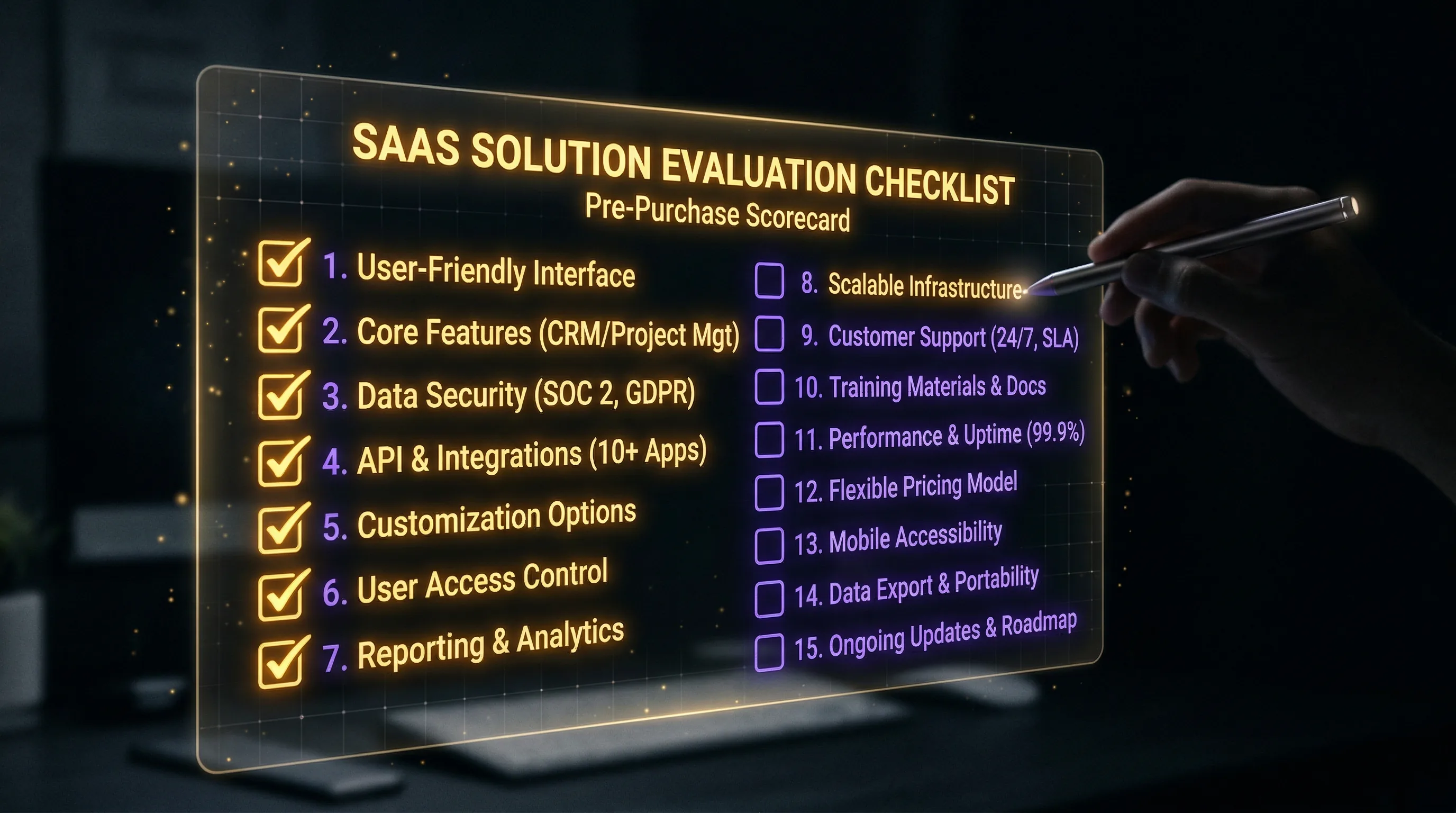
The AI Platform Pre-Purchase Checklist: 15 Questions to Ask Before Subscribing
Before you hand over your credit card for an AI content platform, run through these 15 questions. Each one protects you from a common trap that catches first-time AI tool buyers: hidden fees that inflate your bill, quality problems that waste your time, support gaps that leave you stranded, and...

The Artifio editorial team publishes research, tutorials, and release notes covering image, video, and audio generation models. All posts are reviewed by an editor before publishing.
Before you hand over your credit card for an AI content platform, run through these 15 questions. Each one protects you from a common trap that catches first-time AI tool buyers: hidden fees that inflate your bill, quality problems that waste your time, support gaps that leave you stranded, and terms that quietly sign away your content rights. Bookmark this page and check every box before subscribing to anything.
Pricing Questions (1-5)
Pricing is where most buyers get burned. The advertised price and your actual monthly cost can differ dramatically. These five questions expose the gap.
Question 1: Can I calculate my exact monthly cost based on expected usage?
If the platform's pricing page doesn't let you estimate your monthly cost based on your content volume and mix, that's a red flag. Transparent platforms show you what each generation costs before you sign up. Opaque pricing — "contact sales" or complex tier descriptions — often means the real cost is higher than you expect.
Question 2: Do credits expire? What's the expiration policy?
Some platforms expire unused credits monthly, quarterly, or annually. If you buy 1,000 credits per month but only use 700, those 300 credits are gone. Over a year, that's 3,600 credits you paid for and never used. Credit expiration is effectively a hidden price increase.
Question 3: Is annual billing the default? Can I choose monthly?
Many platforms advertise the annual billing price in big font and bury the monthly option. Annual billing locks you into a 12-month commitment to a platform you may not have adequately tested. Always check the monthly rate and start there. For a broader discussion of pricing traps, see our analysis of unlimited plan hidden throttling.
Question 4: Are there per-feature cost multipliers?
Some platforms charge different rates for different features. Image generation might cost 3x the credits of text generation. Video might cost 10x. If your content mix is heavy on expensive features, the base subscription price is misleading. Map out your expected feature usage and calculate the true cost.
Question 5: What happens if I exceed my plan limits?
Does the platform block you, throttle you, or charge overage fees? If overage fees exist, what's the rate? Some platforms charge premium rates for overage — significantly more per credit than the included credits. Know this before you hit a deadline and discover your content production just got expensive.
Quality Questions (6-9)
Quality determines whether AI saves you time or wastes it. Poor-quality output that requires extensive editing may cost more in labor than it saves in generation time.
Question 6: Have I tested with my actual production prompts?
This is the single most important test. Demo prompts are optimized to showcase the platform. Your prompts reflect your real work. If you haven't tested with your actual prompts at your expected volume, you're buying based on marketing, not evidence.
Question 7: Does the platform cover all my content types?
If you need text, images, and video, but the platform only offers text and images, you'll need a second subscription for video. Factor in the total cost of covering all your content types — either from one platform or the combined cost of multiple platforms. See our AI platform comparison guide for structured evaluation methodology.
Question 8: Have I compared output quality with at least one alternative?
You can't evaluate quality in isolation. Run the same prompts on at least two platforms and compare the results side by side. Quality that seems "good" on its own might be clearly inferior compared to an alternative — or clearly superior. Context from comparison provides insight that solo testing can't.
Question 9: Is the free trial long enough to test at production volume?
A 3-day trial isn't enough to evaluate an AI platform properly. You need at least 7-14 days to test across your content types, test during peak hours (when throttling might occur), evaluate consistency across multiple sessions, and calculate realistic cost projections. If the trial is too short for proper evaluation, that itself is a signal about the platform's confidence in its product.
Support and Reliability Questions (10-12)
When things go wrong — and they will — support and reliability determine whether the problem is a minor inconvenience or a business-critical crisis.
Question 10: Can I reach human support when I need help?
Test this during the trial. Send a support message and measure: how long until you get a response, is the response from a human or a bot, and does the response actually solve the problem? AI-only customer support (chatbots handling everything) is a major red flag — it means the company has under-invested in customer experience.
Question 11: What's the platform's uptime history?
Check the status page. If there's no public status page, that's concerning. Look at the last 90 days: how many incidents occurred, how long was each, and what was affected? A platform that's down for several hours monthly will disrupt your workflow — guaranteed. Evaluate through TrustRadius and similar independent review sites for user-reported reliability data.
Question 12: Are there user reports of throttling or quality degradation?
Search for "[platform name] slow" or "[platform name] quality decrease" on Reddit, X, and community forums. User reports often reveal issues that never appear on official status pages: slower generation during peak hours, quality differences between free trial and paid tiers, and gradual degradation that happens slowly enough to avoid triggering formal incident reports.
Legal and Terms Questions (13-15)
Terms of service protect the platform first and you second. These questions reveal whether the terms are fair or one-sided.
Question 13: Do I own the content I generate?
This seems obvious, but not all platforms grant full ownership of generated content. Read the content rights section of the terms of service. You should own generated content outright, with no residual rights retained by the platform. Ambiguous ownership language is a deal-breaker for professional content production. For detailed ToS evaluation, see our guide to decoding AI platform terms of service.
Question 14: Does the platform use my inputs for model training?
Some platforms use your prompts and outputs to improve their models. This means your content ideas, brand voice examples, and strategic frameworks could end up influencing what the model generates for others — including your competitors. Platforms should offer a clear opt-out from training data usage.
Question 15: How are terms changes communicated?
Can the platform change pricing, terms, or features with 24 hours' notice? Or are there reasonable advance notice requirements? Terms that allow unilateral, immediate changes put you at risk. Look for: minimum notice periods for pricing changes, clear communication channels, and opt-out rights if changes are unfavorable.
Artifio checks every box: transparent pricing, quality models, human support, strong uptime, clear ownership, no input training, and advance notice of any changes. But don't take our word for it — run through this checklist yourself.
Frequently Asked Questions
What should I check before buying an AI tool?
Pricing transparency (can you calculate costs?), credit and subscription terms, output quality with your prompts, customer support quality, platform reliability, content ownership terms, and data privacy policies. This checklist covers all critical areas.
How do I know if an AI platform is worth paying for?
If it saves you more time and money than it costs, passes your quality standards, offers transparent pricing, and provides reliable support, it's worth it. Calculate your ROI based on trial usage before committing.
What's the biggest mistake people make buying AI tools?
Not testing at production volume during the trial. Demo usage doesn't reveal throttling, quality inconsistency, or real-world costs. Use the trial as if you've already subscribed and see if the experience holds up.
Should I commit to an annual AI platform subscription?
Generally, no — at least not initially. Start with monthly billing until you've confirmed the platform meets your needs consistently for 2-3 months. Annual billing locks you in if quality, pricing, or your needs change.
How often should I re-evaluate my AI platform choice?
Quarterly. The AI landscape evolves rapidly. Re-evaluate if pricing changes, quality declines, new platforms launch, or your needs change. Keep your comparison scorecard updated with each evaluation.
Verify for Yourself
Artifio passes the checklist. Transparent pricing, 100+ quality models, human support, and fair terms. Try it and verify for yourself — because the best buying decision is the one you make with all the information.