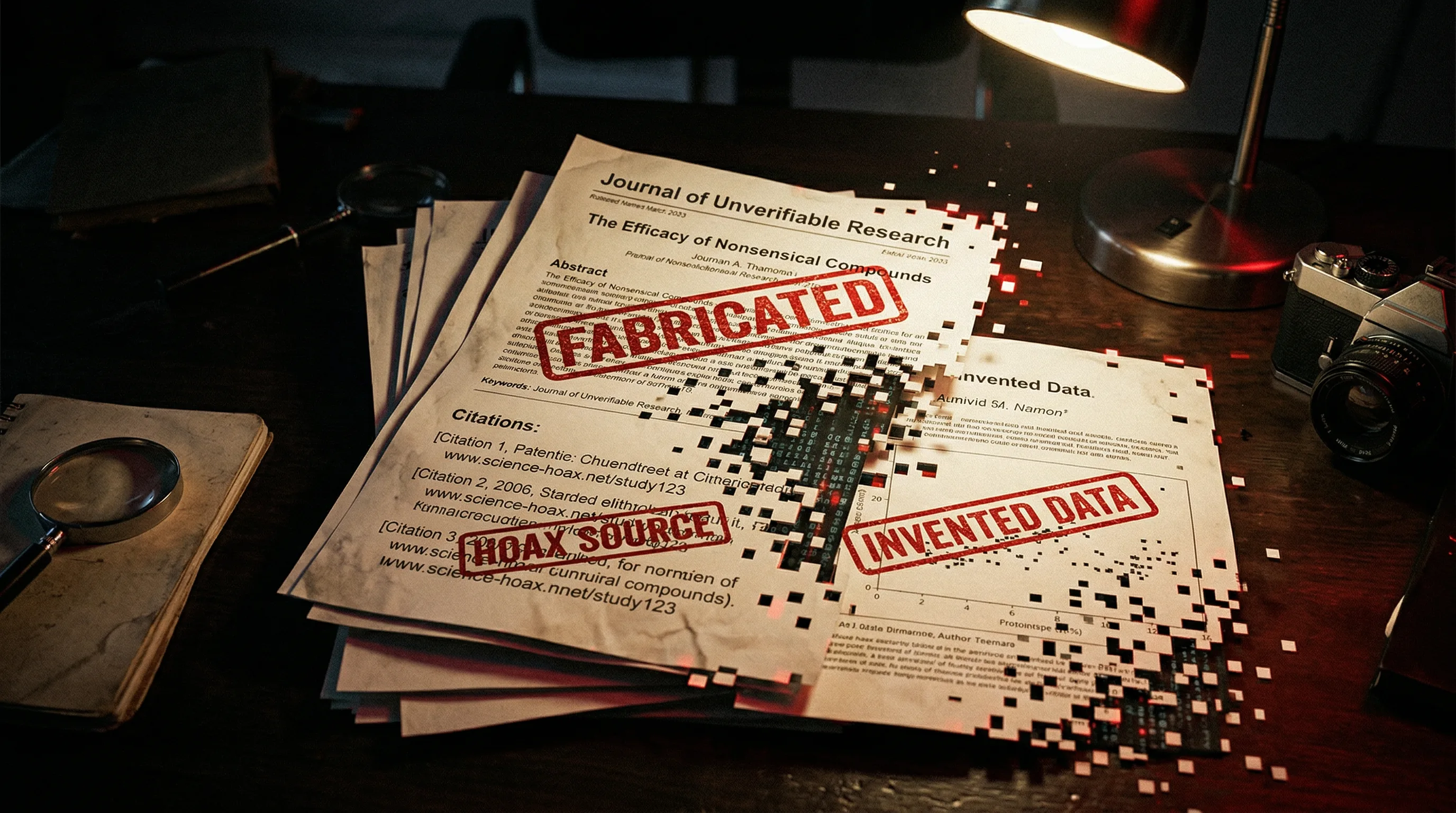
AI Fabricated Sources: How to Spot and Prevent Fake Citations in AI Content
AI fabricated sources are citations, references, and links generated by AI that look real but don't exist. Your AI tool will confidently cite a study from a real journal, give you the author names, the publication year, and even a DOI — and none of it will be real.

The Artifio editorial team publishes research, tutorials, and release notes covering image, video, and audio generation models. All posts are reviewed by an editor before publishing.
AI fabricated sources are citations, references, and links generated by AI that look real but don't exist. Your AI tool will confidently cite a study from a real journal, give you the author names, the publication year, and even a DOI — and none of it will be real. Fabricated sources are among the most dangerous AI hallucinations because they're specifically designed to look authoritative. Here's how to catch them before they destroy your credibility.
How AI Fabricates Convincing Sources
Understanding how AI constructs fake citations helps you recognize them faster.
Real Journals, Fake Papers
AI models are trained on real academic literature, so they know the names of real journals, conferences, and publishers. When generating a citation, the model combines a real journal name (like "The New England Journal of Medicine" or "Harvard Business Review") with a fabricated paper title that sounds like it belongs there. The author names may be real researchers in the field, and the year will be plausible.
The result is a citation that passes a casual glance test. It looks exactly like a real reference. Only when you try to actually find the paper does the fabrication become apparent.
Plausible But Nonexistent URLs
AI-generated URLs follow correct domain patterns. A fake link might point to "nature.com/articles/s41586-024-..." — the domain is real, the URL structure matches Nature's format, but the specific article doesn't exist. Or the AI might generate a URL for a government report that follows the correct .gov domain structure but leads to a 404 error.
Blended Citations from Multiple Real Sources
Some AI fabrications are particularly tricky because they blend information from multiple real sources. The AI might take a real author's name from one paper, a real journal from another, and a plausible title that combines themes from both. Each individual element checks out in isolation, but the combined citation is fiction. This is why checking only the author name or only the journal isn't sufficient — you need to find the specific paper.
How to Verify AI-Provided Citations
Fortunately, verification is straightforward once you know the process.
The Google Scholar Check
Copy the exact paper title and paste it into Google Scholar. A real paper will appear with its citation count, abstract, and links to the full text. If the exact title returns zero results, the paper is almost certainly fabricated. Also try variations of the title — AI sometimes gets titles slightly wrong even for real papers.
The DOI Verification Method
If the AI provides a DOI (Digital Object Identifier), check it at CrossRef's verification system or simply go to doi.org/[the-DOI]. Real DOIs resolve to the actual paper. Fake DOIs return error pages. This is one of the fastest and most reliable verification methods.
The Direct Source Lookup
Visit the claimed source URL directly. Check the publication's own website or database. Search the author's actual publication list on their university profile or Google Scholar page. If the paper appears in none of these places, it doesn't exist. Our pillar guide on AI hallucinations explains why this verification step is essential for all AI-generated content.
Preventing Fabricated Sources in Your Workflow
The best approach is preventing fabricated sources from appearing in the first place.
Provide Your Own Sources
The most reliable method: gather your sources first, then feed them to the AI. Paste relevant research excerpts, data, and quotations into your prompt. Instruct the AI to cite only the sources you've provided. This eliminates the most common fabrication pathway because the AI draws from real material rather than generating citations from scratch.
Instruct AI to Flag Uncertainty
Add explicit instructions: "Only cite sources I've provided. Do not generate any citations, references, or links on your own. If you want to reference external research, describe the general finding and note that I should find and verify the source." This approach trades convenience for accuracy — and it's a trade worth making.
Use Models with Source Access
Models with retrieval capabilities (web access or RAG) can reference real, verifiable sources. They're not perfect — even retrieved sources need verification — but they're significantly more reliable than models generating citations purely from training data. With Artifio, you can test different models' citation reliability — some are significantly better than others at referencing real sources.
What to Do When You've Published Fabricated Sources
If you discover that previously published content contains fabricated citations, act quickly:
- Correct immediately: Update the content with verified sources or remove unverifiable citations
- Audit retroactively: Check all AI-generated content with citations for similar fabrications
- Set up the workflow: Build source verification into your process going forward
- Be transparent: If the error was significant, acknowledge the correction
The damage from a corrected error is far less than the damage from an uncorrected one discovered by readers. See our AI content fact-checking workflow for the complete verification process.
The Scale of the Fabricated Citations Problem
This isn't a rare edge case. Research into AI citation accuracy consistently finds alarming fabrication rates. In academic contexts, studies have found that AI generates partially or fully fabricated citations in 30–70% of cases when asked to provide references, depending on the model and topic.
The implications extend beyond academic contexts. Blog posts that cite "studies" may reference fabricated research. Marketing content that claims "according to a report by [authority]" may be citing a report that doesn't exist. News articles drafted with AI assistance may include fabricated quotations attributed to real people.
The problem compounds when fabricated citations spread. An AI-generated article with a fake citation gets published. Another AI tool encounters that article during retrieval and cites it. Now there's a chain of citations that all trace back to a nonexistent source — but each link in the chain appears to independently confirm the claim.
For content professionals, this means citation verification isn't optional — it's essential. Every source in AI-generated content should be independently confirmed before publication. The extra time required is minimal compared to the reputational cost of publishing fabricated references.
Organizations publishing at scale should consider building a citation verification step directly into their content management system. Flagging all AI-generated content with citations for mandatory verification before publication creates a systematic safeguard that doesn't rely on individual editor vigilance.
Red Flags That Signal a Fabricated Citation
While verification is always necessary, certain patterns should immediately raise your suspicion level:
- Too-perfect specificity: A citation that includes exactly the statistic you needed, from exactly the type of source that would be most authoritative, with a conveniently recent publication date. Real research rarely aligns so perfectly with your needs.
- Unknown authors at prestigious institutions: AI often pairs real institution names with fabricated or obscure researcher names. If you can't find the named researcher through a simple search, proceed with extra caution.
- Unusually round numbers: Real research rarely produces perfectly round results. "Exactly 50% of respondents" or "precisely 75% improvement" should trigger extra scrutiny.
- Citations that echo your prompt: If you asked AI to "find research supporting X" and it provides a citation that perfectly supports X with no caveats, be skeptical. Real research almost always includes nuance and limitations.
- Broken or redirecting URLs: If a provided URL redirects to a homepage rather than a specific page, or returns a 404 error, the specific resource likely doesn't exist.
Training yourself to recognize these red flags speeds up the verification process. Rather than checking every citation with equal effort, you can prioritize the most suspicious ones while still verifying all of them.
Frequently Asked Questions
Does AI make up sources?
Yes. AI models frequently generate fabricated citations that include real-sounding journal names, plausible paper titles, and fake DOIs. This happens because AI creates text that looks statistically correct without verifying whether the sources actually exist.
How do I check if an AI citation is real?
Search the paper title in Google Scholar. Check DOIs at doi.org. Visit the URL directly. Look up the author name and verify they've published on this topic. If you can't find the source through any of these methods, it's likely fabricated.
Why does AI cite fake studies?
AI generates citations by predicting what a plausible citation looks like — real journal name + plausible title + reasonable date. It's not looking up real papers; it's constructing citation-shaped text. The result often looks real but isn't.
Can I trust AI to find academic sources?
Not without verification. AI with web access can sometimes retrieve real sources, but even these should be verified. Never trust an AI-provided citation without independently confirming the source exists and says what's claimed.
How do I get AI to use real sources?
Provide the sources yourself in the prompt. Paste in relevant research and instruct AI to only cite what you've provided. For models with retrieval capabilities, verify every citation against the retrieved document.
Accuracy Requires the Right Tools and Workflow
Try Artifio's multi-model platform to find AI models you can trust — then verify anyway. With 100+ models, you can find the most citation-reliable option for your content needs.