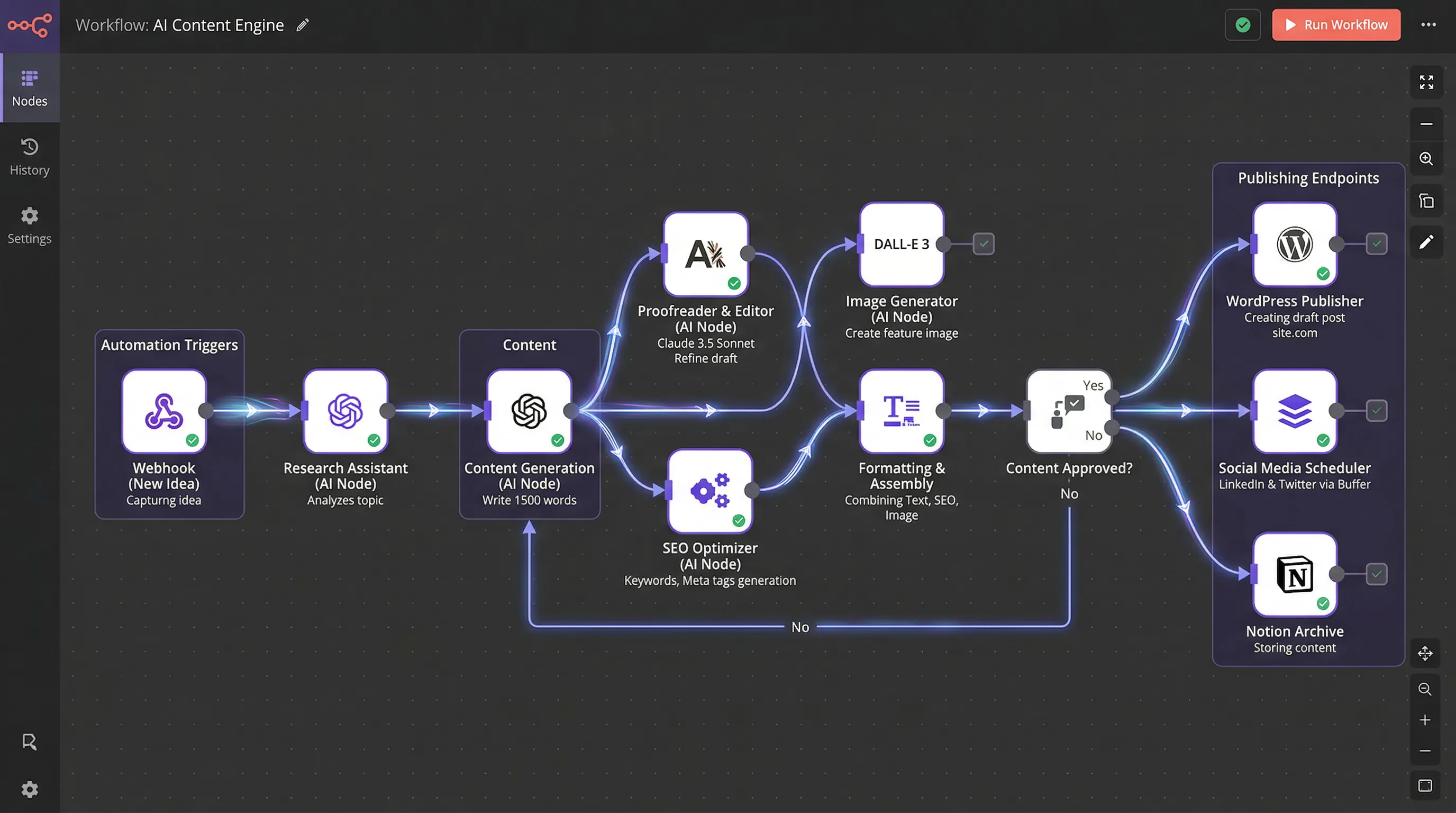
AI Content Workflow Automation: From Ideation to Publication in Half the Time
Content workflows have too many manual steps that consume time without adding proportional value. AI can automate or significantly accelerate most of these steps — from ideation and research synthesis to drafting and cross-format reformatting.

The Artifio editorial team publishes research, tutorials, and release notes covering image, video, and audio generation models. All posts are reviewed by an editor before publishing.
Content workflows have too many manual steps that consume time without adding proportional value. AI can automate or significantly accelerate most of these steps — from ideation and research synthesis to drafting and cross-format reformatting. But automation without structure produces chaos, not efficiency. Here's how to build an AI-assisted content pipeline that's genuinely faster without sacrificing the quality your audience and search engines expect.
According to Content Marketing Institute workflow research, the average content piece passes through 7-12 distinct stages between initial concept and publication. Each handoff and manual step adds time, introduces potential for error, and creates a bottleneck that limits total production throughput. AI can compress or eliminate many of these stages while keeping the essential human checkpoints intact.
The Standard Content Workflow (and Its Bottlenecks)
Before automating, you need to understand where time actually goes in your current workflow — and which steps AI can meaningfully accelerate versus which ones still require human judgment.
Where Time Actually Goes
A typical content workflow breaks down approximately like this: research and information gathering takes about 20% of total time, outlining and structure planning takes 10%, first draft writing takes 30%, editing and revision takes 25%, and formatting plus publishing takes the remaining 15%. The biggest time blocks — research, drafting, and editing — are exactly where AI has the most impact.
Which Steps AI Can Accelerate
AI directly impacts research synthesis, outline generation, and first draft creation — roughly 60% of total content creation time. Research that might take 45 minutes of manual searching, reading, and note-taking can be compressed into 10-15 minutes with AI-assisted synthesis. Outlining drops from 15 minutes of manual structuring to 3-5 minutes of prompt-and-review. First draft generation drops from 90 minutes of manual writing to 10-15 minutes of prompting and AI generation, though thorough editing of the AI output takes longer than editing a manual draft you wrote yourself.
Building an AI-Automated Content Pipeline
A well-designed pipeline moves content through distinct stages with clear inputs, outputs, and quality checkpoints at each transition.
Stage 1: AI-Assisted Research and Ideation
Use AI to synthesize research from your topic brief, identify relevant data points and statistics, surface angles and subtopics you might not have considered, and compile background information that informs the content direction. This stage transforms a vague topic into a specific, well-informed content brief that guides all subsequent stages.
Stage 2: Automated Outline Generation
Feed your researched brief into AI to generate a complete outline: logical section structure, header hierarchy, key points per section, and integration points for original expertise or data. Review and adjust the outline before proceeding — a strong outline is the single biggest determinant of final content quality. Spending 5 minutes refining the outline saves 30 minutes of editing later.
Stage 3: AI Draft Generation
Generate the first draft section by section using optimized prompt templates that include your brand voice guidelines, target keyword integration, and quality requirements. Section-by-section generation produces more focused, detailed output than generating entire articles at once and provides natural quality checkpoints throughout the writing process.
Stage 4: Human Edit and Enhancement
This is the non-negotiable human stage. Editors add original expertise, verify all factual claims and data citations, refine the brand voice and tone, see to it logical flow between sections, and improve the content from "competent AI draft" to "expert-quality published piece." This stage typically takes 20-40 minutes per article and represents the irreplaceable human value in the workflow.
Stage 5: Formatting and Publication
AI can assist with meta description generation, social media promotional post creation, and cross-format reformatting. Human review confirms everything looks correct before publishing. This stage should be streamlined with templates and checklists rather than reinvented for each piece.
Multi-Format Content from a Single Source
One of AI's most powerful workflow applications is content multiplication — transforming a single piece of content into multiple formats for different channels and audiences.
Blog to Social Media
Use AI to extract key insights from a published blog post and reformat them as platform-specific social media content — a LinkedIn post highlighting the main argument, a Twitter/X thread breaking down the key points, and Instagram carousel concepts summarizing practical tips. Each derivative should be optimized for its specific platform's format and audience expectations.
Article to Email Newsletter
AI can distill a 2,000-word blog post into a 300-word newsletter summary that captures the core value proposition and drives clicks to the full article. This repurposing connects your content marketing to your email marketing with minimal additional effort.
Text to Video Script
Convert written content into video scripts with visual direction notes, timing estimates, and speaker notes. This format transformation enables video content production from your written content library without starting from scratch for each video project.
Artifio's multi-modal capabilities (text, image, audio, video) let you repurpose content across all these formats within one platform — no tool switching, no managing multiple subscriptions, and no learning multiple interfaces.
Measuring Workflow Improvements
Track these metrics to confirm your automated workflow is delivering genuine improvements and to identify remaining optimization opportunities:
Time-per-piece tracking: Measure total production time before and after AI integration. Break this down by stage to identify which parts of the workflow improved most and which might still need optimization.
Quality consistency at volume: As you scale production, monitor whether quality metrics (traffic per post, engagement rates, conversion rates) remain stable or decline. Quality degradation at higher volumes signals the need for stronger editorial processes.
Team satisfaction and sustainability: Burned-out editors produce worse results regardless of how good the AI draft was. Monitor your team's workload satisfaction — AI should make work more enjoyable by eliminating tedious tasks, not more stressful by increasing review volume beyond sustainable levels.
For more on content production planning, see our content calendar guide. For the broader strategic context, our content marketing strategy guide covers how automated workflows fit into your overall marketing approach.
Tools and Integrations for Automated Workflows
The most efficient AI content workflows connect your generation platform to your publishing and distribution tools through automation, reducing manual transfer steps and copy-paste overhead.
Content Management System Integration
Set up direct or semi-automated pathways from your AI generation platform to your CMS (WordPress, Webflow, Ghost, or similar). Some platforms offer direct publishing integrations; others work through intermediary tools like Zapier or Make. Even simple automation — like auto-formatting AI output into your CMS template — saves 5-10 minutes per piece and eliminates formatting errors that occur during manual transfer.
Social Media Scheduling Integration
Connect your repurposed social content directly to your scheduling tool (Buffer, Hootsuite, or platform-native schedulers). When you batch-generate social derivatives from your blog content, route them directly into your social scheduling queue. This eliminates the manual step of copying social content from your AI platform to your scheduler — a small friction that, over dozens of posts per month, represents meaningful cumulative time savings.
Editorial Workflow Management
Use project management tools (Trello, Asana, Notion, or similar) to track each piece through your production stages: briefed, generated, edited, approved, published, distributed. Automated status updates — triggered when content moves between stages — keep your team aligned without requiring manual status reporting. The overhead of managing a content workflow without tracking tools increases dramatically as volume scales, making workflow tooling an essential investment for teams producing more than 8-10 pieces per month.
Automating your content workflow isn't a one-time project — it's an ongoing optimization process. Each month, review your pipeline's performance metrics and identify the remaining bottlenecks where time is still being lost to manual processes, unnecessary complexity, or inefficient tool configurations. Continuous incremental improvement compounds into dramatic efficiency gains over quarters and years of sustained attention to workflow optimization.
Frequently Asked Questions
How can AI automate content creation?
AI automates research synthesis, outline generation, first draft writing, and content reformatting across formats. It reduces the roughly 60% of content creation that is production work, freeing humans for the 40% that requires expertise, judgment, and creative direction.
How much time does AI save in content workflows?
Typically 40-60% of total content production time. Research and drafting see the biggest time savings. Editing time may increase slightly as you verify AI output quality, but the net time savings are substantial for most content operations.
Can I automate my entire content pipeline with AI?
You can automate production steps but not editorial judgment. The best pipelines use AI for research, outlining, and drafting, then human experts for review, fact-checking, and quality refinement. Fully automated publishing without human review risks serious quality problems.
What's the best AI content workflow for small teams?
Single person: research with AI, outline with AI, draft with AI, self-edit, publish. Small team of 2-3: one person handles prompting and generation, another handles editing and review. Match the workflow structure to your team size and skills.
How do I maintain quality in automated content workflows?
Set quality gates at each stage: minimum quality scores before publication, mandatory human review for every piece, fact-checking checklists, and brand voice audits. Automation should speed up production without skipping quality control steps.
Automate Your Content Pipeline
Artifio's 100+ models handle every content type — from first draft text to social media graphics to video scripts. Build a production pipeline that's genuinely faster without compromising quality.