How to Build an AI-Powered Content Calendar That Produces Results
A content calendar without AI is a plan. A content calendar with AI is a production system — one that turns strategic planning into published content at a pace and consistency that manual workflows simply cannot match.

The Artifio editorial team publishes research, tutorials, and release notes covering image, video, and audio generation models. All posts are reviewed by an editor before publishing.
A content calendar without AI is a plan. A content calendar with AI is a production system — one that turns strategic planning into published content at a pace and consistency that manual workflows simply cannot match. By integrating AI into both your planning process and your production workflow, you can plan more strategically, produce more efficiently, and publish more consistently than ever before. Here's how to build an AI-powered content calendar that delivers measurable results.
CoSchedule content calendar research shows that marketers who maintain organized content calendars are significantly more likely to report success in their content marketing efforts. AI amplifies this advantage by removing the production bottleneck that causes most content calendars to fall behind schedule within the first month.
Planning Your AI Content Calendar
Strategic planning is the human-driven foundation that determines whether your AI-produced content drives business results or just fills a publishing schedule with noise.
Topic Cluster-Based Planning
Organize your content calendar around topic clusters for maximum SEO impact. Each cluster has a pillar page covering a broad topic comprehensively, supported by 5-10 focused posts targeting specific subtopics and long-tail keywords. Plan which cluster to build or expand each month, and schedule supporting posts throughout the month to build the cluster systematically rather than randomly.
Keyword-Driven Scheduling
Schedule content based on keyword opportunity analysis. Prioritize lower-difficulty keywords early (they rank faster, providing early traffic wins) and build toward higher-difficulty targets as your topical authority grows. Your calendar should show not just what topic each day, but which specific keyword each piece targets and what search intent it addresses — this prevents duplicate targeting and ensures in-depth keyword coverage across your content portfolio.
Seasonal and Trend Alignment
Map your content calendar against seasonal trends, industry events, product launches, and cultural moments relevant to your audience. AI enables the production speed to capitalize on timely opportunities that manual workflows would miss — you can plan seasonal content batches weeks in advance and generate them quickly enough to publish at the optimal time.
The Weekly AI Content Production Rhythm
A structured weekly rhythm transforms content production from reactive scrambling into a predictable, manageable process.
Monday: Plan and Brief
Review the week's content calendar. Write detailed content briefs for each planned piece — including target keyword, search intent, audience, key points, and internal linking targets. Good briefs take 10-15 minutes each and directly determine the quality of AI output for the rest of the week. This upfront investment prevents wasted generations and reduces editing time significantly.
Tuesday-Wednesday: Generate and Draft
Batch AI generation for maximum efficiency. Generate all outlines in one session, then all first drafts in another focused session. Batching develops a prompting rhythm that improves quality consistency and reduces context-switching waste. Two focused generation sessions of 2-3 hours each can produce a full week's content.
Artifio's batching capability lets you generate a week's content in one productive session — multiple formats, multiple models, one dashboard.
Thursday: Edit and Review
Dedicate a focused block to editing all generated content. Edit with fresh eyes (not immediately after generation) for better quality catches. Run through your quality checklist for each piece: factual accuracy, brand voice alignment, SEO optimization, internal linking, and overall readability. Batch editing is more consistent than scattered per-piece editing throughout the week.
Friday: Publish and Distribute
Publish finished pieces and immediately begin distribution — social media promotion, email newsletter inclusion, internal team sharing. Don't let published content sit without distribution. Use AI to generate promotional copy for each distribution channel directly from the published content, ensuring consistent messaging across all touchpoints.
Content Calendar Templates for AI-Powered Teams
Structured templates prevent reinventing the wheel each planning cycle and make sure nothing falls through the cracks.
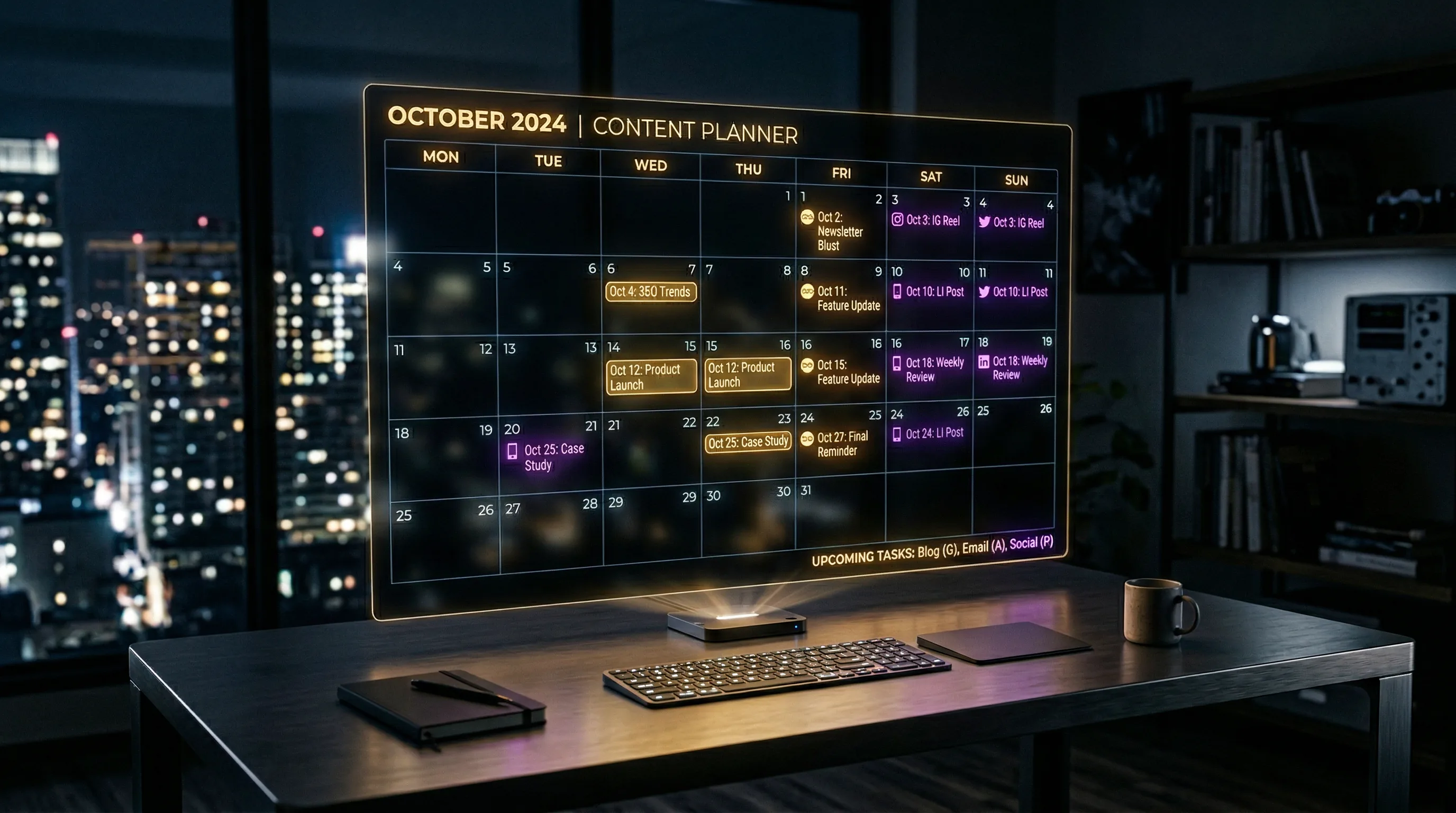
Monthly calendar template: Map out 4-5 weeks of content with topic cluster assignments, target keywords, content format, production stage (brief/generate/edit/publish), assigned team member, and publication date. Include buffer days for revision and unexpected delays.
Weekly sprint template: Break each week into the Monday-through-Friday rhythm described above. Track each piece's progress through the stages: briefed, generated, edited, approved, scheduled, published, distributed.
Quarterly strategy template: Plan which topic clusters to build or expand each quarter, set keyword ranking targets, define content volume goals, and establish quality benchmarks. Review quarterly to assess what's working and adjust the next quarter's plan based on performance data.
For the broader strategic framework your calendar should support, see our content marketing strategy guide. For workflow optimization, our workflow automation guide covers the production side in detail. And for SEO-specific planning, our SEO content guide provides keyword and optimization strategies.
Advanced Content Calendar Strategies
Once your basic content calendar is operational, these advanced strategies maximize its strategic impact and production efficiency.
Content Pillar Rotation
Rather than focusing on one topic cluster per month, rotate through multiple clusters each week. If you have 4 topic clusters, publish one piece per cluster per week. This approach builds all clusters simultaneously, maintains topical variety for your audience, and prevents the content fatigue that comes from publishing too much about one topic in a concentrated period. AI makes this rotation practical because switching between topic areas doesn't require the mental context-switch overhead that slows down manual writing.
Evergreen vs. Timely Content Balance
Maintain a ratio of approximately 70% evergreen content (lasting relevance, compound traffic value) to 30% timely content (trend-related, seasonal, news-responsive). Evergreen content builds your long-term organic traffic foundation while timely content drives short-term engagement spikes and demonstrates your relevance to current industry conversations. AI enables producing both types because the speed of generation makes responding to timely opportunities practical without sacrificing your evergreen production schedule.
Content Gap Analysis Integration
Monthly, review your keyword tracking data to identify content gaps — topics and keywords where competitors rank but you don't have content. Add these gap-filling pieces to your calendar with appropriate priority. AI makes filling content gaps fast once identified, turning competitive intelligence directly into published content within days rather than the weeks or months a manual writing process would require.
Repurposing Schedule
Build a repurposing cycle into your calendar: each piece of pillar content gets repurposed into social, email, and visual formats within 48 hours of publication. Schedule the derivative content across the following week for sustained visibility. This structured repurposing approach ensures you extract maximum distribution value from every piece of content your AI workflow produces.
Handling Content Calendar Disruptions
No content calendar survives contact with reality unchanged. Breaking news, urgent client requests, team illness, and seasonal opportunities will disrupt your carefully planned schedule. Plan for disruptions rather than pretending they won't happen.
Build buffer capacity. Plan to produce at 80% of your maximum capacity, leaving 20% buffer for disruptions and opportunistic content. If your team can produce 5 posts per week, plan for 4 and use the fifth slot for timely opportunities or catch-up when earlier pieces need more revision than expected.
Maintain a content bank. Keep 2-3 fully completed, evergreen posts in reserve that can be published on short notice when production disruptions create gaps in your calendar. AI makes maintaining this bank practical — generate a few extra evergreen pieces during productive weeks to build your safety stock.
Prioritize ruthlessly when behind schedule. When disruptions push you behind, don't try to catch up by producing everything at lower quality. Instead, prioritize the highest-impact pieces — those targeting your most important keywords or supporting active campaigns — and defer lower-priority content to the following week. Quality consistency matters more than schedule perfection for long-term content marketing success.
Frequently Asked Questions
How far ahead should I plan AI content?
Plan topics and keywords 1-3 months ahead. Generate actual content 1-2 weeks before publication. This gives enough lead time for quality editing while keeping content relevant and timely.
How many pieces of content can AI help produce per week?
A single person can produce 5-10 quality pieces per week with AI assistance. A small team of 2-3 can produce 15-25 pieces. The bottleneck is editing and quality control, not generation speed.
Should I batch AI content generation?
Yes. Batching similar content types in one focused session is significantly more efficient than generating individual pieces scattered throughout the week. You develop a prompting rhythm and editing consistency is better.
How do I align AI content with marketing campaigns?
Start with campaign goals and timelines. Work backward to identify all supporting content needed. Use AI to rapidly produce campaign-specific content across all required formats — blog posts, social media, email, video — in coordinated batches.
What should I include in an AI content brief?
Target keyword, search intent, audience description, desired angle or unique perspective, brand voice notes, key points to cover, internal linking targets, and any specific data or examples to include. Better, more detailed briefs produce dramatically better AI output.
Your content calendar is only as good as the consistency with which you follow it. AI removes the biggest barrier to calendar consistency — production capacity — leaving you free to focus on the strategic decisions that determine whether your content drives real business results.
Build a Content Machine
Plan once, generate across 100+ models, and publish more quality content than ever. Artifio powers the production engine behind your content calendar.