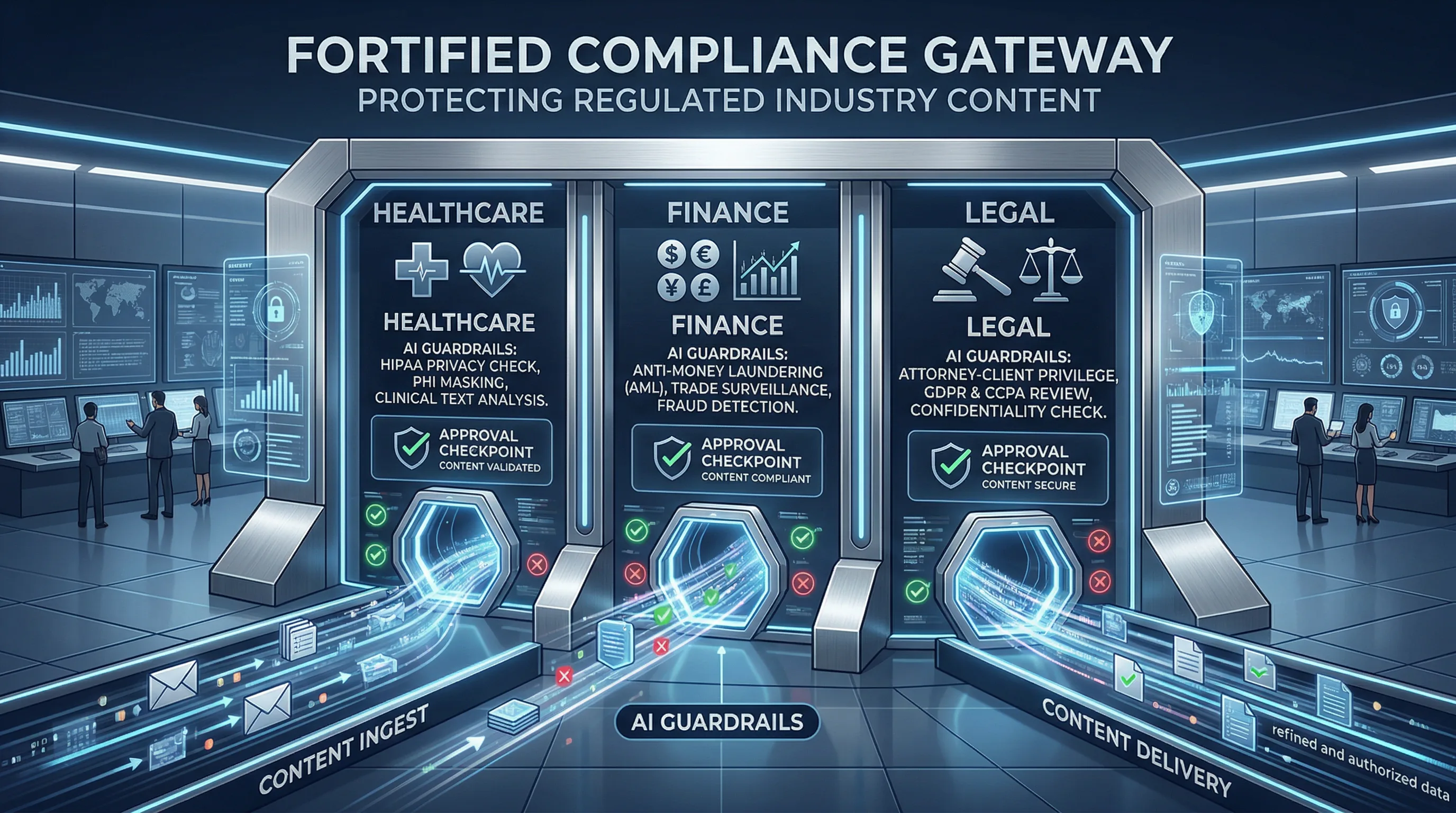
AI Content in Regulated Industries: Compliance Frameworks for Healthcare, Finance, and Legal
AI content in regulated industries — healthcare, finance, and legal — faces compliance requirements that don't disappear just because an AI wrote the content. Existing regulations apply to all published content regardless of authorship method, and new AI-specific rules are being layered on top.

The Artifio editorial team publishes research, tutorials, and release notes covering image, video, and audio generation models. All posts are reviewed by an editor before publishing.
AI content in regulated industries — healthcare, finance, and legal — faces compliance requirements that don't disappear just because an AI wrote the content. Existing regulations apply to all published content regardless of authorship method, and new AI-specific rules are being layered on top. This guide provides compliance frameworks for using AI in regulated content creation without running afoul of authorities or endangering your audience.
The Regulatory Landscape for AI Content
Understanding which regulations apply is the essential first step for any regulated content team considering AI tools.
Existing Regulations That Apply to AI Content
Here's the fundamental principle: regulations that governed your content before AI still govern it after AI. If you needed a compliance review for human-written financial content, you need it for AI-generated financial content. If health claims required substantiation before AI, they require substantiation with AI. The tool changed; the rules didn't.
This means regulated industries can't treat AI as a shortcut that bypasses their existing compliance processes. AI can make content production faster, but every compliance checkpoint must remain in place. The FTC's guidance on AI and advertising makes this explicitly clear: existing consumer protection laws apply to AI-generated claims.
Emerging AI-Specific Regulations
New regulations are adding AI-specific requirements on top of existing content rules. The EU AI Act introduces disclosure requirements, risk classifications, and transparency obligations for AI-generated content. Other jurisdictions are developing similar frameworks. These regulations don't replace existing content rules — they add to them.
For regulated industries, this means a dual compliance obligation: meet your industry-specific content regulations AND meet emerging AI-specific regulations. Organizations that build compliance habits now avoid the scramble when enforcement tightens.
Industry Self-Regulation
Industry associations in healthcare, finance, and legal are developing their own AI content guidelines. These voluntary standards often reflect best practices that eventually become regulatory requirements. Staying current with your industry association's AI guidelines positions you ahead of regulation.
Healthcare AI Content Compliance
Healthcare content carries the highest stakes because inaccurate information can directly harm people.
HIPAA Considerations
Never input patient data, protected health information (PHI), or identifiable health records into AI tools — unless the tool is specifically HIPAA-compliant with a signed Business Associate Agreement. This applies to all AI tools, not just medical-specific ones. Using a general-purpose AI tool to summarize patient records is a HIPAA violation, period.
FDA Content Regulations
Health claims in AI-generated content must meet FDA and FTC substantiation standards. If your AI drafts content that claims a product "cures," "treats," or "prevents" any condition, those claims must be backed by the same level of evidence required for human-written claims. AI doesn't get a pass on substantiation requirements. Our AI medical content safety guide covers these protocols in detail.
Professional Review Requirements
Medical content should be reviewed by qualified healthcare professionals before publication. This is true for human-written content and doubly true for AI-generated content, given the hallucination risk. The reviewer should have current clinical knowledge in the specific topic area.
Financial AI Content Compliance
Financial content regulation focuses on accuracy, fairness, and preventing investor harm.
SEC and FCA Considerations
Content that constitutes investment advice, market analysis, or financial recommendations falls under securities regulation. AI-generated financial content must meet the same accuracy and fairness standards as human-written content. Misleading statements, even unintentional AI hallucinations, can trigger regulatory enforcement. See our AI financial content accuracy guide for specific safety protocols.
Investment Content Disclaimers
Standard disclaimers — "not financial advice," "past performance doesn't guarantee future results," "consult a financial advisor" — must be included in AI-generated financial content just as they would be in human-written content. Add AI disclosure to these standard disclaimers where required by platform or regulation.
Data Accuracy Requirements
Financial data in AI-generated content must be verified against authoritative sources: SEC filings, official company reports, regulated financial data providers. AI-generated financial figures should never be published without independent verification.
Legal AI Content Compliance
Legal content faces unique challenges around unauthorized practice of law and accuracy requirements.
Unauthorized Practice of Law Concerns
AI-generated legal information must not constitute legal advice without proper authorization. The line between legal information (generally permissible) and legal advice (regulated) varies by jurisdiction but is critically important. AI-generated content that tells someone "you should file this type of lawsuit" or "your contract is enforceable because..." may cross into unauthorized practice of law.
Safe territory: educational content about legal concepts, general explanations of regulations, and summaries of legal developments. Dangerous territory: specific legal recommendations, contract interpretation, or case-specific advice.
Accuracy Standards for Legal Information
Legal accuracy standards are particularly high because incorrect legal information can lead to significant financial and personal harm. AI frequently hallucinates legal provisions, misattributes court decisions, and presents outdated legal standards as current. Every legal claim in AI-generated content requires verification against current, authoritative legal sources.
Universal Compliance Framework for AI Content
Regardless of your specific regulated industry, this framework applies to all AI-generated content in regulated contexts.
Pre-Publication Review Checklist
- ☐ All factual claims verified against authoritative primary sources
- ☐ Industry-specific compliance review completed
- ☐ Required disclaimers included
- ☐ AI disclosure included where required by regulation or platform policy
- ☐ Subject matter expert review completed
- ☐ No claims beyond the scope of permissible content for your authorization level
- ☐ All data points current (not based on outdated AI training data)
- ☐ Compliance documentation completed for audit trail
Documentation and Audit Trail
Document your AI usage for compliance purposes. Record which AI tools and models were used, what human review was performed, who approved the content, and what verification steps were taken. This audit trail protects you in case of regulatory inquiry. Artifio's clear usage records and transparent model attribution support the documentation requirements regulated industries demand.
Ongoing Monitoring
Regulated content isn't "done" when it's published. Information changes, regulations update, and previously accurate content can become inaccurate over time. Build a review schedule for published AI-generated content, especially in fast-changing regulatory environments. For the complete approach to AI content fact-checking, see our fact-checking workflow guide.
Building a Compliance-Ready AI Content Culture
Compliance in regulated industries isn't just about checklists — it's about organizational culture. The most effective regulated content teams build compliance awareness into every stage of their AI content workflow.
Hire for compliance awareness. Content team members in regulated industries need to understand both content creation and compliance requirements. Invest in training for existing team members and prioritize regulatory awareness when hiring. A writer who produces great content but doesn't understand HIPAA, SEC requirements, or legal content boundaries is a liability in regulated contexts.
Create clear escalation paths. When someone encounters a potential compliance issue in AI-generated content, they should know exactly who to consult and how to escalate. Ambiguity in escalation processes leads to either over-caution (slowing production unnecessarily) or under-caution (publishing problematic content).
Regular compliance audits. Schedule periodic audits of published AI-generated content. Regulations change, medical guidelines update, financial regulations evolve, and legal precedents shift. Content that was compliant when published may become non-compliant over time. Quarterly audits of high-stakes content catch these issues before they cause problems.
Stay current with regulatory developments. Assign someone on your team to monitor regulatory changes relevant to your content domains. Subscribe to regulatory updates, join industry compliance groups, and maintain relationships with legal counsel who understand AI content regulation. Early awareness of regulatory changes gives you time to adapt rather than scramble.
The organizations that handle regulated AI content most effectively treat compliance as a competitive advantage rather than a burden. When your audience knows your content is thoroughly reviewed, expertly verified, and fully compliant, that trust becomes a powerful differentiator — especially as the volume of unchecked AI content in your industry grows.
Frequently Asked Questions
Can I use AI for content in regulated industries?
Yes, with appropriate safeguards. AI can assist with drafting, formatting, and synthesis. But regulated content requires professional review, accurate sourcing, proper disclaimers, and compliance checks before publication — these requirements don't change because AI is involved.
Does HIPAA apply to AI content creation?
Yes. Never input protected health information into AI tools unless the tool is specifically HIPAA-compliant with appropriate business associate agreements. This applies to any AI tool, not just medical-specific ones.
What compliance documentation do I need for AI content?
Document which AI tools and models were used, what human review was performed, who approved the content, and what verification steps were taken. This audit trail protects you in case of regulatory inquiry.
Are there industry guidelines for AI content?
Many industry bodies are developing AI content guidelines. Check your specific industry association for current guidance. The general principle: existing content standards apply to AI content, plus emerging AI-specific transparency requirements.
What's the biggest risk of AI content in regulated industries?
Publishing inaccurate information that leads to harm (medical misinformation, financial losses, legal errors). The combination of AI hallucinations and high-stakes content domains creates significant risk that requires rigorous verification processes.
Regulated Content Demands Reliable Tools
Artifio's transparent platform and multi-model access support the compliance standards your industry requires. Clear usage records, model attribution, and pay-as-you-go pricing — built for teams that need accountability.