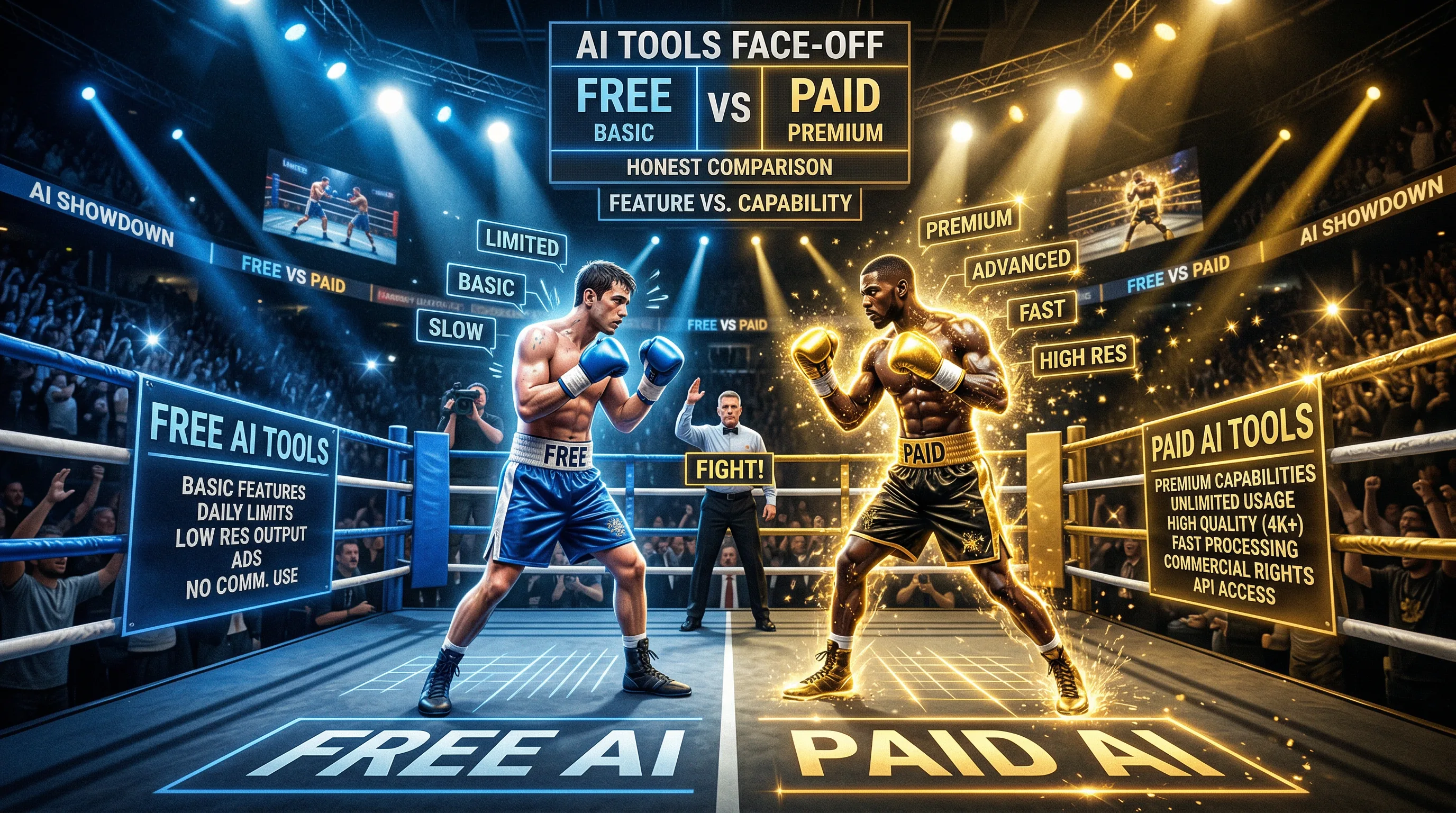
Free vs. Paid AI Tools: An Honest Comparison of What You Actually Get
Free AI tools are everywhere — and they're genuinely tempting. Why pay when you can generate content at no cost? But "free" always comes with tradeoffs that aren't visible on the sign-up page: quality limitations, usage caps, data practices you might not agree with, or feature restrictions that...

The Artifio editorial team publishes research, tutorials, and release notes covering image, video, and audio generation models. All posts are reviewed by an editor before publishing.
Free AI tools are everywhere — and they're genuinely tempting. Why pay when you can generate content at no cost? But "free" always comes with tradeoffs that aren't visible on the sign-up page: quality limitations, usage caps, data practices you might not agree with, or feature restrictions that make professional work impractical. Here's an honest, detailed breakdown of what free AI tools actually give you, what they withhold, and exactly when paying for a tool makes financial and professional sense.
This comparison isn't about shaming anyone for using free tools — they serve legitimate purposes. But making an informed decision requires understanding the real differences, not just the marketing claims. PCMag's AI tool reviews provide independent assessments of both free and paid options across the market.
What Free AI Tools Actually Offer
Understanding the specific limitations of free tiers prevents frustration and sets realistic expectations from the start.
Quality Tiers in Free Plans
Free tiers typically use older or smaller model versions — not the latest, most capable models that produce the highest quality output. This isn't arbitrary; the newest, most powerful models are the most expensive to run computationally, and providing them free to millions of users would be financially unsustainable for any platform. The result: free-tier output is noticeably less sophisticated, creative, and accurate than paid-tier output from the same platform using premium models.
The quality difference shows up in specific, observable ways: more generic and formulaic phrasing, less nuanced understanding of complex topics, more frequent factual errors and hallucinations, weaker creative capabilities, and less ability to follow complex multi-part instructions accurately. For casual personal use, these differences may not matter significantly. For professional content published under your name or your brand, they almost certainly do.
Usage Limits and Restrictions
Free tiers impose strict daily or monthly generation limits — typically 5-25 text generations per day or 50-200 per month, depending on the platform. Image generation limits are usually tighter: 3-10 per day. Video generation is rarely included in free tiers at all because of the high computational cost.
These limits make free tools impractical for any content operation that requires consistent, reliable output volume. If you need 5 blog posts per week and each requires 3-4 generations to produce a quality result, you'll exhaust most free tiers in the first 2-3 days of the week and spend the rest waiting for limits to reset.
Data and Privacy Tradeoffs
Some free AI tools monetize through means that aren't immediately obvious. Your prompts, content, and usage patterns may be used to train future models, shared with partners, or analyzed for advertising targeting. Paid plans typically offer stronger privacy protections because the subscription revenue eliminates the incentive to monetize user data as a secondary revenue stream. Always read the privacy policy of any free tool before inputting sensitive, proprietary, or client-related content.
Where Free AI Tools Are Genuinely Sufficient
Free tools aren't worthless — they serve specific, legitimate use cases where their limitations don't matter or where the alternative is not using AI at all.
Testing and Evaluation
Free tiers are perfect for evaluating whether AI fits your workflow before committing any money. Test multiple platforms, compare interface experiences, try different prompting approaches, and develop a sense of which platform's output style and quality matches your needs. This evaluation phase is valuable and worth taking time with — spending a few weeks testing free tiers can save you months of paying for the wrong platform.
Occasional Personal Use
If you need AI assistance a few times per week for personal tasks — drafting emails, brainstorming ideas, creating occasional social posts — free tiers may cover your needs adequately. The quality limitations that matter for professional publishing are less critical for personal use where "good enough" is genuinely good enough.
Learning and Experimentation
Learning how AI tools work, developing prompting skills, and experimenting with different content types are all well-served by free tiers. The generation limits constrain volume but don't prevent you from learning the fundamental techniques. Invest time learning on free tiers before investing money on paid plans — the skills you develop will make your paid usage more efficient and cost-effective when you do upgrade.
Where Paid AI Tools Are Clearly Worth the Investment
The transition from free to paid becomes clearly justified when AI moves from experimentation into your production workflow.
Professional Content Production
Professional output that appears under your name, your company's brand, or your client's brand requires access to current, high-quality models that produce sophisticated, accurate, on-brand content. Free-tier models produce output that's usually identifiable as lower quality by experienced readers, editors, and especially by your clients who are paying for professional-grade work. The model quality gap between free and paid tiers is real and meaningful for professional use.
Consistent Quality and Speed
Paid plans offer consistent generation speeds without the throttling and queue delays that plague free tiers during peak usage hours. When you're working against a deadline and need output now — not in 10 minutes when the free tier queue clears — paid access eliminates that uncertainty and ensures your production schedule is in your control rather than at the mercy of server load.
Support, Features, and Reliability
When something goes wrong — and it will eventually — paid plans include customer support that can actually resolve problems. They also typically offer team collaboration features, generation history, prompt libraries, batch generation, API access, and reliability guarantees that free tiers don't provide. These features become essential as your content operation matures beyond experimentation into regular production.
Artifio's affordable starting tier makes the transition from free to paid smooth — access 100+ premium models at a price point that makes sense for creators at every level, from individual beginners to production-focused teams.
The Smart Progression: Free to Paid
The optimal path isn't jumping straight to the most expensive paid plan — it's a deliberate progression that matches your spending to your actual needs and proven value.
Phase 1: Test and learn on free tiers. Spend 2-4 weeks testing multiple free-tier platforms. Learn which interfaces you prefer, which output styles match your needs, and which prompting approaches work best for your content type. This is pure education and evaluation — don't try to produce client work during this phase.
Phase 2: Commit to one paid platform at the lowest tier. Once you've identified your preferred platform, start with the most affordable paid plan. Use it for real production work and track your ROI carefully — time saved, additional output enabled, client feedback on quality.
Phase 3: Scale spending as ROI confirms value. After 1-2 months of tracking, you'll have hard data on whether AI is delivering positive returns for your specific situation. If it is, scale your plan or credit purchases to match your growing usage. If it isn't, re-evaluate your workflow before spending more — the problem might be prompt optimization rather than tool capability.
Choose a paid platform that scales with your needs without penalty — pay for what you use, nothing more. For a complete framework on evaluating when and how to transition, see our full pricing guide and our freelancer budgeting recommendations.
The Real Cost of "Free" AI Tools
While free tools don't charge money, they do impose costs that aren't always obvious at the point of use — costs that can exceed what a modestly priced paid tool would charge.
Time costs from limitations. Waiting for slow free-tier generation speeds, working around daily usage caps that interrupt productive sessions, and dealing with lower-quality output that requires more extensive editing all consume time. For anyone whose time has professional value, these time costs can quickly exceed the price of an affordable paid plan. A freelancer spending an extra hour per week working around free-tier limitations is effectively paying more than most entry-level subscriptions cost.
Quality costs in published output. Free-tier models produce output that experienced readers and clients can often identify as lower quality — more generic phrasing, less nuanced arguments, more formulaic structure. Publishing this output under your brand name or delivering it to clients risks reputation damage that's difficult to quantify but very real in its business impact.
Data and privacy costs. Some free AI tools fund their operations by using your inputs — your prompts, content, and creative ideas — as training data for future model improvements. Your proprietary content strategies, client information, and creative approaches may be feeding a system that benefits other users and the platform's commercial interests. Paid plans typically offer stronger data privacy commitments because the subscription revenue model eliminates the incentive to monetize user data.
Opportunity costs of limited features. Free tiers deliberately withhold features — batch generation, team collaboration, prompt history, model selection, advanced parameters — that improve productivity in paid plans. Working without these features isn't just less convenient; it means slower production, less consistency, and reduced ability to improve your workflow over time. The productivity gap between a well-configured paid workflow and a free-tier workaround grows wider every month as the paid user optimizes while the free user works around limitations.
Frequently Asked Questions
Are free AI tools good enough for professional use?
Generally no. Free tools use older models, impose tight usage limits, and lack the quality consistency needed for professional content. They are useful for learning and testing, but professional production requires paid access to current, capable models.
What's the best free AI writing tool?
Most major AI providers offer limited free tiers with varying quality. Use free tiers to test multiple platforms and find the interface and output style that matches your needs best, but expect limitations in output quality, generation speed, and daily usage volume.
When should I switch from free to paid AI tools?
When AI becomes a regular part of your workflow and free tier limits are constraining your production. If you regularly hit daily limits, wait for slow free-tier speeds, or need higher quality output than free models provide, it is time to invest in a paid plan.
What do I get with paid AI tools that I don't get free?
Current model versions, faster generation speeds, higher usage limits, priority access, customer support, team collaboration features, API access, and typically significantly higher quality output from premium models not available in free tiers.
How much do paid AI tools cost?
Entry-level plans start under ten dollars per month on many platforms. Professional plans typically range higher depending on volume. The key is matching your plan to your actual usage — credit-based systems typically offer the most cost-efficient approach for variable usage patterns.
Ready to Upgrade from Free?
Artifio's affordable plans give you access to 100+ premium models with transparent pricing that grows with you. Start creating professional content with the models the free tiers don't offer.