AI Content Analytics: How to Measure What's Working and Double Down on It
Producing content with AI is easy. Knowing which AI-produced content actually works — which pieces drive traffic, engage readers, and generate business results — is the hard part that separates profitable AI content operations from expensive content factories producing noise.

The Artifio editorial team publishes research, tutorials, and release notes covering image, video, and audio generation models. All posts are reviewed by an editor before publishing.
Producing content with AI is easy. Knowing which AI-produced content actually works — which pieces drive traffic, engage readers, and generate business results — is the hard part that separates profitable AI content operations from expensive content factories producing noise. Without proper analytics, you're flying blind, spending credits on content types that don't convert while underinvesting in what does. Here's how to measure AI content performance effectively and use that data to continuously improve your content strategy.
As Google Analytics documentation makes clear, effective content measurement requires tracking multiple metric layers — from basic traffic through engagement to conversion attribution. AI content adds additional measurement dimensions: model selection impact, production cost tracking, and quality-versus-volume tradeoff analysis.
Key Metrics for AI Content Performance
Organize your measurement around four metric categories, each telling a different part of the performance story.
Traffic Metrics
Track organic search traffic, direct traffic, and referral traffic for each published content piece individually. Aggregate these into weekly and monthly trends at both the individual post level and the overall content program level. Pay special attention to organic traffic — it indicates whether your content is being found through search, which is the highest-tap into traffic source for content marketing because it compounds over time.
Engagement Metrics
Time on page, scroll depth percentage, bounce rate, comments, and social shares measure whether visitors find your content valuable enough to consume thoroughly and share with others. High traffic with low engagement signals that your content attracts clicks but doesn't deliver on its promise — a quality problem that needs addressing regardless of how efficiently AI produced the initial draft.
Conversion Metrics
Email signups, demo requests, free trial starts, purchases, and any other business actions attributed to specific content pieces or topic clusters. This is the metric category that justifies your content investment to business stakeholders. Without conversion tracking, content marketing looks like a cost center rather than a revenue driver.
SEO Metrics
Keyword ranking positions for target keywords, SERP feature appearances (featured snippets, People Also Ask), and backlinks earned per content piece. These metrics predict future organic traffic growth — a piece ranking on page 2 today may reach page 1 next month with minor optimization or additional internal linking support.
Comparing AI Content Performance vs. Human-Written
This comparison provides the data foundation for deciding how much of your content production to AI-assist and where human-only creation still delivers meaningfully better results.
Setting Up Fair Comparisons
Control for confounding variables when comparing AI and human content performance. Match pieces by topic difficulty, keyword competition level, publication timing, and promotion effort. A well-promoted AI article outperforming an unpromoted human article doesn't mean AI content is inherently better — it means promotion matters. Isolate the content quality variable by keeping everything else as consistent as possible.
What the Data Typically Shows
Well-edited AI content typically performs within 10-20% of human-written content on per-piece engagement metrics like time on page and scroll depth. The quality gap is smallest for informational and educational content, and largest for content requiring deep original analysis, personal narrative, or specialized technical expertise.
Crucially, the volume advantage of AI often makes it more valuable even with per-piece performance gaps. If AI enables 15 posts per month at 85% per-piece performance versus 5 human posts at 100%, the AI approach generates significantly more total traffic, more total conversions, and more total business value despite each individual piece performing slightly below the human benchmark.
Using Analytics to Fine-tune AI Content Strategy
Data should drive strategy decisions, not just validate them after the fact.
Identify High-Performing Content Types
Track which content categories (format, topic area, target audience, content length) consistently perform best. If how-to guides outperform opinion pieces and listicles outperform long-form essays for your specific audience, allocate more AI production resources to the formats that work. Don't produce content types that consistently underperform simply because they're easy to generate with AI.
Improve Model Selection Based on Results
If you use multiple AI models (which platforms like Artifio make easy by offering 100+ models in one dashboard), track performance metrics by model. You may discover that one model produces blog content that ranks better, while another generates social content that gets more engagement. Use this data to match models to content types for optimal results rather than defaulting to one model for everything.
Artifio's clear model attribution makes it easy to track which AI models produce your best-performing content — giving you the data to double down on what works and stop investing in what doesn't.
Iterate on Prompts Using Performance Data
Your highest-performing content pieces contain implicit lessons about what your audience values. Analyze the specific characteristics of your top performers: their structure, depth, tone, angle, and formatting choices. Feed these characteristics back into your prompt templates as explicit requirements: "Structure this article like our top-performing posts: include a clear definition in the first paragraph, use question-format H2s, include at least 3 specific examples, and end with an usable checklist."
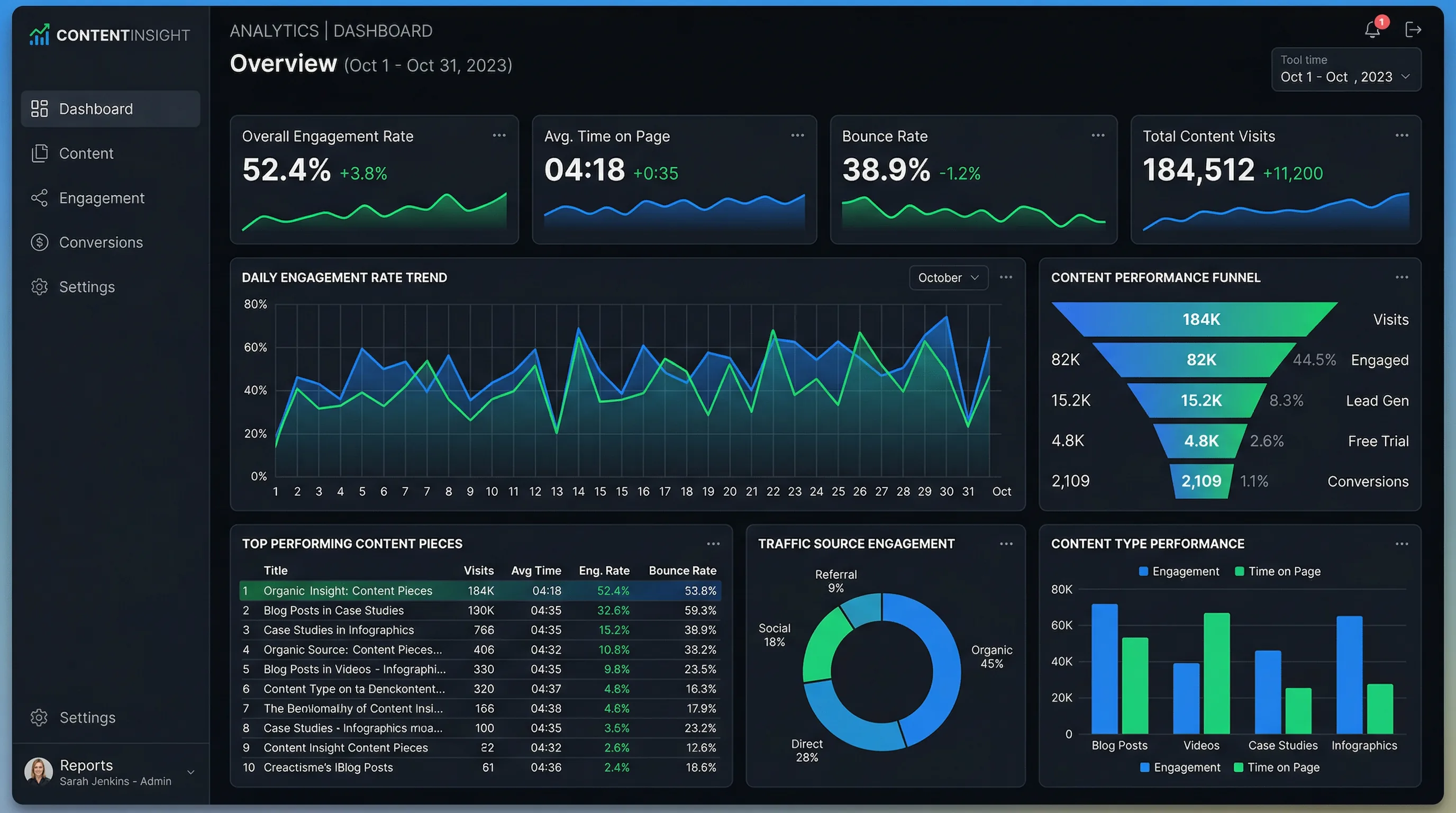
The AI Content Performance Dashboard
Build a simple dashboard tracking these essential metrics to guide your content strategy decisions week over week.
Weekly metrics: New content published (count and word volume), organic traffic trend, top-performing pieces by traffic, conversion events attributed to content, AI generation cost for the week.
Monthly metrics: Keyword ranking changes, content ROI calculation (revenue attributed minus production cost), model performance comparison, content type performance comparison, editorial efficiency metrics (time per piece, regeneration rate).
Alert triggers: Set notifications for significant changes — traffic drops below a threshold, a high-ranking piece loses position, conversion rate declines, or AI generation costs spike without corresponding output increases. Early detection of negative trends allows quick corrective action before performance declines compound.
For the strategic framework your analytics should inform, see our content marketing strategy guide. For SEO-specific measurement, our AI SEO content guide covers ranking optimization in detail. And for cost tracking, our ROI calculation guide provides the financial measurement framework.
Building a Content Analytics Practice
Moving from occasional metric checks to a systematic analytics practice requires structure, consistency, and the right measurement framework.
Setting Up Proper Attribution
Content marketing attribution requires connecting your analytics platform (Google Analytics, Plausible, or similar) to your conversion tracking system. Set up goal tracking for every meaningful action: email signups, demo requests, purchases, contact form submissions. Create content groups in your analytics platform to track performance by topic cluster, content type, and production method (AI-assisted versus human-written). Without this foundation, you're measuring vanity metrics rather than business impact.
Establishing Baseline Metrics
Before setting up AI content at scale, document your baseline metrics: average organic traffic per post after 90 days, average time on page, average conversion rate from content, and average production cost per piece. These baselines become your comparison points for measuring AI's actual impact versus your previous production method. Without baselines, you can't quantify improvement — you can only report current performance without meaningful context.
Cohort Analysis for Content Performance
Group content published in the same time period into cohorts and track their collective performance over time. Compare cohort performance across months to identify trends: are recent cohorts performing better or worse than earlier ones? Improving performance indicates your AI workflow and strategy are optimizing effectively. Declining performance suggests quality erosion that needs investigation — perhaps prompt fatigue, changing search dynamics, or editorial standards slipping under increased volume pressure.
Competitive Performance Monitoring
Track your ranking positions relative to key competitors for shared target keywords. Are you gaining ground, holding steady, or losing positions? AI enables you to respond quickly to competitive content moves — when a competitor publishes a complete resource targeting a keyword you rank for, you can use AI to rapidly update and improve your existing content to maintain or improve your competitive position rather than watching your ranking gradually erode.
Frequently Asked Questions
How do I measure AI content performance?
Track the same metrics as any content — traffic, engagement, conversions, and SEO rankings — plus AI-specific metrics like cost per piece, model used, and editing time required. Compare performance by content type, topic, and model to identify what works best.
Does AI content perform as well as human-written?
Properly edited AI content typically performs within 10-20% of equivalent human-written content on engagement metrics. The volume advantage of AI — producing 3-5x more content — often delivers more total value even with modest per-piece performance gaps.
What's the most important metric for AI content?
Revenue attribution — how much business value does each piece generate through conversions, leads, or sales. Traffic and engagement are useful leading indicators, but ultimately content must drive measurable business outcomes to justify the investment.
How long before AI content shows SEO results?
Same timeline as any content: 3-6 months for significant organic traffic impact. AI accelerates production but does not accelerate Google's indexing and ranking timeline. Patience and publishing consistency matter as much as volume.
How do I know which AI model produces the best content?
Track performance metrics by model over time. You will see which models produce content that ranks better, engages readers longer, and converts more visitors. This performance data should directly inform your model selection for each content type going forward.
Data-Driven AI Content Creation
Artifio's transparent model tracking helps you identify what works and scale your winning content strategies. Create with data, not guesswork.