AI API vs. Platform Subscription: Which Is More Cost-Effective for Your Workflow?
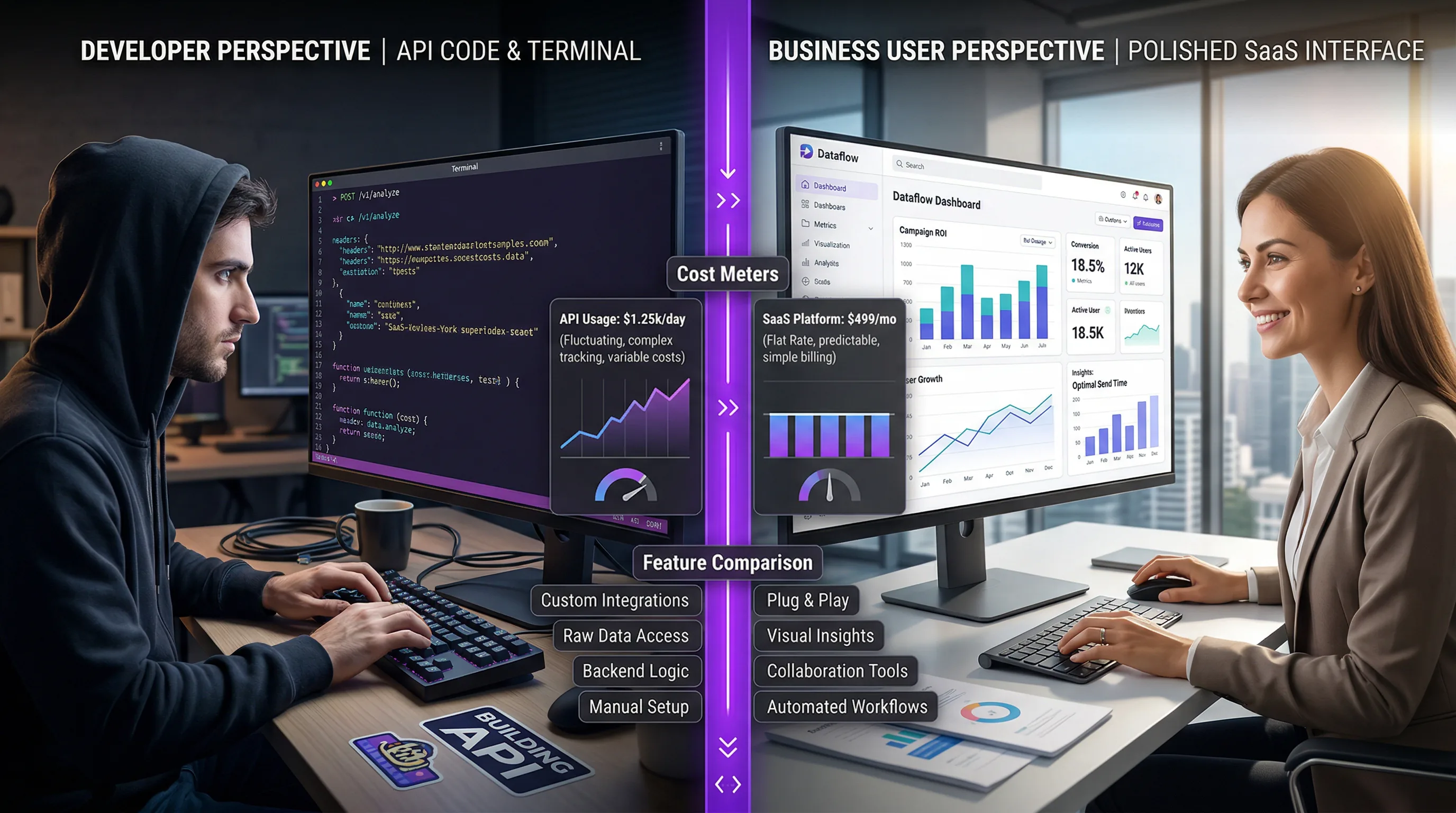
You can access AI models two ways: through a platform with a user-friendly interface and added features, or directly through the model provider's API at a lower base cost per generation.

The Artifio editorial team publishes research, tutorials, and release notes covering image, video, and audio generation models. All posts are reviewed by an editor before publishing.
You can access AI models two ways: through a platform with a user-friendly interface and added features, or directly through the model provider's API at a lower base cost per generation. The right choice depends entirely on your technical skill level, content production volume, and how much your time is worth per hour. Here's an honest comparison with real cost analysis to help you decide — or choose a hybrid approach that gives you the best of both worlds.
This comparison matters more than most creators realize. The cost difference between API access and platform access for the same underlying model can be substantial — sometimes 2-3x for identical output. But raw cost per generation is only part of the equation. OpenAI publishes their API pricing transparently, which makes direct comparison possible for anyone willing to do the math. Let's break down when each approach delivers the best value.
API Direct Access: Pros and Cons
Direct API access means interacting with AI models programmatically — sending requests and receiving responses through code rather than through a graphical interface.
Cost Advantages of Direct API Access
The primary appeal of API access is cost. Direct API pricing is typically 50-75% cheaper than the same model accessed through a platform's interface. For high-volume users producing hundreds or thousands of generations per month, this cost difference compounds into substantial annual savings — potentially thousands of dollars per year for heavy production workflows.
API pricing is also highly transparent. Provider pricing pages show exact costs per token or per generation, making budget planning precise and predictable. There are no hidden tiers, no throttling masks, no credit abstraction layers — just a direct cost per unit of AI computation consumed.
Technical Requirements
The cost savings come with a significant technical barrier. API access requires programming skills — typically Python or JavaScript proficiency. You need to handle authentication and key management, format requests correctly for each model's specific API schema, build error handling for rate limits and failures, parse and format output for your use case, build any interface you want for team members to use, and maintain the integration as APIs evolve and change.
This technical overhead represents a real time cost that reduces the net savings from lower per-generation prices. For a single technical user who enjoys coding, the overhead is manageable. For a team of non-technical content creators, building and maintaining an API integration is a significant ongoing project.
Flexibility and Control
API access gives you complete control over every parameter: temperature, max tokens, system prompts, fine-tuning, output format, and model selection logic. You can build custom workflows, automated pipelines, and integrate AI directly into your existing tools and content management systems. This level of control is impossible with most platform interfaces, which expose only a subset of available parameters through simplified controls.
Platform Subscription: Pros and Cons
Platform subscriptions provide a graphical interface, added features, and managed infrastructure between you and the underlying AI models.
Convenience and Accessibility
The primary value of platforms is accessibility. No coding required. No API key management. No error handling code to maintain. You type a prompt, click a button, and get output. This accessibility opens AI to millions of users who would never interact with a raw API endpoint — and for those users, the platform premium is essentially a convenience tax that enables access they wouldn't otherwise have.
Added Features That Save Time
Good platforms justify their markup through features that genuinely save time: curated prompt templates, generation history and favorites, team collaboration and sharing, style and brand presets, batch generation interfaces, output formatting tools, and integrated editing capabilities. These features reduce friction, improve consistency, and make repetitive tasks faster. The value of these features depends on your workflow — power users who tap into them extensively may find the platform markup pays for itself in time savings alone.
The Markup Reality
Platforms typically charge 1.5-3x the direct API cost for access to the same underlying models. This isn't hidden — it's the business model. The question isn't whether markup exists (it does, universally) but whether the convenience, features, and support justify the premium for your specific use case and budget.
The Break-Even Analysis
The optimal choice depends on your production volume and technical capability.
Low Volume: Platform Wins
If you generate fewer than 100 outputs per month, the absolute dollar difference between API and platform pricing is small — often less than the cost of a single productive hour. At this volume, the time saved by platform convenience (no setup, no code, no maintenance) easily exceeds the cost premium. The platform wins on total value delivered per dollar spent.
Medium Volume: Calculate Carefully
At 100-1000 generations per month, the calculation becomes genuinely nuanced. The platform markup represents a meaningful monthly cost at this scale. But so does the time to build, maintain, and troubleshoot an API integration. Calculate: (Platform cost minus API cost) versus (Hours spent on API development and maintenance multiplied by your hourly rate). If the platform premium is less than your API management time cost, the platform still wins despite the markup.
High Volume: API or Aggregator Wins
At 1000+ generations per month, API pricing savings become substantial — enough to justify dedicated technical investment or hiring developer support. At this scale, consider either direct API access with custom tooling, or an aggregator platform like Artifio that offers platform convenience with more competitive pricing than typical markup platforms.
Artifio bridges the gap between raw API access and overpriced platforms — offering the convenience of a user-friendly dashboard with access to 100+ models at fair, transparent pricing that doesn't impose the excessive markups typical of the platform category.
The Hybrid Approach: Best of Both Worlds
Many sophisticated content operations use both access methods strategically: a platform for everyday interactive production where convenience matters and a direct API connection for high-volume batch processing where per-generation cost dominates the value equation.
Some platforms, including forward-thinking ones, offer their own API access at reduced markup for power users — giving you programmatic access without managing connections to multiple model providers directly. This hybrid access model lets you use the platform interface when convenience matters and switch to API calls when you need to process large batches cost-effectively.
The practical progression for most users: start with a platform to learn which models and prompting approaches work best for your content, then evaluate API access once you've established consistent, repeatable workflows that would benefit from automation and volume pricing. See our pricing guide for frameworks on evaluating this transition, and our ROI guide for calculating when the switch makes financial sense.
Making the Decision: A Practical Framework
Use this decision framework to determine the right access method for your specific situation right now — and revisit it quarterly as your needs and capabilities evolve.
Choose a platform if: You're non-technical or prefer visual interfaces, your monthly generation volume is under 500 outputs, you value features like prompt libraries and generation history, team collaboration is important to your workflow, and you want customer support available when issues arise. For most content creators, solopreneurs, and small marketing teams, a well-chosen platform delivers the best overall value despite the per-generation markup.
Choose direct API access if: You're technically comfortable with Python or JavaScript, your monthly generation volume exceeds 1,000 outputs consistently, you need custom integrations with your existing tools and CMS, you want maximum control over generation parameters and model selection logic, and you have the time to maintain and update your integration as APIs evolve. For technical power users and development teams, API access delivers substantial savings at scale.
Choose a hybrid approach if: You have both technical and non-technical team members who need access, your volume varies significantly between quick interactive generation and large batch processing, you want the convenience of a platform for daily work combined with API efficiency for batch operations, or you're transitioning from platform-only to include API access gradually as your technical comfort grows.
The worst decision is analysis paralysis — spending weeks evaluating the API vs. platform tradeoff instead of producing content. Start with whichever approach matches your current skills and volume, generate content, measure costs, and fine-tune your access method over time based on real data rather than theoretical calculations about which approach might be marginally more cost-effective.
Frequently Asked Questions
Is it cheaper to use AI APIs directly?
Yes, typically 50-75% cheaper per generation. But factor in development time, maintenance, error handling, and the value of platform features like UI, templates, history, and team management. For non-technical users, the platform premium is usually worth the convenience and time savings.
Do I need coding skills to use AI APIs?
Basic programming skills in Python or JavaScript are needed for API access. You will need to handle authentication, request formatting, error handling, and output parsing. Platforms eliminate this technical requirement entirely with user-friendly interfaces.
How much markup do AI platforms charge?
Typically 1.5-3x the direct API cost for the same models. This markup pays for the UI, added features, support, and infrastructure. Whether it is worth it depends on whether those features save you more time and money than the markup costs.
What's the best option for non-technical users?
A platform with transparent pricing and multi-model access. You get the convenience of a user-friendly interface with access to multiple models from different providers. Look for platforms with competitive pricing that do not add excessive markup over API costs.
Can I start with a platform and switch to API later?
Yes, and this is a common progression path. Start with a platform to learn which models and workflows work best for your needs, then evaluate whether direct API access makes financial sense as your volume and technical comfort increase over time.
Platform Convenience Without Excessive Markup
Artifio offers 100+ models in an easy-to-use dashboard at fair, transparent pricing. Get the convenience of a platform without overpaying for access to the models you need.